Search Ranking in Travel APIs: What Developers Need to Know
How Nowah ranks flight and hotel results — balancing price, duration, layover quality, and reliability — and how developers can customize ranking via parameters.
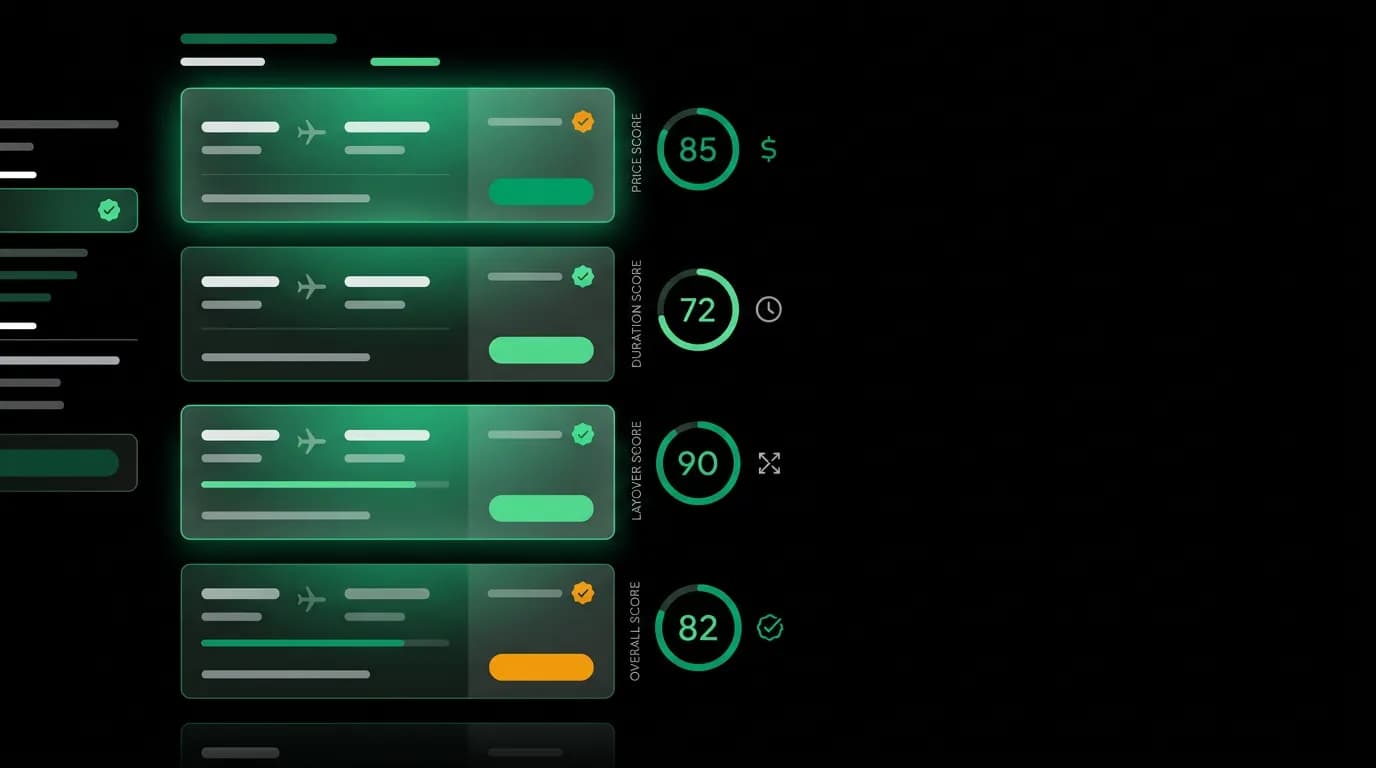
The default sort order for most travel APIs is "cheapest first." It is the most obvious ranking and the most wrong one for actual travelers.
The cheapest flight from New York to London might be a 22-hour journey with two layovers, a 45-minute connection in a notoriously slow airport, on an airline with a 60% on-time rating. The second-cheapest option might be a direct flight on a reliable carrier that takes 7 hours and costs $80 more. For almost every traveler, the second option is the better choice. But "cheapest first" hides it below a wall of inferior results.
The average traveler visits many websites before booking a trip, and bad ranking contributes to that exhaustion. When results are sorted only by price, travelers have to manually evaluate duration, layovers, airlines, departure times, and connection quality for every option. Smart ranking does that work for them.
We built our search ranking to consider multiple signals and surface results that real travelers actually want. We also made it customizable, because every developer building on our API has their own users with their own priorities.
Default ranking factors

Our default ranking model weighs five signals:
Price is a factor but not the only one. Lower prices score higher, but a $50 savings does not override a significantly worse travel experience. The price score is relative to the search results — a flight is scored against other options for the same route, not against an absolute scale.
Duration matters because time has value. A 7-hour direct flight scores higher than a 14-hour itinerary with stops, even if the long option is cheaper. We score total travel time including layovers, not just flight time.
[Layover quality](/blog/data-behind-layover-quality) is something most APIs ignore entirely. A 90-minute connection at a large, well-organized airport is very different from a 90-minute connection at an airport known for slow security and long transfer distances. We factor in airport size, typical connection times, and historical data on missed connections at each airport.
Airline reliability uses historical on-time performance data. Airlines with consistent schedules score higher than those with frequent delays and cancellations. This is particularly important for connections, where a delayed first leg can cause a missed second leg.
Traveler preferences personalize the ranking when we know something about the user. If a traveler has historically preferred direct flights, we weight duration more heavily. If they have a preferred airline, those results get a boost. These preferences come from the agentic memory system that tracks user behavior across sessions.
The five signals combine into a single score between 0 and 100 for each result. We normalize each factor to a 0-100 scale before weighting them, so no single factor can dominate due to its natural numeric range (price in cents versus duration in minutes, for example).
Transparent scoring
We expose the ranking components in the response so developers can explain results to their users:
{
 "id": "flt_abc123",
 "rank": 1,
 "score": {
 "overall": 87,
 "price": 72,
 "duration": 95,
 "layover": 90,
 "reliability": 88,
 "preference": 85
 }
}
This transparency serves two purposes. First, developers building UIs can use the component scores to explain why a result is ranked where it is. "This flight ranks #1 because of its short duration and reliable airline, even though it's not the cheapest option." Users trust rankings more when they understand the logic.
Second, the scores help developers debug ranking behavior during integration. If a developer expects a particular flight to rank higher, the component scores show exactly which factors are pulling it down. Maybe the layover quality score is low because the connection airport has a poor transfer experience. That is actionable information.
Developer-facing customization

Different products have different priorities. A budget travel app wants price-heavy ranking. A business travel tool cares more about schedule reliability and duration. A luxury travel platform might weight airline quality and comfort.
We provide parameters that let developers adjust the ranking weights:
{
 "origin": "JFK",
 "destination": "LHR",
 "departureDate": "2026-06-15",
 "ranking": {
 "sort_by": "score",
 "prefer_direct": true,
 "airline_preference": ["BA", "VS"],
 "weights": {
 "price": 0.5,
 "duration": 0.3,
 "reliability": 0.2
 }
 }
}
`sort_by` switches between our AI-powered score ranking and simple price or duration sorting. `prefer_direct` boosts nonstop flights in the ranking. `airline_preference` adds a scoring bonus for specified carriers. The `weights` object lets developers redistribute the ranking formula entirely.
These parameters are optional. The defaults work well for general-purpose travel products. But we find that developers who build specialized products always want to tune the ranking, and giving them that control prevents them from re-implementing ranking on the client side (which is slower and less accurate because they do not have the layover quality and reliability data we do).
Bias mitigation
Ranking systems can inadvertently favor or suppress specific providers, routes, or airlines. We take this seriously because developers trust us to present options fairly.
Our ranking model does not include any commercial weighting. We do not boost results based on commission rates, preferred partnerships, or revenue considerations. The five ranking factors are all traveler-centric: price, time, quality, reliability, and personal preference.
We run regular bias audits that check whether any airline, route, or provider is systematically over- or under-represented in top-ranked results relative to their actual performance on the ranking factors. If the audit detects bias, we investigate the cause and correct it.
We also publish our ranking methodology in our developer documentation, including the default weights and the formula for combining scores. Developers can verify that the ranking is working as documented. This level of transparency is unusual in travel APIs, where ranking is often a black box that mixes relevance with commercial interests.
Integrating ranked results
For developers building search result pages, we recommend showing the ranking score alongside each result. Users are accustomed to scores and ratings from other product categories, and a visible score helps them trust the ordering.
If you are using our results in an AI agent, the ranking is particularly valuable. Instead of presenting the user with 50 options sorted by price, the agent can pick the top three ranked results and explain why each one is a strong choice. The component scores provide the raw material for that explanation.
For comparison tools that show results side by side, the component scores work as radar charts — visual representations of how each option performs across multiple dimensions. Two flights might have similar overall scores but very different profiles: one is cheap with a rough layover, the other is pricier but direct and reliable. The component breakdown makes this visible.
Smart ranking is the difference between a search result page that overwhelms travelers and one that helps them decide. The technology matters, but what matters more is the philosophy behind it: ranking should serve the traveler, not the platform. We built it that way, and we give developers the tools to tune it for their specific audience.
Nowah is an AI travel agent that searches and books real flights and hotels through conversation — no filters, no thirty open tabs. Plan your next trip.