Launch Fatigue: How We Avoid Burning Out the Team on Constant Shipping
The human side of rapid shipping — sustainable cadence, on-call rotation for launches, celebration rituals, and balancing urgency with team well-being.
An engineer shipped three launches in two weeks and quietly updated their LinkedIn the following Monday. We did not see the profile update. We saw the burnout symptoms: shorter code reviews, less participation in architecture discussions, more "LGTM" comments without substantive feedback. The launches were successful. The engineer was exhausted. Those two facts can coexist, and when they do, the launches are not actually successful.
Launch fatigue is real, it is cumulative, and it is the team's responsibility to manage before it becomes an individual's crisis.
Recognizing the signs
Launch fatigue does not announce itself with a dramatic collapse. It creeps in through subtle behavioral changes that are easy to miss when everyone is focused on the next ship date.
The first sign is declining code quality. An engineer who normally writes thorough tests starts submitting code with minimal coverage. Code reviews become rubber stamps. Architecture discussions lose their rigor. The team is still shipping, but the quality of what ships is degrading because the people doing the work are running on fumes.
The second sign is communication withdrawal. Engineers who normally participate actively in planning meetings start going quiet. Questions that would usually spark debate are met with "sounds fine." The creative friction that produces good decisions evaporates because people do not have the energy for constructive disagreement.
The third sign is personal boundaries eroding. Weekend work that was once occasional becomes expected. Late-night deployments become routine. The on-call engineer handles incidents during dinner, during family time, during what should be recovery time. The boundary between work and rest dissolves.
Sustainable cadence
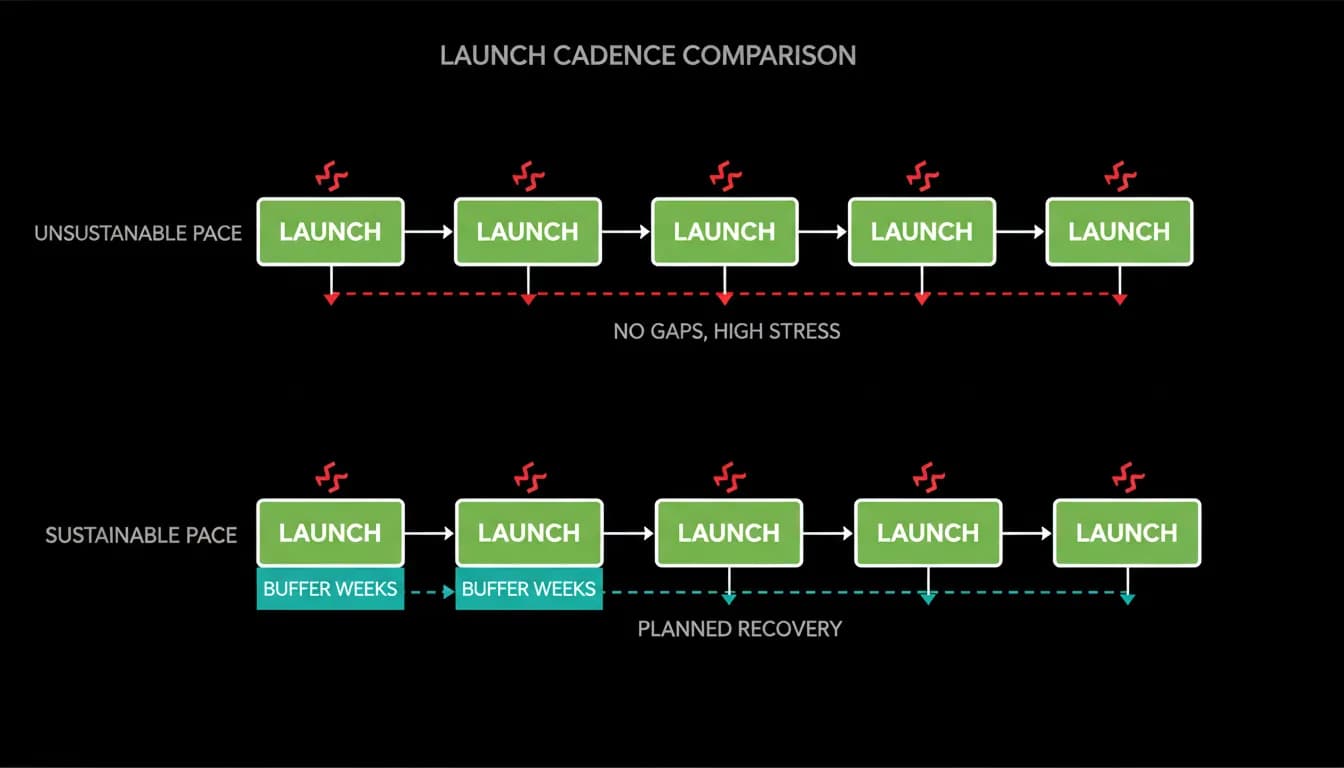
We target no more than two major launches per month, with at least one week of buffer between them. This is not a suggestion. It is a scheduling constraint that the product manager enforces.
The buffer week is not idle time. It is recovery and preparation time. Engineers use it to address technical debt, improve test coverage, refactor code that was rushed during the launch sprint, and simply think about the codebase without the pressure of an imminent deadline. The buffer week is what makes the launch weeks sustainable.
When business pressure pushes for three launches in a month, we have a conversation about tradeoffs. Which launch can be delayed? Which can be scoped down? Which is genuinely urgent versus artificially urgent? The answer is rarely "all three must ship this month." More often, one of the three can move to next month without meaningful business impact, and the team ships better work on the remaining two because they are not stretched across three.
On-call rotation
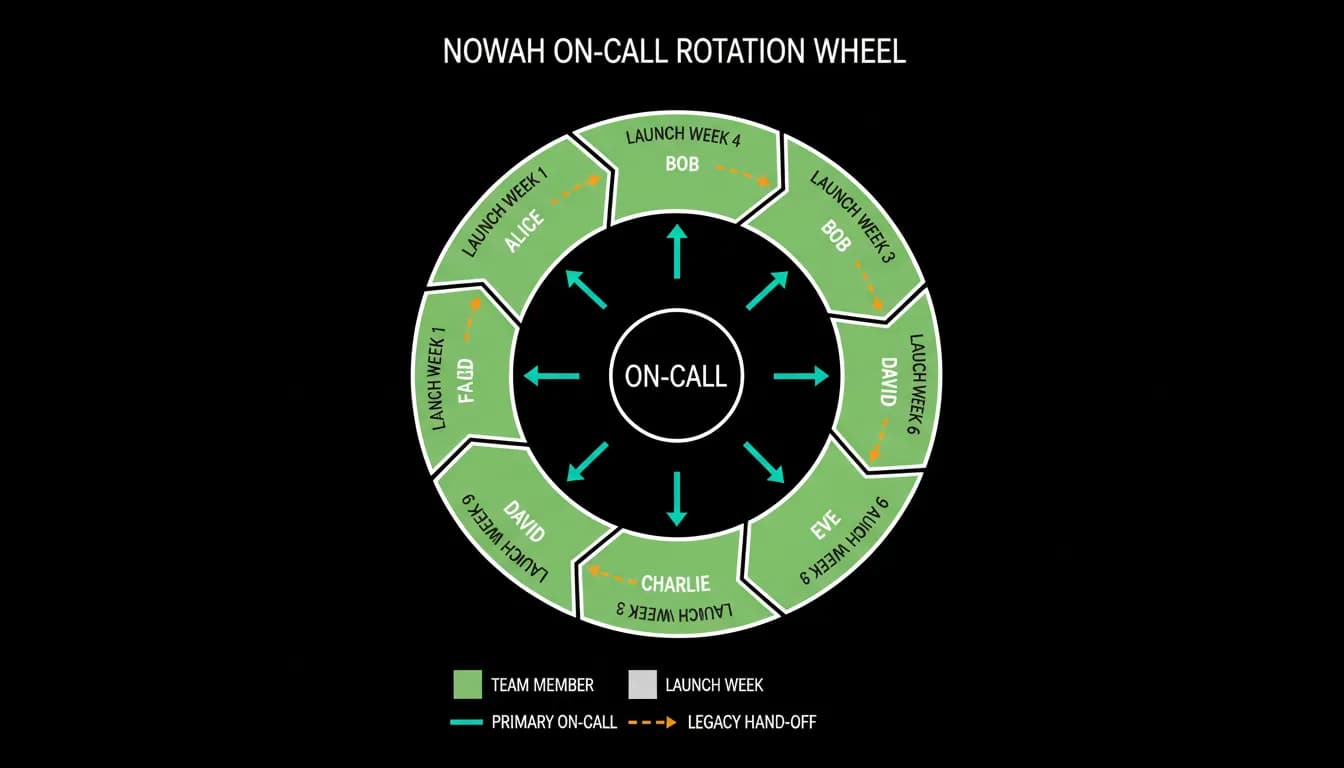
The same engineers should not be in the war room for every launch. On-call rotation distributes the launch burden so that the stress, the late hours, and the pager anxiety are shared equitably.
Our rotation ensures that no engineer is on-call for consecutive launches. After a launch where you served as the primary on-call engineer, you are guaranteed at least one launch cycle off. This rotation is visible to the entire team and planned in advance so that engineers can anticipate their on-call weeks and plan their personal lives accordingly.
The growing codebase, with its expanding API surface and seven background worker queues, requires on-call attention that extends beyond launch day. Status monitoring, job queue health, and incident response are ongoing responsibilities. Distributing these across the team prevents any single engineer from becoming the bottleneck for operational knowledge.
Celebration and rest
Post-launch celebration is not optional team-building. It is an operational practice that marks the transition from high-intensity shipping to normal-intensity operating.
Our celebration ritual is simple: after a successful launch, the team gathers for a brief retrospective that focuses on what went well, followed by a shared meal or activity that has nothing to do with work. The retrospective honors the effort. The non-work activity signals that the effort is complete and it is time to decompress.
We also explicitly grant recovery time after intensive launches. If a launch required late nights or weekend work, the engineers involved get compensatory time off, not as a formal policy to be negotiated but as an automatic expectation. The engineering lead tracks this and ensures it happens.
Rest is not a reward for good work. It is a prerequisite for the next round of good work. An engineer who ships a major launch on Friday and is expected to start the next sprint at full intensity on Monday is being set up for burnout. The recovery gap between sprints is what makes sustained shipping possible.
The quality connection
Fatigued teams ship worse code. This is not a moral judgment. It is a measurable reality. Code review thoroughness decreases. Edge case handling becomes less comprehensive. Test coverage drops. Documentation is skipped. The velocity appears high because features are shipping, but the quality is declining in ways that accumulate into future incidents.
We monitor quality proxies alongside shipping velocity. If test coverage trends down during a period of rapid launches, that is a signal that the team is trading quality for speed. If incident rates increase after a series of closely spaced launches, that is a signal that the launches are too close together. The metrics do not lie, even when the team insists they are fine.
The most expensive bug is the one shipped by a tired engineer who would have caught it on a normal day. The cost of that bug, in incident response time, customer impact, and team morale, always exceeds the cost of the extra day or week that would have prevented it.
Building a culture of honest capacity
The most important cultural norm for preventing launch fatigue is making it safe to say "we need more time." In a startup where shipping velocity is celebrated, admitting that the pace is unsustainable can feel like admitting weakness. It is not weakness. It is operational awareness.
We reinforce this norm by making the engineering lead responsible for capacity management, not individual engineers. The engineering lead monitors the team's workload, identifies fatigue signals, and adjusts timelines before engineers need to ask. This removes the burden from individual contributors who may feel pressure to keep pace even when they are struggling.
When an engineer does say "I need more time" or "this pace is not sustainable," the response is never "we need to push through." The response is "thank you for telling us. Let us figure out how to adjust." The adjustment might be delaying a launch, redistributing work, or bringing in additional support. The point is that honest communication about capacity is met with genuine problem-solving, not dismissal.
Shipping fast is important. Shipping sustainably is more important. The team that burns out cannot ship at all. The goal is not maximum launches per month. It is maximum launches per year, which requires a pace that the team can maintain indefinitely.
Nowah is an AI travel agent that searches and books real flights and hotels through conversation — no filters, no thirty open tabs. Plan your next trip.