Multi-City Trip Planning — Where AI Truly Shines
Rome, Florence, Milan in 10 days with open-jaw flights and ground transport? This is where traditional search breaks and AI excels.

A round-trip flight is easy to book. You pick an origin, a destination, dates, and search. The problem is well-defined and the tools handle it adequately.
A multi-city trip is a different beast entirely. Rome for 4 days, train to Florence for 3 days, then fly from Milan back home. Now you need an outbound flight to Rome, a train from Rome to Florence, a train from Florence to Milan, a return flight from Milan, and separate hotel reservations in three cities with dates that align with your transport schedule.
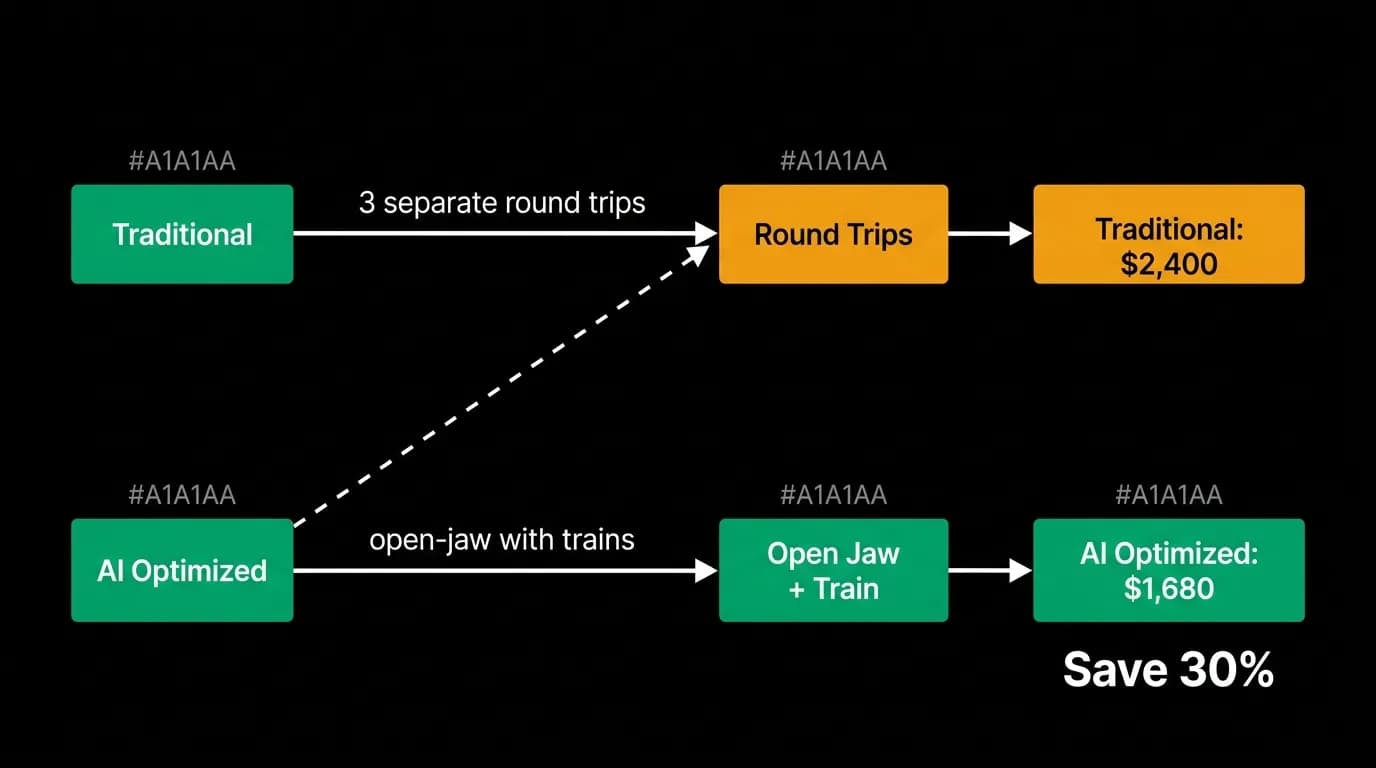
Price comparison for this trip takes days on traditional platforms because you have to run separate searches for each component and manually coordinate them. Open-jaw flights (flying into one city and out of another) can save 20-40% versus booking separate round trips, but most travelers do not know this option exists because their search tools do not surface it.
This is where AI trip planning genuinely shines. The combinatorial complexity that defeats human manual search is exactly the kind of problem an AI agent handles well.
The combinatorial explosion
For a simple round-trip, the search space is manageable. You have origin, destination, dates, and a few hundred flight options. One search covers it.
For a 3-city trip with flexible ordering, the search space explodes.
City ordering. Should you do Rome-Florence-Milan or Rome-Milan-Florence or Milan-Florence-Rome? The order affects transport options, prices, and logistics. Three cities have 6 possible orderings.
Transport mode between cities. Between each pair of cities, you might choose train, bus, flight, or rental car. For 3 segments, that is 4^3 = 64 transport combinations.
Day allocation. How many days in each city? With 10 total days, the allocations might range from 2-4-4 to 5-3-2 and everything in between. Dozens of combinations.
Flight routing. Fly into Rome and out of Milan (open-jaw)? Fly round-trip to Rome and take ground transport both ways? Fly round-trip to Milan and reverse the order? Each routing has different pricing.
Multiply these together and you have thousands of viable configurations. No human can evaluate all of them. Traditional search tools do not even try. They handle one search at a time and leave the coordination to you.
An AI agent evaluates the space systematically. It considers city ordering based on geography and transport options. It checks inter-city transport prices and durations. It searches open-jaw flights alongside round-trip options. It allocates days based on your interests and the available time.
Open-jaw flights and creative routing
Open-jaw flights are one of the best-kept secrets in travel booking. Instead of flying round-trip to one city, you fly into city A and out of city B. For a multi-city European trip, this can save 20-40% compared to booking separate round-trip flights or backtracking to your arrival city for the return.
Most travelers do not book open-jaw flights because:
- They do not know the option exists
- Traditional search forms default to round-trip
- Comparing open-jaw vs. round-trip pricing requires multiple separate searches
An AI agent knows about open-jaw routing and searches it automatically alongside round-trip options. It presents the comparison: "Open-jaw (fly into Rome, out of Milan) saves $720 compared to round-trip to Rome with a return train to Rome from Milan."
Beyond open-jaw, the agent can identify creative routing that humans would not consider. Maybe flying into Naples is $200 cheaper than Rome and only adds a 1-hour train ride. Maybe a budget carrier operates the Milan-home leg at half the price of the full-service airline. These savings add up, and the agent finds them because it searches comprehensively rather than following the traveler's initial assumption about routing.
Time allocation intelligence
"How many days in each city?" is a question that traditional platforms cannot answer because they have no concept of what you want to do in each city.
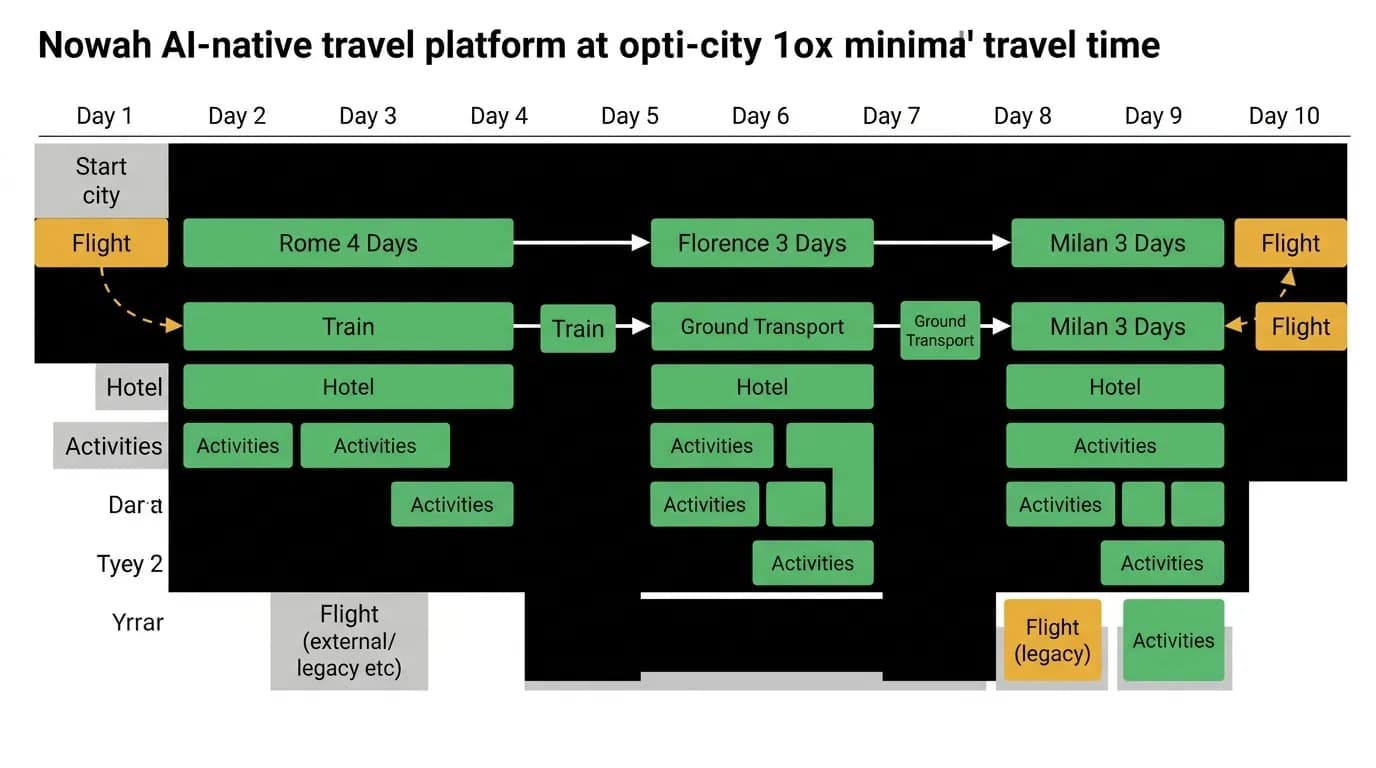
An AI agent with knowledge of your interests can allocate time intelligently. If you are a food-focused traveler, Rome gets extra days because the food scene is deep and spread across neighborhoods. Florence might get fewer days because the historic center is compact. Milan gets the minimum because your interests align less with what Milan offers.
If you are an art enthusiast, Florence might get the most days because the Uffizi, Accademia, and Pitti Palace alone justify 2-3 days. Rome still needs time for the Vatican and Borghese, but Milan's highlights are quicker to cover.
The agent makes these allocations explicit: "I'm suggesting 4 days in Rome, 3 in Florence, and 3 in Milan. Rome gets the most time because you mentioned wanting to explore the food scene, which is spread across many neighborhoods. Florence gets 3 days because the art museums alone justify it. Want me to adjust?"
Traditional booking requires 15-20 decisions per trip segment. An AI agent handling a multi-city trip collapses this to a handful of high-level decisions: "Do you prefer this routing or that one?" The agent handles the hundreds of micro-decisions (which train, which hotel, how to coordinate check-in and check-out times) automatically.
Ground transport integration
Multi-city trips often involve ground transport between nearby cities. The train from Rome to Florence takes 90 minutes on the high-speed line. A flight would take longer door-to-door when you account for airport transfers and security.
Traditional flight search platforms do not include train options. Hotel platforms do not show train stations. You have to research ground transport separately and manually coordinate the schedule with your flights and hotels.
An AI agent integrates all transport modes. It knows that Rome-Florence is faster by train. It knows that certain train departures connect well with your hotel checkout time. It books the train as part of the itinerary, not as a separate task.
For longer distances, the agent evaluates whether flying or taking ground transport is better based on your priorities. A 3-hour train ride might be preferable to a 1-hour flight when you account for the fact that the train station is in the city center and the airport is 40 minutes out.
The complexity stress test
Multi-city trip planning is the ultimate stress test for an AI travel agent. It requires:
- Multi-turn reasoning across 15-25 conversational turns
- Constraint management across multiple cities and dates
- Cross-modal transport optimization
- Budget tracking across all components
- Preference application at every decision point
- Temporal coordination (check-out times, train schedules, check-in times)
If the agent can handle a 5-city, 2-week trip with open-jaw flights, inter-city trains, and different hotel styles per city, it can handle anything simpler. Multi-city is the capability proof point.
Average international trips require coordinating 5-8 separate bookings. Multi-city multiplies this. A 3-city trip might involve 10-15 separate bookings. An AI agent that can manage all of them within a single conversation, maintaining coherence across every component, is delivering value that no traditional search engine can match.
This is where AI trip planning moves from "nice to have" to "I cannot imagine doing this manually." The best travel app for multi-city trips is not the one with the best flight search. It is the one that understands the trip as a whole.
Nowah is an AI travel agent that searches and books real flights and hotels through conversation — no filters, no thirty open tabs. Plan your next trip.