How Real-Time Data Changes Travel Recommendations
Flight delays, weather disruptions, price shifts, and inventory updates flow in real time. See how the AI adjusts recommendations as conditions change.

The flight you were looking at ten minutes ago just got delayed by three hours. The hotel you almost booked just sold its last room at that rate. The route you were considering now has a weather advisory. The AI already knows all of this, and your recommendations have already changed.
Traditional travel search gives you a snapshot — a frozen moment in time that starts going stale the instant it loads. Real-time recommendation means the AI treats travel data as a stream, not a snapshot, and continuously adjusts what it shows you based on what is happening right now.
What real-time data flows into the recommendation engine
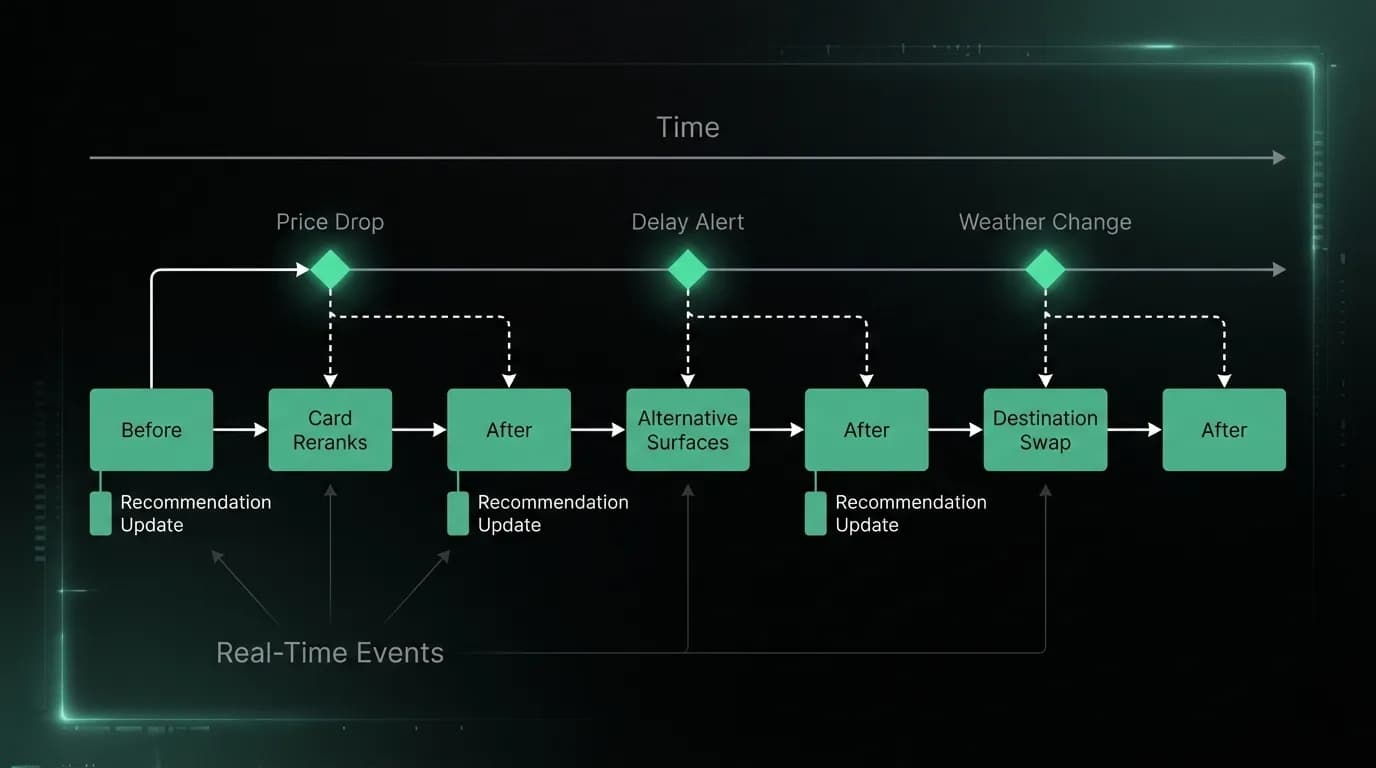
The AI processes several categories of live data simultaneously. Price changes are the most frequent. Airlines adjust fares three to five times daily on competitive routes, and each adjustment ripples through the recommendation set. A flight that was your budget pick an hour ago might no longer be the cheapest option.
Inventory depletion is closely related but distinct from price changes. As seats sell, the available fare classes change. A flight might still exist at the same headline price but now only has middle seats available, which changes its ranking for a traveler who prefers aisle seats.
Weather and disruption signals add another layer. When a storm system affects an airport, the AI factors in delay probabilities for flights routing through that hub. A connecting flight through a weather-affected airport might get demoted in the ranking even before any delay is officially announced, because the probability of disruption has risen.
Operational updates from airlines — schedule changes, equipment swaps, gate changes — flow in as well. These are lower-frequency signals but can matter. An equipment swap from a wide-body to a narrow-body aircraft on a long-haul route changes the comfort calculus significantly.
How inventory depletion triggers recommendation updates
This is one of the most practically important real-time dynamics. When you search for a flight, the AI returns recommendations based on current availability. But availability is a moving target, especially on popular routes close to the departure date.
Consider a scenario where the AI recommended three flights and the top pick was a moderately priced nonstop with good timing. If that flight's economy fare class sells out and the only remaining seats are in a higher fare class, the recommendation needs to update. The flight still exists, but its value proposition changed. The AI recalculates and might now surface a different flight as the top pick because the original's price-to-value ratio shifted.
This is why static search results can be misleading. The page you pulled up 30 minutes ago shows prices that may no longer be bookable at those prices. The AI, processing data as a stream, gives you recommendations that reflect current reality.
Weather and disruption signals
During peak storm seasons, weather disruptions affect 20 to 30% of flights. The AI does not wait for a delay to be announced before factoring weather risk into recommendations. When a storm system is building over a major hub, flights routing through that hub receive a risk penalty in the scoring model. This penalty is proportional to the storm's severity, timing, and the traveler's connection window.
The practical effect is that the AI might recommend a slightly more expensive routing that avoids the weather-affected hub, accompanied by an explanation: "A weather system near your connection city increases delay risk. This alternative routing avoids it for an additional cost." The traveler can accept the recommendation or take the risk — but they are making an informed decision rather than discovering the problem at the gate.
The freshness vs. completeness tradeoff
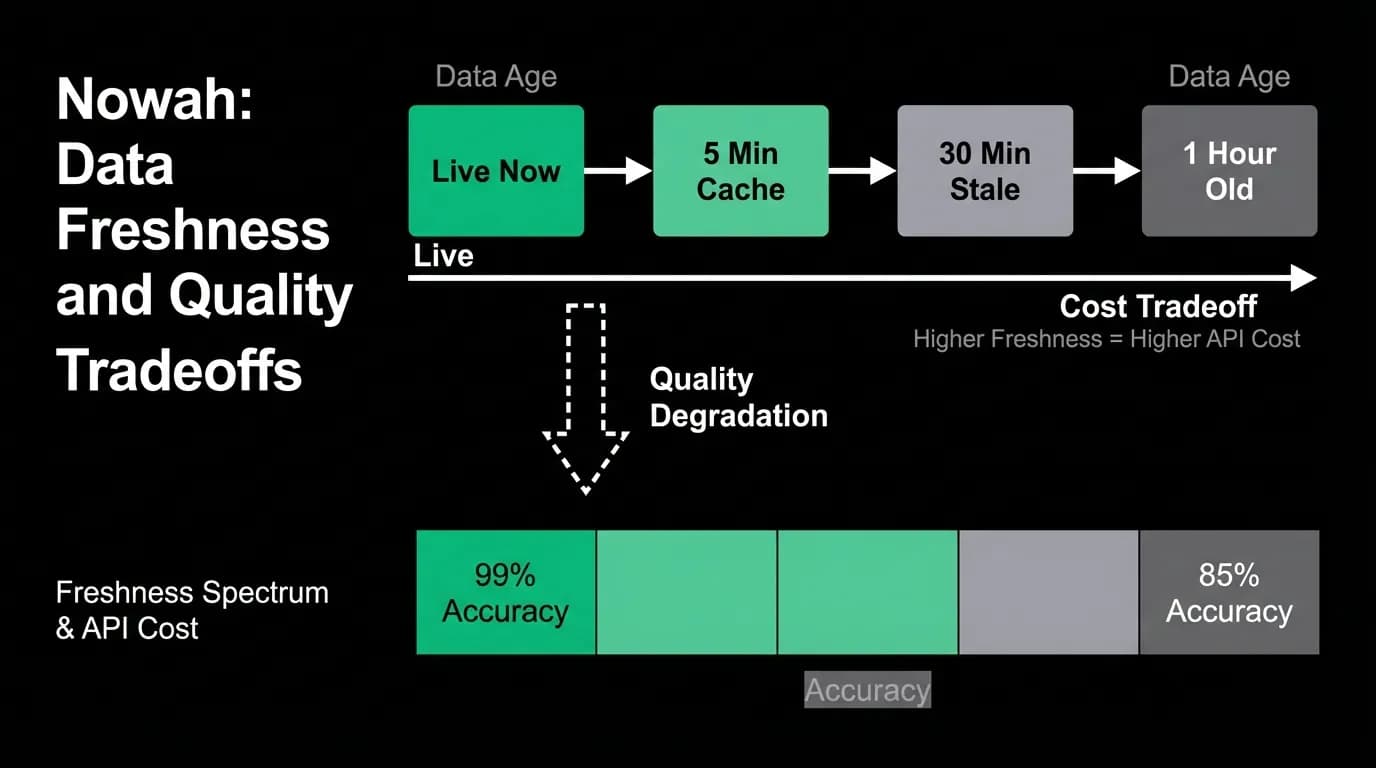
There is a real tension in travel data between freshness and completeness. Live pricing queries return the most current data but are expensive in terms of time and computing resources. Cached data is faster and cheaper to serve but might be minutes or hours old.
The AI manages this tradeoff by using different freshness levels for different stages of the recommendation process. Initial broad searches can use slightly cached data because the goal is to identify candidate options, not to commit to specific prices. When the traveler narrows to a shortlist, the AI refreshes pricing on those specific options with live queries. And at the moment of booking, the system always validates price and availability against live data.
This layered approach means you get fast initial recommendations with the understanding that exact prices might shift slightly, followed by precise pricing when you are ready to commit. It is a better experience than either extreme — waiting 30 seconds for every search to return fully live data, or getting instant results that are wrong when you try to book.
Why static results are a snapshot — AI recommendations are a stream
The fundamental shift is conceptual. A traditional search engine treats your query as a one-time event. You search, you get results, the transaction is complete. If conditions change, you have to search again.
An AI recommendation treats your intent as an ongoing stream. You told the AI you want to fly to Barcelona next month. That intent persists. As conditions change — prices move, availability shifts, weather patterns develop — the recommendations update. You do not have to re-search. The AI is monitoring on your behalf.
This is the difference between a tool that shows you data and an agent that works for you. The search engine waits for you to ask again. The AI updates proactively because it knows your intent has not changed, even though the landscape has.
Book with Nowah knowing your recommendations reflect the latest data. The AI does not show you stale snapshots — it gives you a living view of your best options as conditions evolve.
Nowah is an AI travel agent that searches and books real flights and hotels through conversation — no filters, no thirty open tabs. Plan your next trip.