Reasoning Models and Complex Travel Decisions
Simple queries need fast models. Multi-constraint itineraries need deep reasoning. When to deploy chain-of-thought — and when speed wins.

There is a fundamental tension in building a conversational AI travel agent. The user expects the responsiveness of a text message. But some travel planning problems require the kind of deliberate, multi-step reasoning that takes time. You cannot have both instant responses and deep thinking on the same query. What you can have is a system smart enough to know which queries need which.
Not all queries are equal
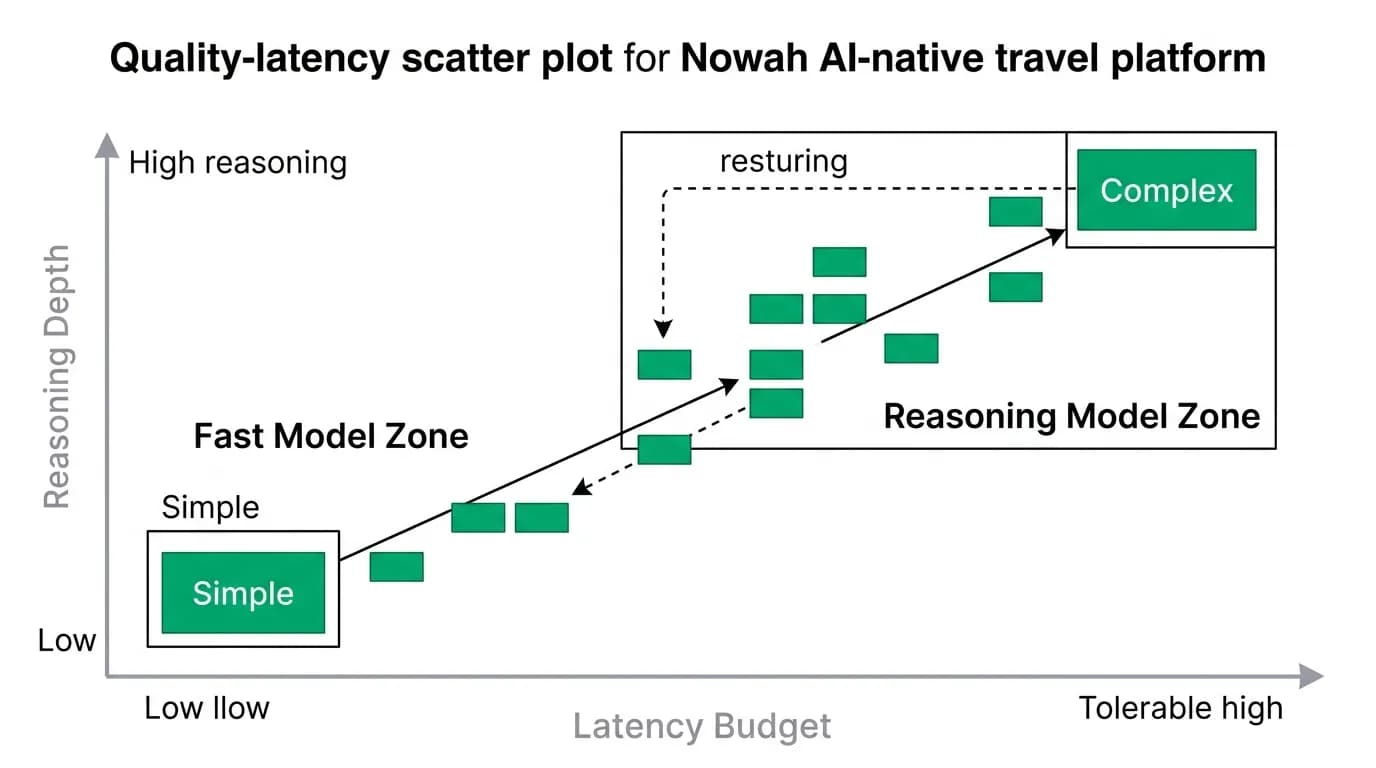
"What time does my flight land?" is a lookup. The agent retrieves a fact and returns it. This should take under a second. Deploying a frontier reasoning model for this is like using a supercomputer to add 2+2.
"Plan a 10-day trip through Europe for four people, visiting at least three countries, with a budget of $5,000 per person, everyone has different food restrictions, and we need to be in Munich on October 3rd for Oktoberfest." This is an optimization problem with dozens of constraints. It involves coordinating flights across multiple legs, finding hotels that satisfy diverse dietary needs, scheduling intercity travel to hit a fixed-date event, and staying within budget across all of it.
Between these extremes sits a spectrum. "Find me cheap flights to Tokyo" is medium complexity. "Find flights to Tokyo but I am flexible on dates and prefer to avoid long layovers" is a bit more complex. Each increment of complexity benefits from more reasoning capability.
The mistake we made early on was treating all queries the same. We used a single model for everything. Complex queries got great results but simple queries felt sluggish. Users do not want to wait two seconds for a seat assignment lookup.
Chain-of-thought and why it matters for travel
Chain-of-thought reasoning is the technique of having a model explicitly work through intermediate reasoning steps before producing a final answer. Instead of jumping from question to answer, the model writes out its thought process: "First, I need to find flights to Munich arriving before October 3rd. Then I need to work backward to fit in two other countries. Given the budget of $5,000 per person..."
For multi-constraint travel planning, chain-of-thought produces measurably better results. We ran a controlled evaluation on a set of 200 complex trip queries. With standard prompting, the agent satisfied all stated constraints on 62% of queries. With chain-of-thought, that number jumped to 84%.
The improvement is largest for queries where constraints interact. "Under budget AND hitting three countries AND being in Munich by the 3rd" creates dependencies. Adding a city might blow the budget. A cheaper routing might miss the Munich deadline. The model needs to reason about these interactions explicitly, and chain-of-thought forces it to do so.
The latency tax
Here is the tradeoff: chain-of-thought reasoning takes longer. The model is generating more tokens (the reasoning steps) before it generates the final response. A fast model that skips reasoning might deliver first-token in 200 milliseconds. A reasoning model working through a complex query might take 2-5 seconds before it starts producing visible output.
For a conversational interface, 2-5 seconds of silence is an eternity. Users will assume the app is frozen. They will tap again. They will close and reopen.
We manage this with two strategies. First, we stream the reasoning steps as "thinking" indicators. The user sees "Checking flights to Munich..." "Comparing routes through Paris and Amsterdam..." "Calculating budget across all legs..." This transforms dead time into visible progress. The user feels like they are watching an expert work rather than staring at a loading screen.
Second, we route. Simple queries go to fast models. Complex queries go to reasoning models. The routing decision happens in milliseconds based on query analysis.
Model routing in practice
Our routing system classifies incoming queries into three tiers:
Tier 1 (simple): Lookups, confirmations, simple modifications. "What is my confirmation number?" "Change my seat to 14A." These go to the fastest available model. First-token under 200 milliseconds.
Tier 2 (standard): Single-destination searches with moderate constraints. "Find me flights to Tokyo in April, direct preferred, under $1,200." These go to a mid-tier model that balances reasoning with speed. First-token under 500 milliseconds.
Tier 3 (complex): Multi-destination planning, group coordination, constraint optimization. "Plan a two-week Europe trip for four." These go to a frontier reasoning model. First meaningful output within 3 seconds, with thinking indicators showing progress from the start.
The classification is not rule-based. We use a lightweight model to analyze the query and route accordingly. This adds ~50 milliseconds of overhead, which is worth it for the improvement in both speed and quality.
The cost difference between tiers is significant. A tier 3 query costs 10-50x more in inference than a tier 1 query. But tier 3 queries also represent the highest-value interactions. Nobody plans a $20,000 Europe trip casually. The cost of getting that recommendation right is easily justified.
Impact on trip quality
I want to be specific about what "better reasoning" actually means for the user experience in AI trip planning-trip-planning-ai-shines).
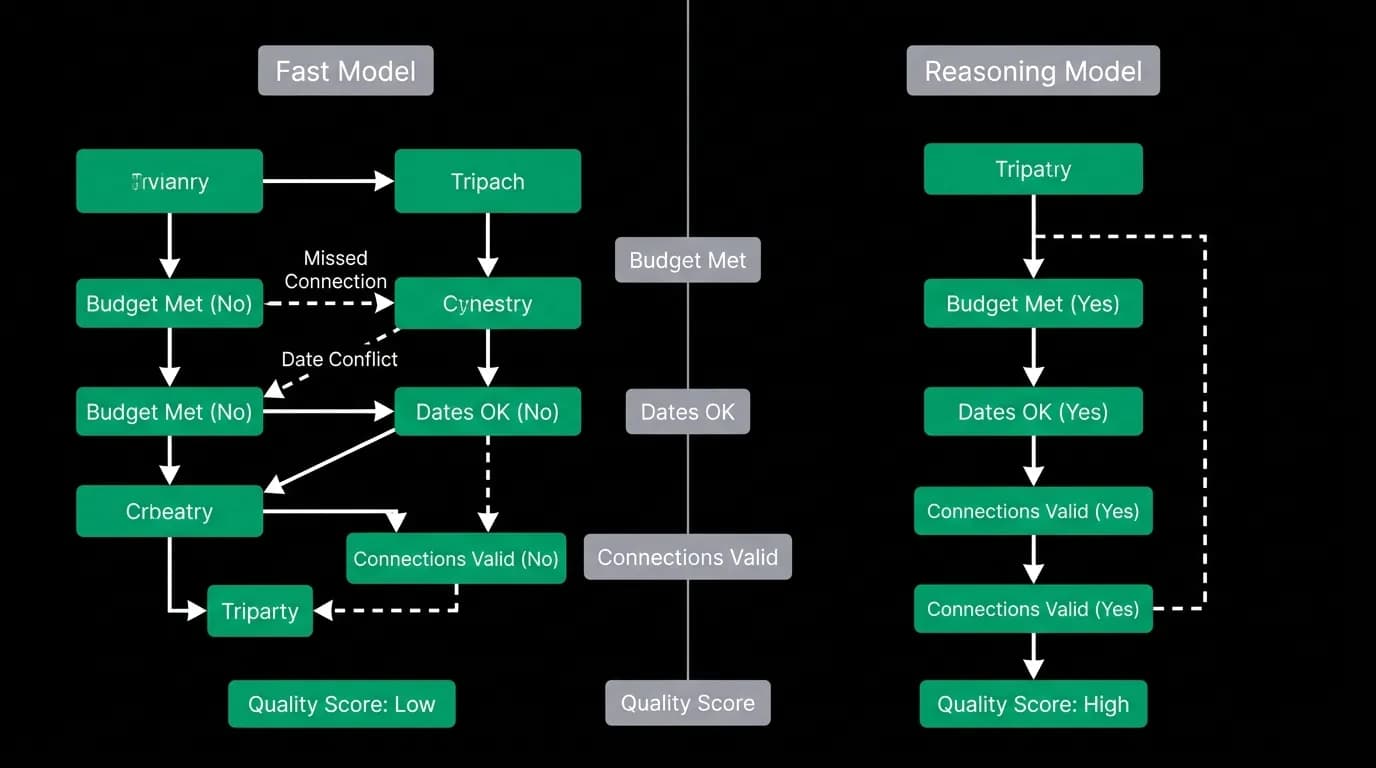
A fast model asked to plan a 10-day Europe trip might produce a plausible-looking itinerary. But look closely and you find problems. A flight connection with only 45 minutes in a large airport. A hotel booked in a neighborhood that is inconvenient for the planned activities. A day with three cities that requires mathematically impossible travel time. A total cost that exceeds the stated budget by 15%.
A reasoning model catches these. It explicitly verifies: "The connection in Frankfurt is 45 minutes. Terminal transfer at FRA typically takes 60 minutes minimum. I need to find a different routing." "The total across all bookings is $5,740, which exceeds the $5,000 budget. Let me adjust the hotel in Amsterdam to a more affordable option." For complex trips with five or more cities, we see a significant improvement in itinerary coherence when using reasoning models. The constraints are all satisfied. The transitions between cities make physical sense. The budget is respected. The user gets an itinerary they can actually follow, not one that looks good on paper but falls apart on contact with reality.
The convergence
The good news is that the gap between fast models and reasoning models is narrowing. Fast models are getting smarter with each generation. Reasoning models are getting faster as inference optimization improves.
In 2024, the quality gap between a fast model and a reasoning model on complex travel queries was enormous. In 2026, it is significant but smaller. By 2028, I expect mid-tier models to handle most complex queries with reasoning quality that matches today's frontier.
This convergence means that model routing will become less important over time. Eventually, a single model will be fast enough for simple queries and smart enough for complex ones. But we are not there yet, and the routing approach gives us the best current user experience across the full spectrum of query complexity.
If you are building a travel AI agent and not routing by complexity, you are either making simple queries too slow or complex queries too dumb. Both hurt. The routing layer is not optional for a production system.
Nowah is an AI travel agent that searches and books real flights and hotels through conversation — no filters, no thirty open tabs. Plan your next trip.