The 10-Year View — AI Travel in 2036
Fully autonomous booking, real-time price negotiation, proactive trip suggestions. A decade from now, travel apps as we know them will not exist.
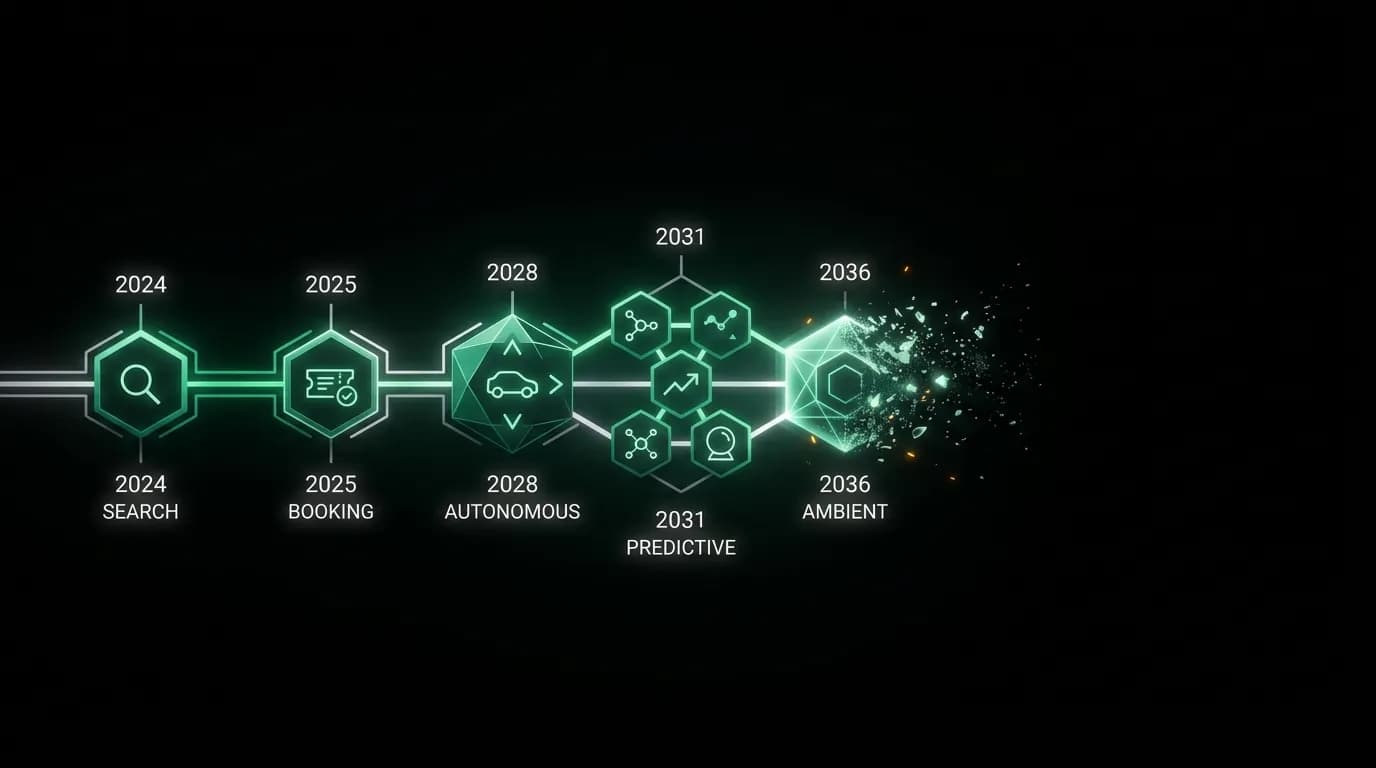
Prediction is a humbling exercise. In 2016, nobody predicted that a chat interface would become the primary way people interact with AI. In 2020, nobody predicted that language models would be able to plan complex itineraries. In 2024, nobody predicted how fast consumer trust in AI booking would grow.
With those caveats firmly in place, I want to sketch what AI travel looks like in 2036. Not as science fiction, but by extrapolating the trends that are clearly visible today. Every capability I describe below either exists in prototype form now or is a direct extension of something that does.
The trajectory
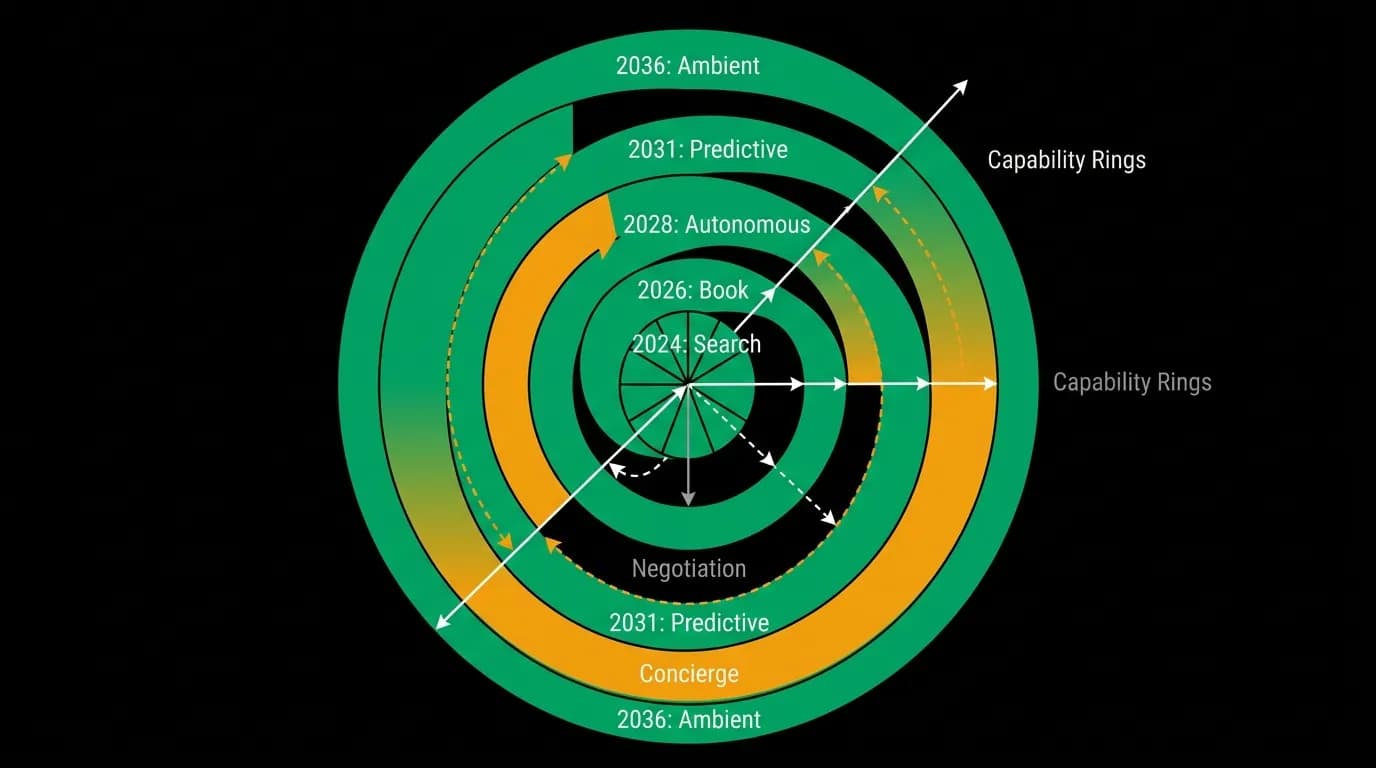
Three trends are converging and accelerating:
AI capability is growing exponentially. Context windows, reasoning depth, tool-use reliability, and multimodal understanding all improve with each model generation. Cost drops 10x per year. What is expensive and experimental today is cheap and reliable in two years.
Consumer trust in AI for high-stakes decisions is doubling roughly every two years. From about 25% willingness to use AI for travel in 2024 to about 55% in 2026. Extrapolate that curve: by 2030, AI-assisted travel booking is the default, not the exception.
Data integration is expanding. More APIs, more real-time data sources, more structured travel information available to AI agents. The information asymmetry between human travelers and travel suppliers is collapsing.
These three trends compound. Better AI uses better data to build more trust, which drives adoption, which generates more data, which improves the AI.
2028: fully autonomous planning and booking
By 2028, I expect AI travel agents to handle the complete planning and booking lifecycle autonomously for straightforward trips.
You say "plan our anniversary trip, somewhere in Europe, first week of June, budget $4,000." The agent considers your past trips, your shared preferences (it knows both partners' preferences from history), the current pricing landscape, seasonal factors, and event calendars. It presents a complete itinerary: flights, hotel, restaurant reservations, a surprise cooking class it knows you will love based on a similar experience you had in Tuscany, and a walking tour of the historic quarter.
You review it. You adjust one thing (swap the hotel for one closer to the waterfront). The agent rebooks and presents the final itinerary. Done. An anniversary trip planned in ten minutes, better than anything you could have assembled in ten hours.
This is not science fiction. Every individual capability, flight search, hotel search, preference matching, itinerary construction, booking execution, already exists. The 2028 version is just more reliable, faster, and cheaper.
2031: real-time price negotiation
Here is where things get speculative and interesting. By 2031, AI agents on the buyer side will negotiate with AI agents on the seller side.
Hotels already use dynamic pricing engines that adjust rates based on demand, season, and booking patterns. Airlines use revenue management systems that optimize seat pricing in real time. These are AI systems, even if they are not called that.
When the traveler's AI agent and the supplier's pricing AI can communicate directly, negotiation happens at machine speed. "My user needs a room for 3 nights, is flexible on dates by 2 days, and has stayed with your chain 4 times previously. What is the best rate you can offer for a loyalty customer?"
The pricing AI evaluates: the hotel is at 65% occupancy for those dates, the guest has a positive stay history, filling the room at a modest discount is better than leaving it empty. It offers a rate 15% below the published price.
This negotiation happens in milliseconds, invisible to the user. They see the result: "I got you a 15% discount at the Hilton. They value your repeat stays."
2034: proactive trip suggestions based on life context
By 2034, AI travel agents will not wait for you to plan a trip. They will know when you need one.
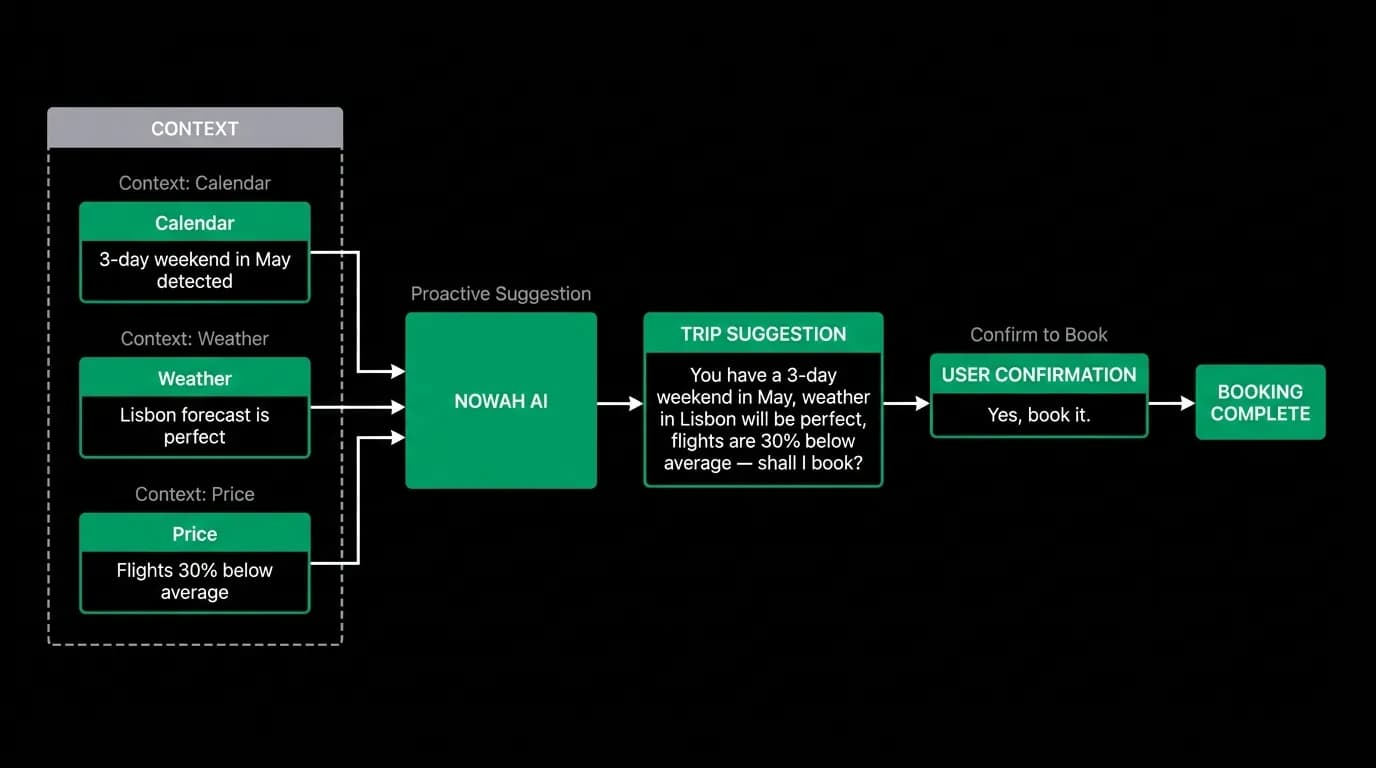
The agent has access to your calendar (with permission). It sees a long weekend in May. It checks your recent work patterns and notices you have been working 60-hour weeks for a month. It correlates with weather data: Lisbon will be 22C and sunny that weekend. It checks prices: flights are 30% below the 90-day average.
It sends a notification: "You have a 3-day weekend in May. Weather in Lisbon is perfect, and flights are unusually cheap. Your partner mentioned wanting to try Portuguese food last month. Want me to put something together?"
This is not creepy if the user has built trust over dozens of successful interactions. It is helpful. It is what a great human assistant would do. The difference is the AI can do it at scale, for millions of users simultaneously, processing data that no human could track.
Life events trigger trip proposals. Anniversary approaching. School break starting. Friend's wedding in another city. Passport renewal reminder with a suggestion to use the new passport for that Japan trip you keep talking about.
2036: the AI concierge and the disappearance of travel apps
By 2036, the concept of a "travel app" starts to dissolve.
During your trip, the AI concierge is always available. It translates conversations in real time. It navigates local transit. It recommends restaurants based on what is good right now, not what was good when the blog post was written three years ago. It reroutes your day when rain cancels outdoor plans. It handles a flight delay by rebooking before you know there is a problem.
The AI is not an app you open. It is a layer over your entire travel experience, accessible through voice, text, or whatever interface is standard in 2036 (probably some form of ambient computing).
The "travel app" disappears because the app was always just a container for information and actions. When the AI handles both, the container becomes redundant. You do not need a flights tab, a hotels tab, and a trips tab when the AI knows what you need and provides it contextually.
What does not change
For all the technology speculation, some things about travel will not change in a decade:
The desire for discovery. People will always want to be surprised, delighted, and inspired by new places. AI can facilitate discovery, but it cannot replace the human experience of walking through an unfamiliar city at sunset.
The social dimension. Travel is shared. Planning a trip with friends or family is part of the fun. AI will handle the logistics, but the conversations about where to go and what to do will remain human.
The unexpected. The best travel memories are unplanned. The restaurant you stumbled into. The local who showed you a hidden beach. AI can optimize for known preferences, but it cannot manufacture serendipity. The wise AI travel agent will leave room for the unplanned.
The value of being present. As AI handles more of the logistics, travelers are freed to be more present in the experience. Less time on phones checking maps and reviews. More time looking up at the architecture, tasting the food, and talking to the person across the table.
The AI in travel market is projected to reach $80+ billion by 2028. By 2036, with the capability expansions I have described, the addressable market is the entire travel industry. Not a segment of it. All of it.
The apps and websites we use to book travel today will look as dated as calling a travel agency in 2036. The 38-website journey will be a historical curiosity. AI travel planning will be so natural that we will wonder how anyone tolerated the alternative.
Nowah is an AI travel agent that searches and books real flights and hotels through conversation — no filters, no thirty open tabs. Plan your next trip.