Our Approach to AI Safety in High-Stakes Decisions
When AI recommendations involve thousands of dollars, safety is not optional. Here is our framework: confirmations, guardrails, fallbacks, and human oversight.

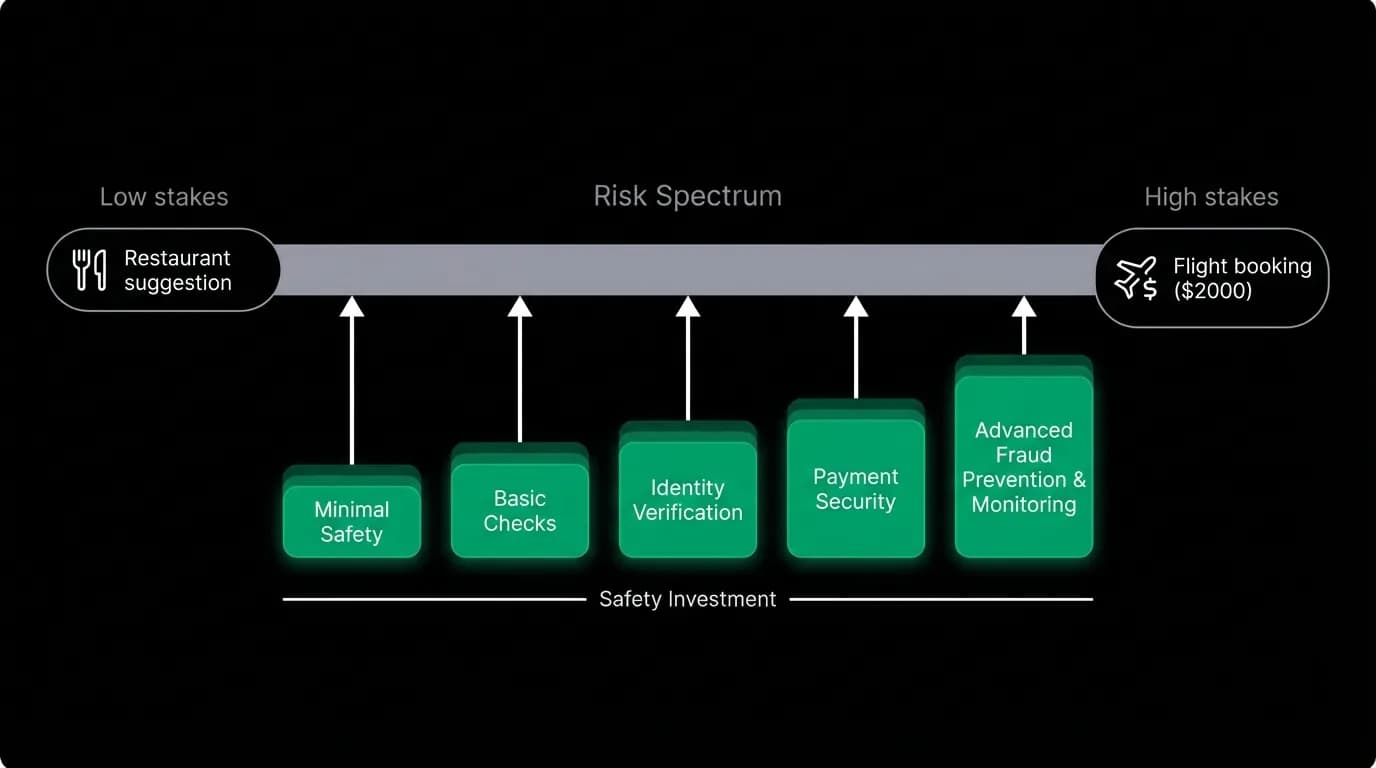
Not all AI applications carry the same risk. Suggesting a song costs nothing if wrong. Suggesting a restaurant costs a bad meal. Suggesting a flight costs thousands of dollars and potentially a ruined vacation.
Travel is on the high end of the stakes spectrum. Our safety approach reflects that.
The four-layer framework
We protect users through four complementary layers, each independent, each capable of preventing harm on its own.
Layer one: confirmations. No money moves without explicit user approval. The agent recommends. The user reviews every detail: airline, times, price, policies, cancellation terms. The user confirms. This is absolute. The agent cannot autonomously spend money under any circumstances.
Layer two: guardrails. The agent operates within declared boundaries. If you state a budget, the agent will not recommend options that exceed it. If you specify constraints, the agent respects them. The guardrails are not suggestions. They are hard limits in the agent's behavior.
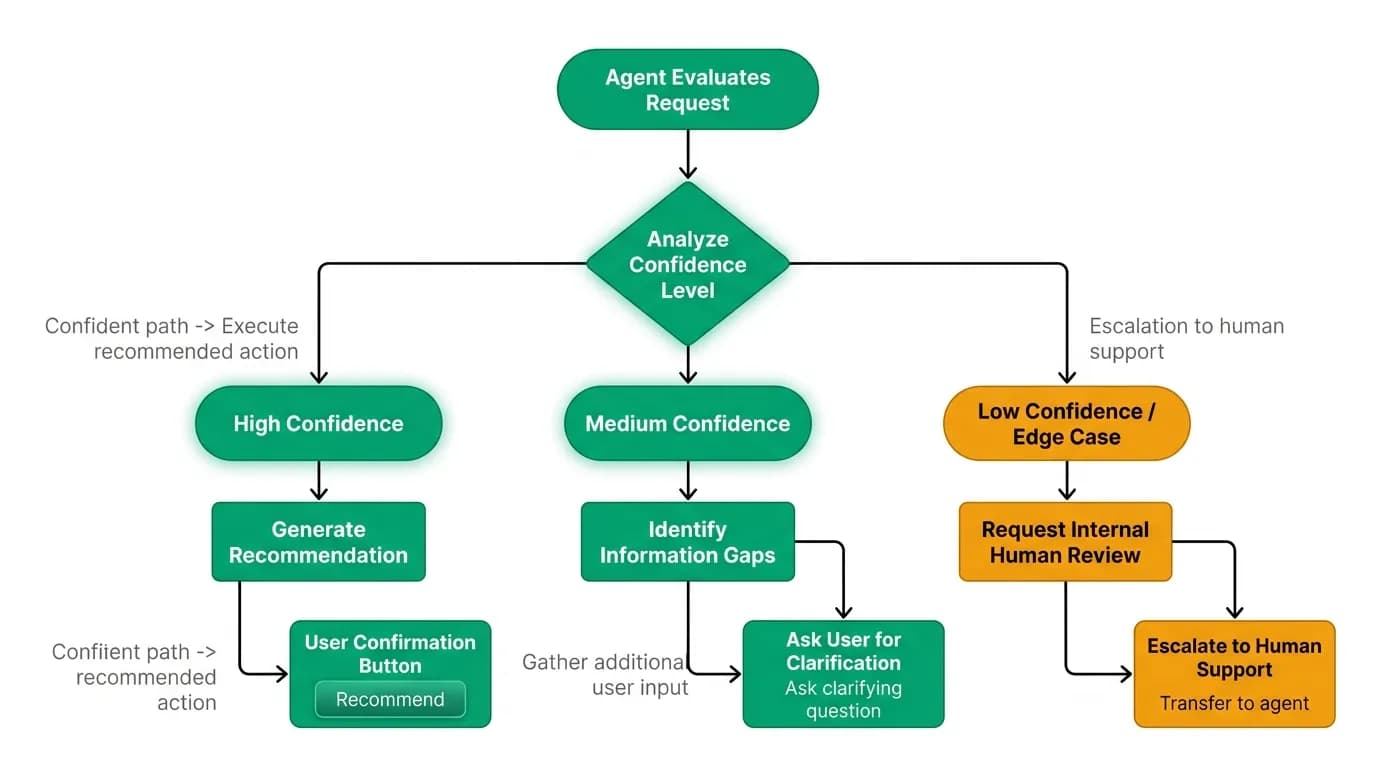
Layer three: fallbacks. When the agent is uncertain, it asks rather than guesses. If a request is ambiguous, it seeks clarification. If the data seems inconsistent, it flags the issue. If it cannot find a good option, it says so rather than stretching to recommend something suboptimal.
This third layer is counterintuitive. Many AI products are designed to always have an answer. We designed ours to sometimes say "I am not sure" or "I could not find anything that fits all your criteria." Honest uncertainty is safer than confident hallucination.
Layer four: human oversight. For edge cases that the automated layers cannot resolve, human support can step in. This is the safety net of last resort, but it exists because we recognize that AI is not perfect and some situations require human judgment.
The risk spectrum
We design the safety investment proportional to the risk. Low-risk interactions (destination suggestions, general travel information) get lightweight safety measures. High-risk interactions (booking execution, payment processing) get the full four-layer treatment.
This is not about being cautious everywhere. It is about being appropriately cautious where the stakes demand it.
Safety as a continuous investment
Safety is not a feature we are shipping and moved on from. It is a continuous investment. Our dedicated safety evaluation suite tests edge cases and boundary conditions regularly. Every new capability gets a safety review before launch. Every user-reported concern is investigated and, if warranted, converted into a new safety test.
The safety framework evolves with the product. As we add new capabilities, especially proactive features and autonomous actions, the safety layers expand to cover the new territory.
The honest truth
Our AI is very good and getting better. It is not infallible. No AI system is. The safety framework exists not because we expect failures but because we design for the possibility of failure. In a domain where mistakes cost thousands of dollars, designing for the worst case is the only responsible approach.
Safety is not a constraint on the product. It is part of the product. The users who trust us with their travel plans and their money deserve nothing less.
Nowah is an AI travel agent that searches and books real flights and hotels through conversation — no filters, no thirty open tabs. Plan your next trip.