The Travel API Economy: How AI Agents Access Better Inventory
NDC, modern APIs, and direct connections give AI-native platforms access to richer inventory than legacy OTAs built on older integration patterns. Here is how.
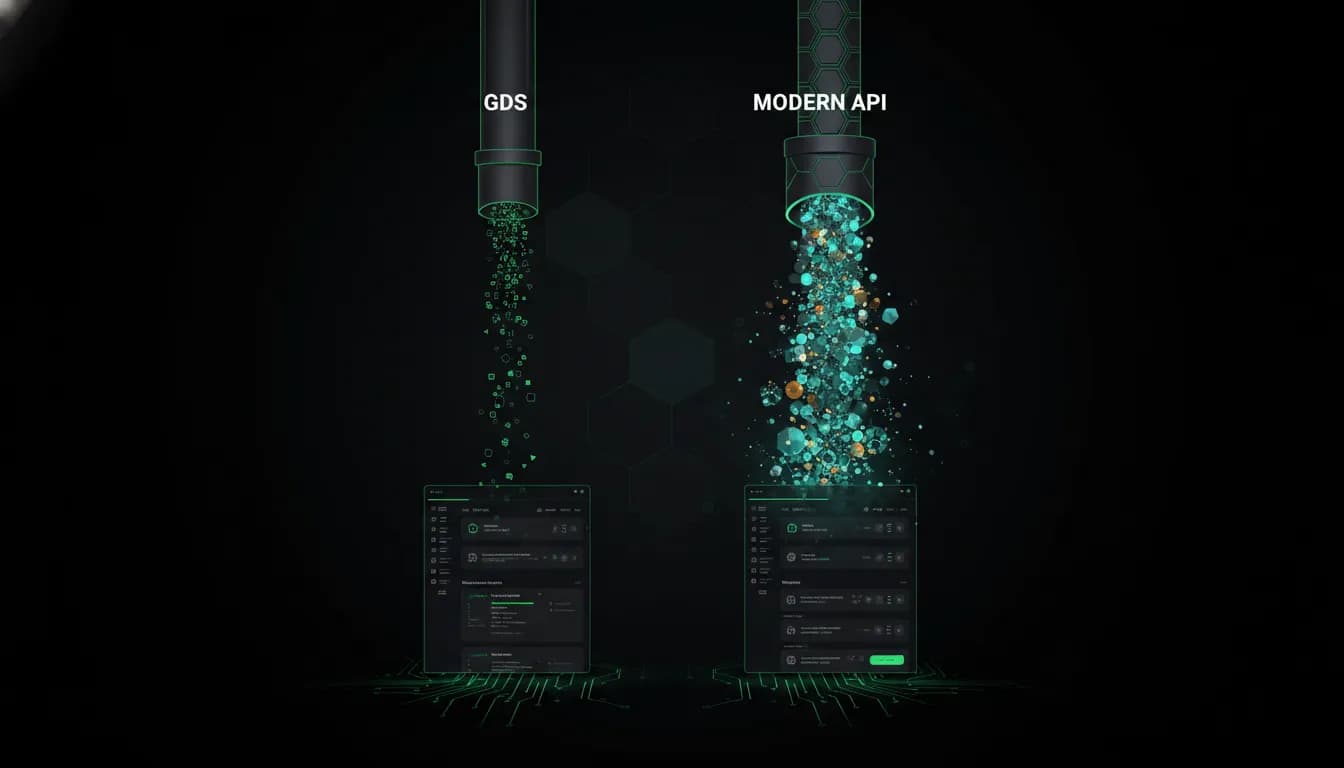
The API your booking platform uses determines the quality of results you see. Most travelers do not know this. They assume that all platforms see the same flights, the same prices, and the same availability. They do not.
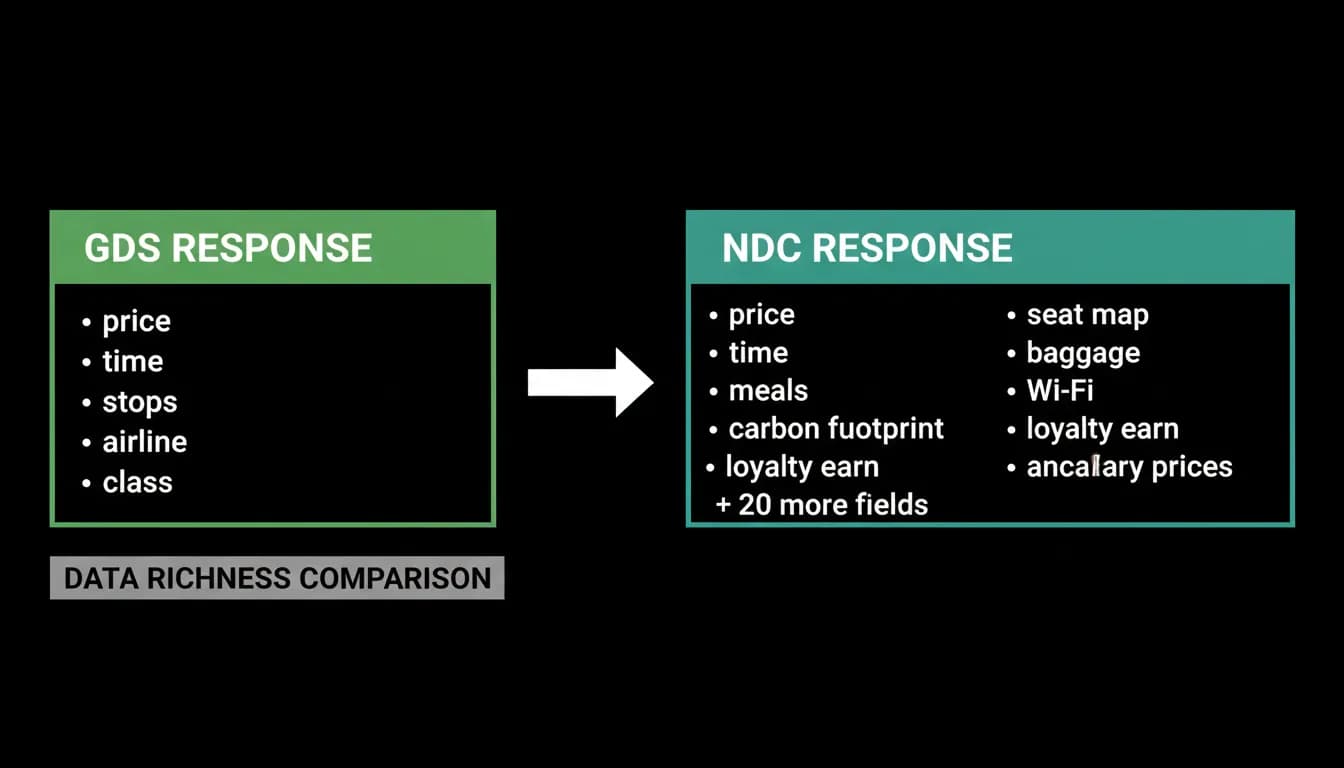
The technical infrastructure connecting booking platforms to airline and hotel inventory has evolved dramatically. Legacy systems transmit sparse data — price, time, stops, and a fare class code. Modern APIs transmit rich data: seat maps, baggage allowances, meal options, Wi-Fi availability, loyalty earning rates, carbon emissions, and personalized bundle offers. The same flight, accessed through different APIs, appears as two fundamentally different products.
This matters because AI agents are built to consume and process rich data. A traditional booking interface was designed around sparse data — a list of flights with 5 to 8 data points each. An AI agent that processes 30 or more data points per flight makes dramatically better recommendations. But it can only process what it receives. The API determines the ceiling.
Legacy distribution: the GDS era
For decades, the travel industry relied on Global Distribution Systems — centralized databases that store and transmit flight schedules, prices, and availability. Three major GDS providers process the majority of global flight distribution.
The GDS was revolutionary when it launched in the 1960s. It replaced phone calls and telex messages with electronic booking. But the data model was designed for an era of simple fare structures: economy, business, first class. A GDS response for a flight query typically returns 5 to 8 data points per offer: price, departure time, arrival time, number of stops, carrier, fare class code, and maybe aircraft type.
This sparse data works for a list-based interface where the traveler sorts by price and scans departure times. It does not work for personalized recommendation engines that need to evaluate total value, ancillary inclusion, seat availability, and loyalty implications.
The GDS also operates with caching. Fare data can be 15 to 60 minutes delayed from the airline's real-time pricing engine. During periods of high fare volatility — flash sales, competitor price drops, dynamic pricing adjustments — the cached data may show prices that are already outdated.
Airlines pay significant distribution fees for GDS bookings — typically $5 to $12 per segment. This creates a financial incentive for airlines to steer bookings away from GDS channels and toward lower-cost alternatives.
Modern APIs: the NDC era
New Distribution Capability and modern travel APIs represent a fundamental upgrade in how flight data is transmitted and consumed.
An NDC response for the same flight query returns 30 or more data points per offer: everything the GDS provides plus seat map previews, specific baggage allowances by fare type, meal options and pre-order availability, Wi-Fi availability and pricing, loyalty mile earning rates for the specific fare class, ancillary bundle options with pricing, carbon emissions estimates, and personalized offers based on the traveler's loyalty status or booking history.
Modern API providers aggregate NDC connections from 100 or more airlines into a single technical integration. An AI agent connecting through one modern API gains access to rich content from dozens of carriers without needing individual airline integrations.
The data updates in real time. There is no 15 to 60-minute cache delay. The price and availability the AI agent sees is the price and availability available right now. For travelers booking during volatile pricing periods, this real-time accuracy can be the difference between capturing a deal and missing it.
Airlines save 3 to 5 percent on distribution costs through NDC versus GDS. This saving translates to better fares for travelers in some cases — airlines that offer NDC-only fares or NDC discounts pass a portion of the distribution savings through as lower prices.
What better APIs mean for travelers
The richer data available through modern APIs translates to tangible improvements in the booking experience.
More fare options. NDC enables airlines to create and distribute fare bundles that do not fit the GDS model. A fare that includes a carry-on bag, seat selection, and one checked bag as a bundle is a product type that NDC supports and GDS does not. More fare options means more opportunities to find a package that matches your needs at a competitive price.
Accurate ancillary information. "Does this fare include a checked bag?" is one of the most common questions in flight booking. Through the GDS, the answer often requires clicking through to the airline's website. Through NDC, the ancillary inclusions are part of the initial offer data. The AI agent can state definitively: "This fare includes one carry-on, one personal item, and one checked bag up to 23 kg."
Personalized offers. NDC enables airlines to recognize returning customers and offer personalized pricing. A loyalty member might see a fare that includes lounge access — an offer created specifically for their status tier. This personalization was impossible through the GDS's one-size-fits-all data model.
Real-time seat availability. NDC responses include seat map data, enabling the AI agent to check whether your preferred seat type is available before recommending the flight. "This flight has aisle seats available in rows 8 and 14. The alternative flight has only middle seats remaining." This information prevents the common frustration of booking a flight only to discover your preferred seat is not available.
Why AI agents benefit most
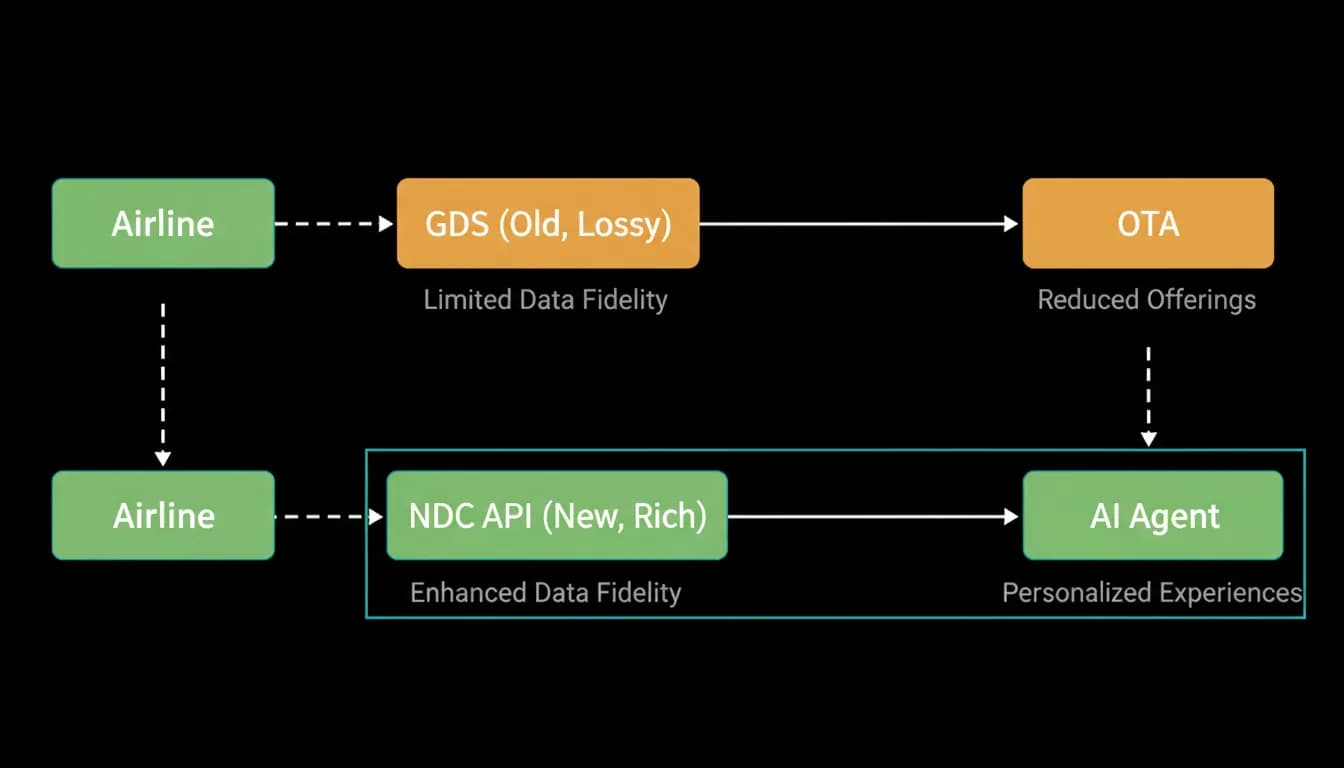
The irony of richer API data is that traditional booking interfaces struggle to display it. An OTA search results page designed for 5 data points per flight does not gracefully accommodate 30. Displaying NDC content in a traditional list requires expanding each result into a product page — a redesign most OTAs have been slow to implement.
AI agents have no display constraint. The agent processes all 30 data points per offer and synthesizes them into a natural language recommendation: "This fare on the A321neo includes your preferred aisle seat, one checked bag, and Wi-Fi. You will earn 1,800 miles at your current status level. The carbon footprint is 15 percent lower than the alternative due to the newer aircraft. Total cost including all the ancillaries you typically need: $387."
That single paragraph communicates more information than a traditional search results row could fit in a full-width display. The conversational format is inherently suited to rich, complex data because natural language can express nuance, trade-offs, and context that a grid of numbers cannot.
Rich API data enables AI agents to make 3 times more nuanced recommendations than sparse GDS data allows. The recommendation is not "cheapest flight" — it is "best flight for you, considering 30 factors, with total cost and trade-offs explained."
The API advantage
AI-native platforms built on modern APIs have a structural advantage over OTAs built on legacy GDS connections. The advantage compounds:
Richer search. More data points per offer enable more precise matching to traveler preferences. An agent that knows the aircraft type can factor in seat pitch, cabin noise, and mechanical reliability. An agent that knows the fare's ancillary inclusions can calculate true total cost.
Faster updates. Real-time API data means the agent sees current pricing. No cache lag. No stale availability. The booking is made against live inventory.
Lower distribution cost. Airlines that save on distribution through NDC sometimes pass savings to travelers through lower fares or exclusive offers. The AI agent on modern APIs accesses these savings automatically.
Future-proof architecture. As airlines add more content to their NDC feeds — dynamic offers, personalized bundles, retailing capabilities — AI agents built on modern APIs receive the new content automatically. OTAs on legacy systems require integration work to access each new feature.
The question to ask
The next time you evaluate a booking platform, ask: what API does it use for flight data? The answer determines whether you see 5 data points per flight or 30. Whether prices are cached or real-time. Whether you can access exclusive NDC fares or only standard GDS content.
The API is invisible to most travelers, but its impact on the booking experience is profound. The richest, most accurate, most personalized flight booking experience requires the richest, most accurate, most modern data source. In 2026, that means modern APIs and NDC connections. The platforms built on them deliver better results. The ones still running on legacy infrastructure are showing you a smaller, sparser, less accurate picture of what is available.
Nowah is an AI travel agent that searches and books real flights and hotels through conversation — no filters, no thirty open tabs. Plan your next trip.