Why Your Travel App Needs AI — Not Just a Chatbot
Chatbots answer questions. AI agents search inventory, rank by preference, book flights, process payments, and manage trips. The difference is everything.
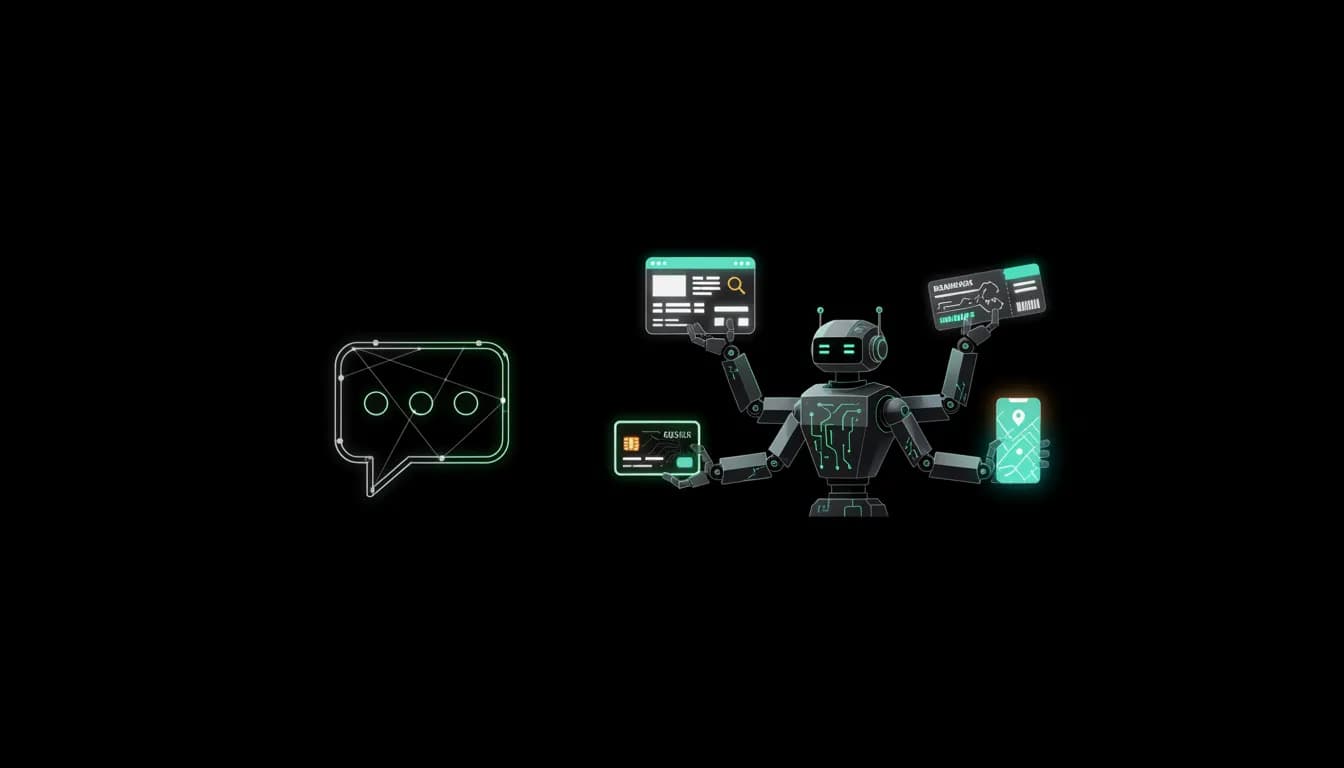
"Can you book that for me?"
Five words that separate an AI agent from a chatbot. The chatbot can tell you about flights to Tokyo. It can quote you prices. It can explain baggage policies. It can recommend departure times. But when you say "book it," the chatbot hands you off — to a search results page, to a booking form, to a human agent.
An AI agent books it. Searches inventory, selects the best option matching your preferences, fills in your traveler details from memory, processes the payment, and sends the confirmation. Five words in, boarding pass out.
This distinction — between a tool that provides information and a tool that takes action — is the single most important dividing line in travel technology. And 80 percent of travel "AI" features launched in 2023 and 2024 are on the wrong side of it.
The chatbot ceiling
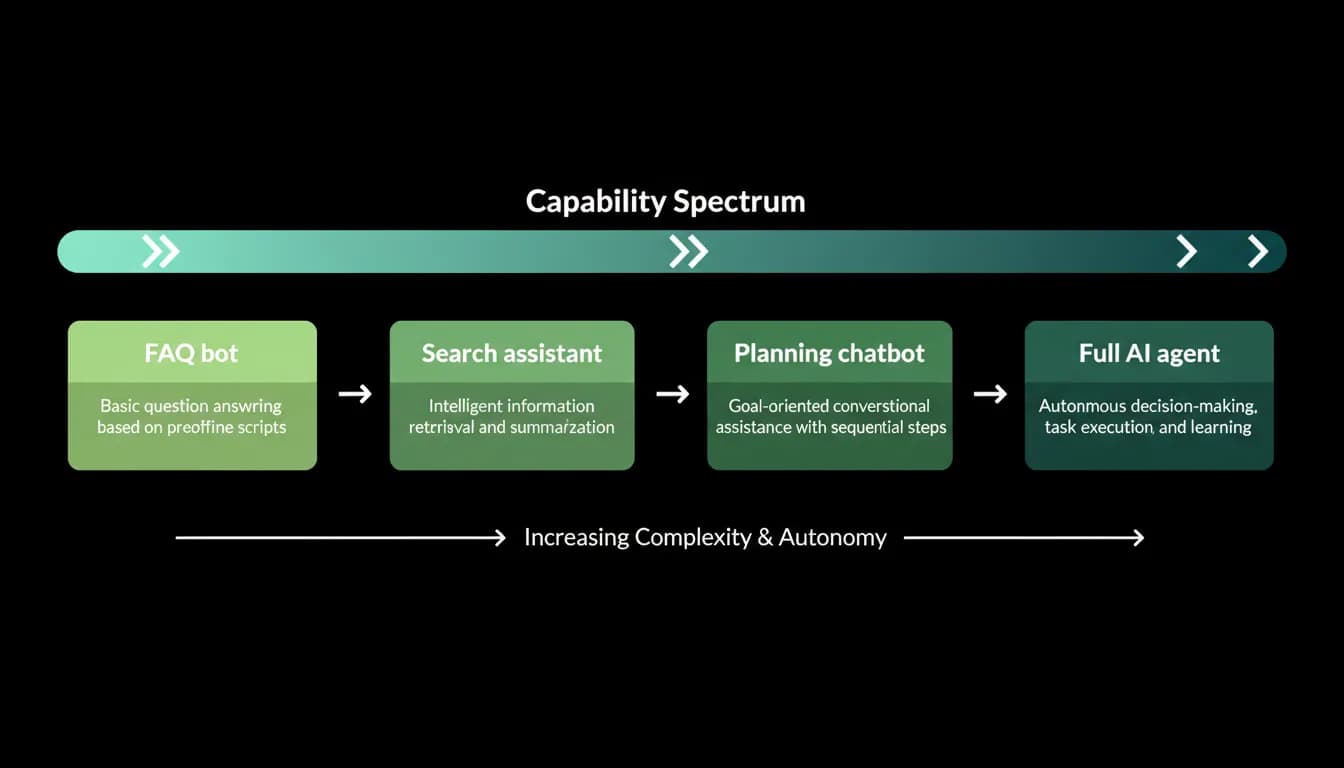
Chatbots are language models wrapped in a conversation interface with access to a knowledge base. They can answer questions — sometimes impressively well. Ask "What is the baggage allowance for economy class on a transatlantic flight?" and a well-built chatbot provides a clear, accurate answer.
The capability set is bounded: answer 200 to 300 FAQ patterns. Provide information about policies, schedules, and features. Maybe suggest options based on simple criteria. Perhaps escalate to a human agent when the question exceeds the knowledge base.
What chatbots cannot do is act. They cannot query a live flight inventory. They cannot evaluate 200 flights against your personal preferences and rank them. They cannot process a payment. They cannot modify an existing booking. They cannot monitor a flight for disruptions and proactively rebook you.
This ceiling is not a temporary limitation that will be resolved with better training data. It is an architectural constraint. Chatbots are designed to process language and return text. AI agents are designed to process language, determine the required actions, execute those actions across multiple systems, and return results. The difference is akin to the difference between a reference librarian and a personal assistant — both understand your question, but only one can act on it.
The agent floor
An AI travel agent starts where the chatbot ceiling ends. The minimum capabilities include:
Inventory search. The agent queries live flight, hotel, and activity databases in real time. It does not work from a cached knowledge base — it sees what is available right now, at current prices, with current availability.
Preference-weighted ranking. The agent does not return results sorted by price or "recommended." It ranks options by your personal preferences: seat preference, airline preference, departure time preference, layover tolerance, loyalty program earning, and any other factors you have communicated or that the agent has learned.
End-to-end booking. The agent completes the booking within the conversation. Selects the option, confirms the details, processes the payment, and delivers the confirmation. No handoff to a different interface. No form fields. No "click here to complete your booking."
Trip modification. Change dates, upgrade seats, add bags, cancel reservations — all through the same conversational interface, with the agent handling the mechanics.
Proactive management. Monitor flights for disruptions. Alert you to price changes. Remind you about visa requirements. Check in for flights when the window opens. The agent does not wait for you to ask — it acts on your behalf based on the trip context.
Memory. The agent remembers your preferences, your loyalty programs, your dietary needs, your travel patterns, and your past trips. Every interaction informs the next one.
These capabilities require 10 to 50 times more engineering investment than a chatbot wrapper. They require integrations with booking APIs, payment processors, flight status services, and preference management systems. The difference in architecture is comparable to the difference between a static website and a full application — they look similar on the surface but are fundamentally different underneath.
Why the distinction matters for travelers
For the traveler, the practical difference between a chatbot and an AI agent is the difference between research and results.
A chatbot helps you research your trip. You still need to take the research, go to a booking platform, enter the details, compare the options, and complete the purchase yourself. The chatbot saved you some Googling but did not save you the booking process.
An AI agent completes your trip. You describe what you want. The agent handles everything from search to confirmation. The time investment is 2 to 5 minutes instead of 30 to 60 minutes. The cognitive load is one decision ("does this recommendation look right?") instead of dozens.
User satisfaction data confirms the gap: AI agents receive 40 percent higher satisfaction ratings than chatbots for travel assistance. Completion rate tells the same story: chatbots hand off to human agents or search UIs 65 percent of the time, while AI agents complete 85 percent of interactions end-to-end.
The five-capability check
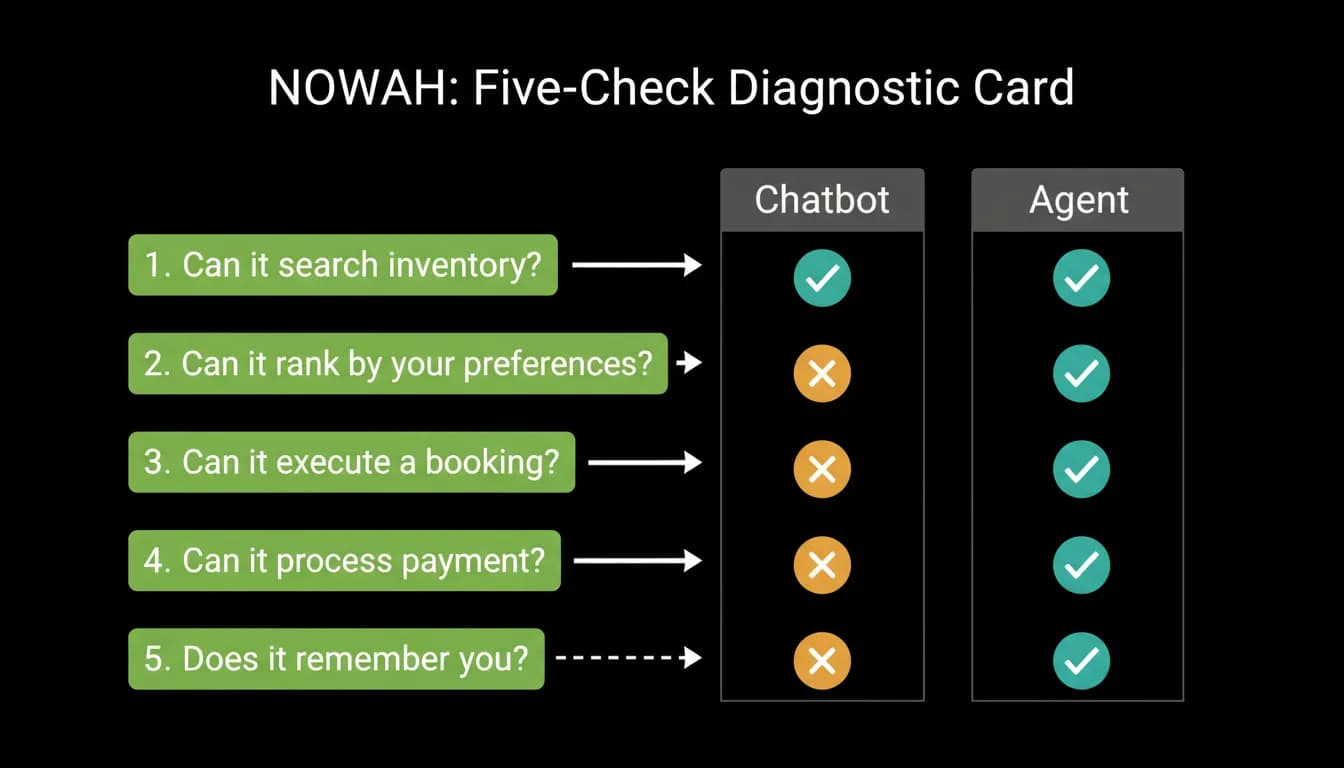
Want to know whether your "AI" travel tool is actually an agent? Test these five capabilities:
1. Can it search live inventory? Ask it to find flights from your city to a specific destination next month. If it returns real-time pricing and availability from multiple airlines, it has inventory access. If it points you to a search engine or gives generic pricing, it is a chatbot.
2. Can it rank by your preferences? Tell it you prefer aisle seats, morning departures, and nonstop flights. Then ask for flight options. If the results reflect all three preferences, it is ranking by your criteria. If the results are generic, it is not.
3. Can it execute a booking? Ask it to book the flight it recommended. If it completes the booking within the conversation — payment, confirmation, itinerary — it is an agent. If it sends you to a website, it is a chatbot.
4. Can it process payment? Does the tool handle payment within the conversation, using stored payment methods or secure payment integration? Or does it redirect you to a separate payment page?
5. Does it remember you? Ask it a week later about your trip. Does it know what you booked? Does it remember your seat preference? If every conversation starts from zero, it lacks the memory that defines an agent.
A true AI agent passes all five. A chatbot passes zero to two.
Architecture matters
The reason chatbots cannot be simply upgraded to agents is architectural. A chatbot is a language processing layer sitting on top of a knowledge base. An agent is a language processing layer connected to execution systems through an orchestration layer that decides which actions to take, in what order, with what parameters.
Adding booking capability to a chatbot is not a feature update — it is a rebuild. It requires API integrations with flight and hotel suppliers. It requires a payment processing stack. It requires a trip management system. It requires a preference memory store. It requires an orchestration engine that can chain multiple API calls into a coherent workflow.
This is why the travel industry has so many chatbots and so few agents. Chatbots are quick to build: wrap a language model around your FAQ database and launch. Agents take years to build properly because the execution layer is where the real complexity lives.
Test your travel AI
Open your current travel app or platform. If it has an AI feature, test it. Ask it to book a flight for you. Not suggest a flight. Not show you flights. Book one.
If it can do it — from your request through payment to confirmation — you have an agent.
If it cannot, you have a chatbot with good marketing. And the difference, in saved time, reduced friction, and booking quality, is everything.
Nowah is an AI travel agent that searches and books real flights and hotels through conversation — no filters, no thirty open tabs. Plan your next trip.