Travel Planning in 2026: Why AI Agents Replace Travel Blogs and Forums
Blogs are generic. Reddit is noisy. Guidebooks are outdated. AI agents synthesize all of it and personalize it to your trip in seconds.

You have 47 browser tabs open. Three Reddit threads about the best neighborhoods in Kyoto. Two blog posts titled "The Ultimate Guide to Japan" — one from 2022, one from 2024, and you are not sure which recommendations are still current. A TripAdvisor page with reviews that contradict each other. A YouTube video that is 70 percent ads. And a guidebook PDF that was published before the pandemic.
After 3 hours of reading, you know that Kyoto is beautiful and that you should visit Fushimi Inari. You knew both of those things before you started.
The fragmentation of travel information across dozens of sources — each with its own biases, blind spots, and expiration dates — is a problem that AI agents solve not by being another source, but by synthesizing all existing sources into personalized intelligence.
The fragmentation problem
Travel information is scattered across an ecosystem of sources, none of which provides a complete picture.
Travel blogs are SEO-optimized content that prioritizes ranking over relevance. The "Top 10 Restaurants in Tokyo" listicle exists to capture search traffic, not to recommend restaurants that match your specific dietary needs, budget, and neighborhood. Blog content has an average shelf life of 12 to 18 months before specific recommendations become outdated — restaurants close, prices change, neighborhoods evolve. But the blog post remains indexed and continues appearing in search results for years.
Forums and Reddit contain genuine traveler experiences and local knowledge that is often more valuable than professional content. The problem is volume and noise. Travel subreddits receive over 10,000 posts per day. Advice is contradictory ("definitely stay in Shinjuku" versus "avoid Shinjuku, it is overpriced and touristy"), context-dependent (advice for a solo backpacker is not relevant to a family with young children), and time-sensitive (the great ramen shop someone recommended 6 months ago may have closed).
Review platforms suffer from manipulation and selection bias. The loudest voices are the most extreme — 5-star gushers and 1-star complaints — while the useful middle-ground perspective is underrepresented.
Guidebooks are comprehensive but static. By the time a guidebook is researched, written, published, and purchased, much of its specific information is 12 to 24 months old.
How AI synthesis works
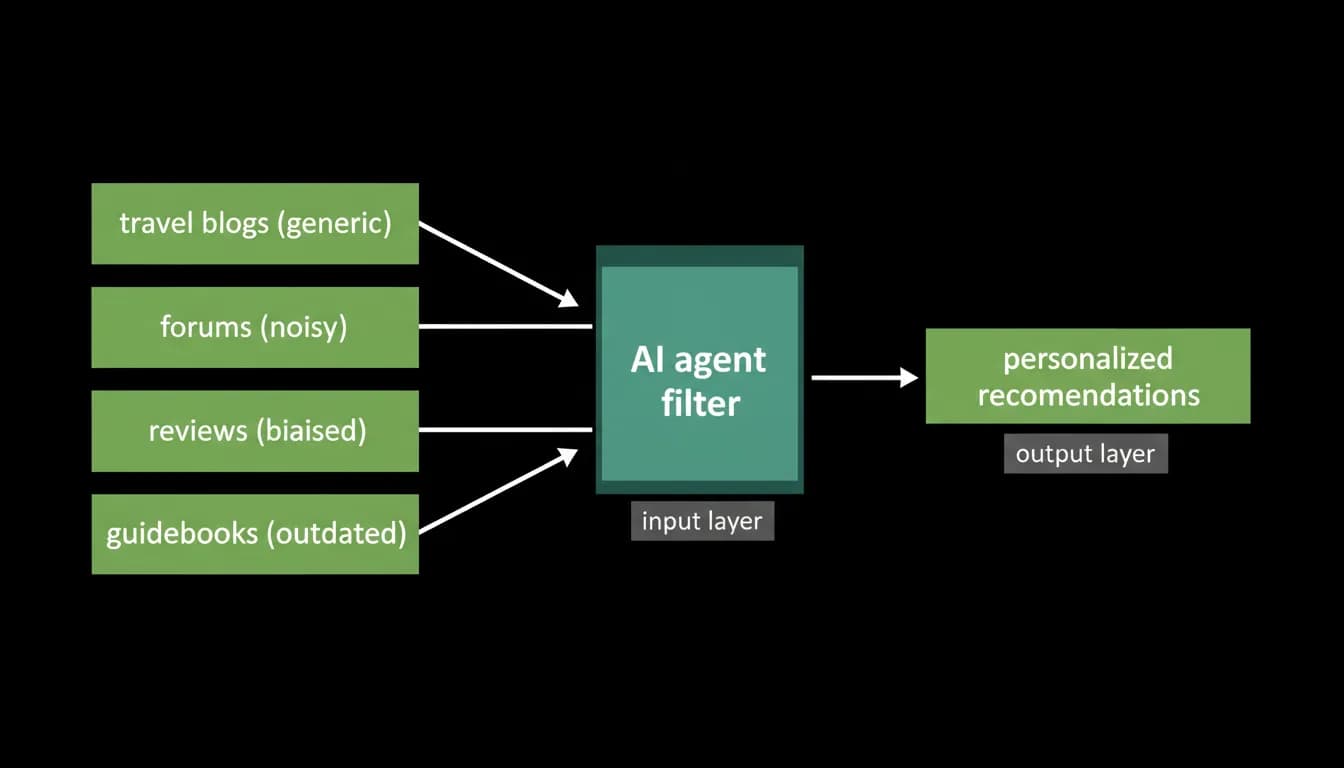
An AI agent does not replace these sources. It consumes, processes, and synthesizes them, then personalizes the output to your specific trip.
When you tell the agent you want restaurant recommendations in Kyoto, the agent processes the equivalent of 50 or more blog posts, hundreds of reviews, and forum discussions about Kyoto dining. It identifies patterns: which restaurants are consistently praised across multiple sources, which complaints are recurring, which recommendations are recent enough to be current.
Then it personalizes. You are vegetarian — the agent filters for restaurants with strong vegetarian options. You prefer local, non-touristy spots — it deprioritizes places that appear on every "Top 10" list and surfaces places praised in local food forums. You are staying near the Higashiyama district — it prioritizes proximity to your hotel.
The result is not a generic listicle. It is a curated, personalized set of recommendations backed by synthesis of far more information than you could process manually in hours.
Blogs are generic; your trip is not
The fundamental limitation of travel blogs is that they are written for a general audience. "The Best Hotels in Paris" assumes every reader has the same needs, budget, and preferences. In reality, the best hotel for a business traveler near the La Defense district has zero overlap with the best hotel for a honeymooning couple in Montmartre.
AI agents do not produce generic recommendations because they know who you are. Your preferences, your itinerary, your budget, your travel history — all of this context shapes every recommendation. The agent's output is a one-of-one guide created specifically for your trip, not a one-to-many blog post created for search engine traffic.
Forums are valuable but time-consuming
Reddit is arguably the most valuable travel information source because it contains genuine, experience-based advice from real travelers. The problem is extraction. Finding the relevant advice requires searching across subreddits, reading through long threads, evaluating contradictory opinions, and assessing whether the advice is still current.
AI agents can process forum content at scale and extract the consensus view. "Travelers consistently recommend taking the local train from Kyoto to Nara instead of the express — it is 10 minutes longer but cheaper and the scenery is better. Recent posts (last 3 months) confirm the Nara deer park is still accessible and free."
This synthesis takes seconds for AI and hours for humans. It captures the valuable signal from forums while filtering the noise.
The shift from research to conversation
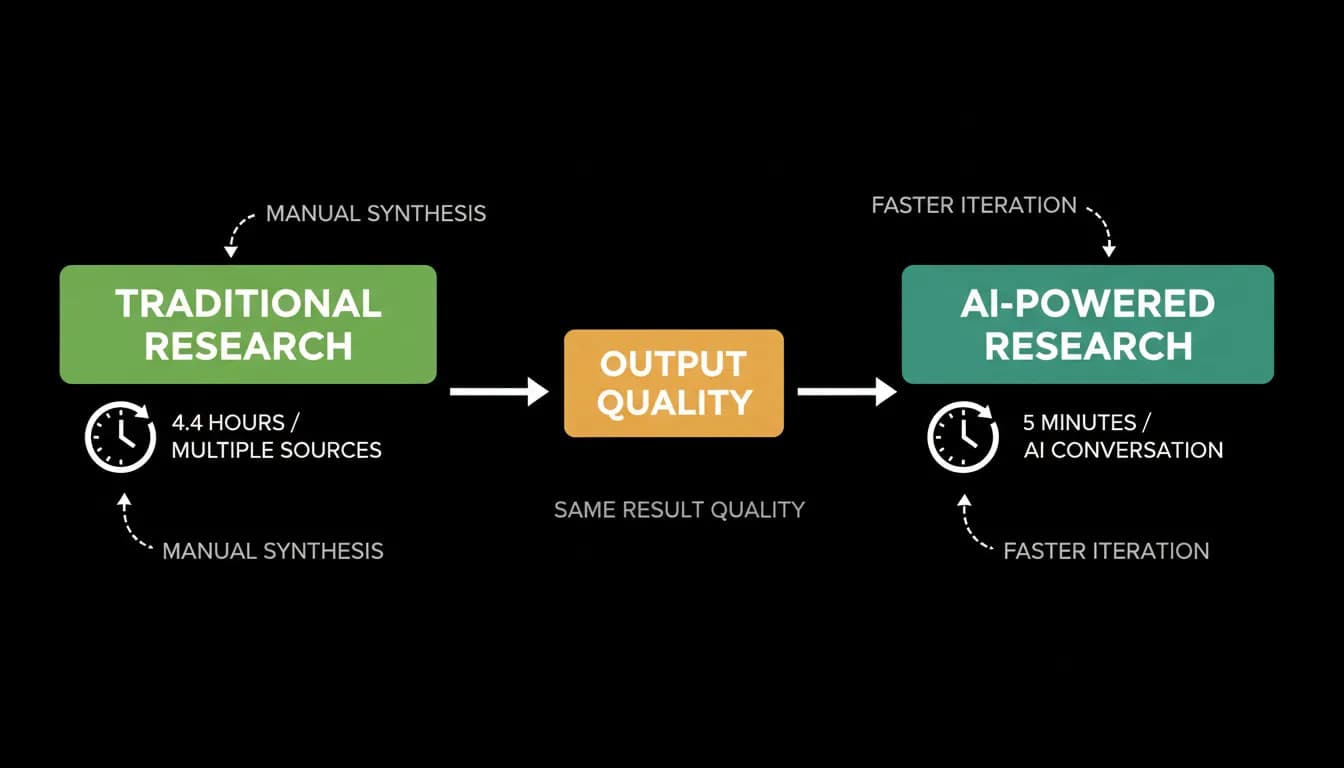
The old model: spend 3 to 4 hours reading blogs, forums, and reviews across 38 websites. Take notes. Cross-reference. Make decisions based on incomplete information and hope for the best.
The new model: describe your trip in a few sentences. Receive personalized recommendations synthesized from thousands of data points. Ask follow-up questions. Refine. Book.
Average research time drops from 4.4 hours to 5 to 10 minutes. But it is not just faster — it is better. The AI synthesizes more information than you could ever read manually, personalizes it to your specific trip, and delivers it in a format that supports decision-making rather than requiring it.
Replace your next 3-hour research session with a 5-minute AI conversation. The recommendations will be more relevant, more current, and more aligned with what you actually want — because they were generated for you, not for a search engine.
Nowah is an AI travel agent that searches and books real flights and hotels through conversation — no filters, no thirty open tabs. Plan your next trip.