Best Flight Booking in 2026: AI Agents vs. Google Flights vs. OTAs
Head-to-head flight booking comparison across search speed, price accuracy, deal detection, change handling, and real-world user experience.

There are three primary ways to book a flight in 2026, and the differences between them have never been more significant.
Google Flights leverages enormous data infrastructure for fast structured search and basic price prediction. Traditional OTAs offer broad inventory with advertising-influenced results and multi-step booking flows. AI agents use natural language, preference memory, and multi-factor ranking to handle the entire process in a conversation.
Which one is best depends on what you are booking and what matters to you. But the data increasingly favors one approach.
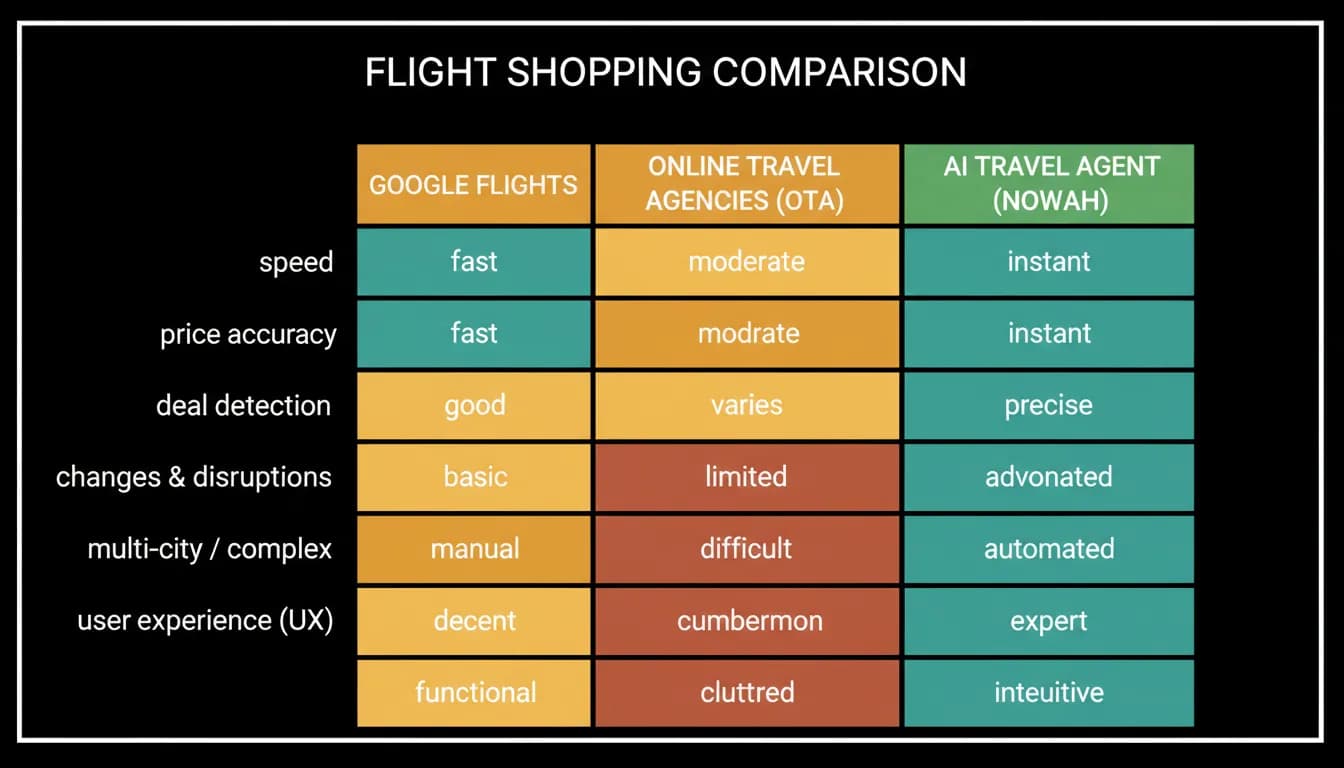
Search speed
Google Flights is fast at returning structured results once you have entered your origin, destination, and dates into the search form. If you know exactly where you are going and exactly when, the speed of the initial query is excellent.
OTAs are comparable in raw search speed but slower in the end-to-end process. The additional steps of filtering, comparing, and navigating to the booking page add significant time. Eight or more steps from first search to confirmed booking is standard, averaging 20 to 45 minutes.
AI agents redefine what "search speed" means because the search is not a step you perform — it is something that happens while you describe your trip. You say what you want, the agent searches, and curated results appear. Three steps total: conversation, review options, confirm. Average booking time: 2 to 5 minutes.
The gap widens for complex trips. Multi-city searches on OTAs require separate queries per leg. Google Flights supports multi-city but the form becomes cumbersome and the results require significant manual comparison. An AI agent handles "fly into Paris, then to Barcelona, then home from Rome" as a single natural language request and evaluates all legs simultaneously.
Price accuracy and transparency
Google Flights tracks prices and shows historical trends for specific routes. This is useful context, but the price you see on Google Flights is often not the final price you pay — Google redirects you to an airline or OTA to complete the booking, where fees, seat selection, and baggage charges may change the total.
OTAs display booking-ready prices but have their own transparency issues. Resort fees on hotels, baggage charges on basic economy fares, and ancillary costs are frequently buried until the final checkout step. The sticker price and the checkout price can differ by 15 to 30 percent.
AI agents present total cost upfront because the agent has access to the full fare rules and ancillary pricing at the time of recommendation. "This fare is $340. Checked bag is included. Change fee is $75. Total is $340." No surprises at checkout. Furthermore, the agent provides price context: "This is 12% below the 90-day average for this route" — turning a number into actionable intelligence.
Deal detection
Google Flights offers price alerts — you set a route and dates, and it notifies you when the price changes. The limitation is that alerts are reactive and often delayed by 6 to 12 hours from the actual fare change. By the time you get the notification, the deal may be gone.
OTAs have similar alert features, some combined with basic price prediction. The prediction accuracy across the industry averages around 70 percent directional — meaning it correctly predicts whether the price will go up or down 70 percent of the time, but does not tell you how much or when to act.
AI agents provide contextual price intelligence that goes beyond alerts. Instead of "the price dropped," you get "this price is $80 below the 90-day average for this route, and fares on this city pair historically rise 2 weeks before departure, which is 3 weeks away — book now." The recommendation incorporates your flexibility, your budget, and the specific dynamics of the route. This proactive, contextual approach captures savings that reactive alerts miss.
Change and disruption handling
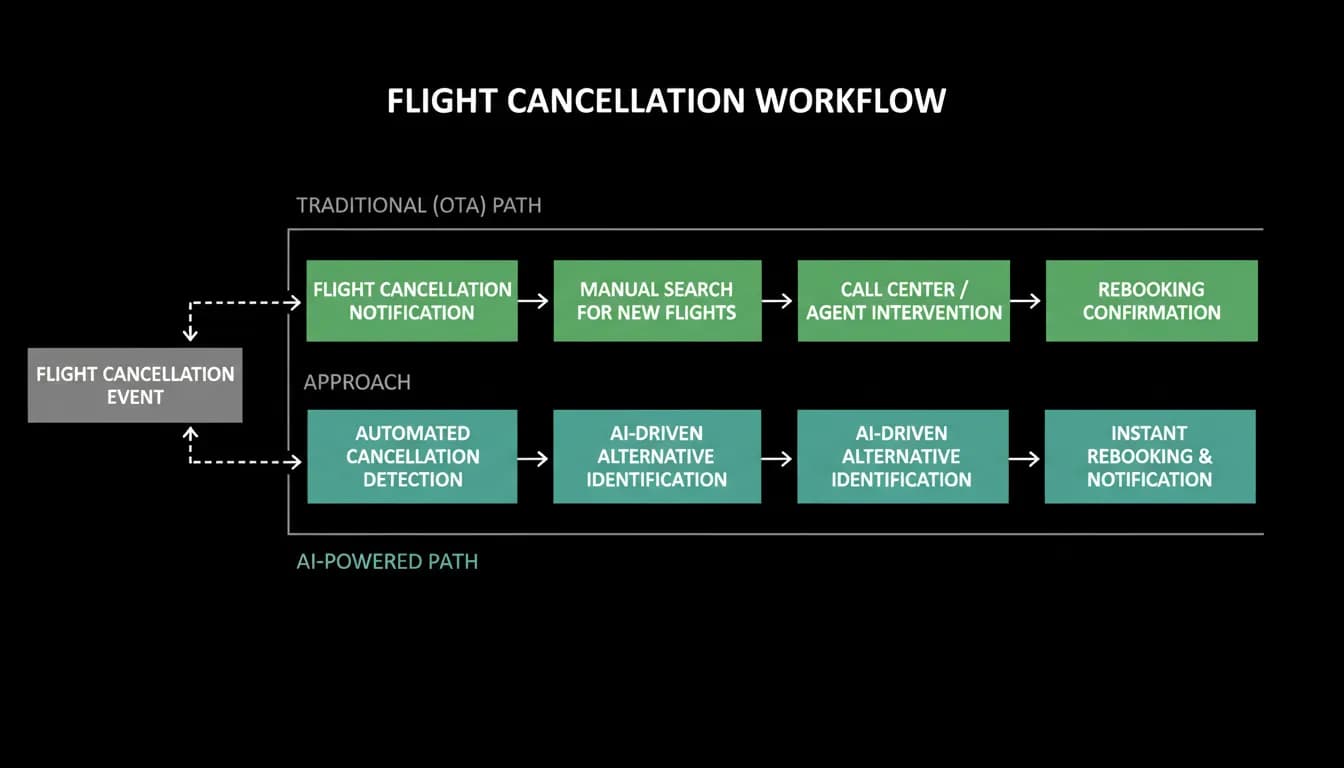
This is where the gap between the three approaches becomes most dramatic.
Google Flights does not handle changes at all. It is a search tool. If your flight changes or gets canceled, you deal with the airline or the OTA where you actually booked.
OTAs offer self-service change flows that vary widely in quality. On a good day, you can modify dates and routes through the app. On a bad day — which often coincides with the days you most need to make changes, like during widespread disruptions — you are on hold for 45 to 90 minutes waiting for a human agent.
AI agents handle changes conversationally. "My meeting moved to Thursday — can you change my flight?" The agent checks your fare rules, searches alternatives, evaluates them against your preferences, and executes the change. Under 3 minutes. During disruptions, the agent can detect the issue 15 to 30 minutes before the airline notification reaches you, evaluate alternatives, and rebook proactively.
Average disruption recovery time: OTA self-service is 25 or more minutes. Airline phone hold during disruptions is 45 to 90 minutes. AI agent: under 3 minutes.
Multi-city and complex routing
Google Flights supports multi-city searches but presents results as separate leg options that you must combine manually. There is no route optimization and no consideration of open-jaw itineraries that might save money.
OTAs handle multi-city bookings with varying capability. Most require searching each leg separately. Few offer open-jaw optimization or mixed-carrier routing.
AI agents handle complex routing natively. "I need to visit Rome, Barcelona, and Lisbon in two weeks and I want to spend the least time in airports" is a single request that the agent processes holistically. It evaluates open-jaw options (fly into Rome, out of Lisbon), mixed-carrier combinations, and positioning flights between cities. Multi-city bookings that take 45 to 60 minutes on OTAs take 5 to 8 minutes through an AI agent.
Pick the right tool for your next flight
For a simple round-trip domestic flight where you know the exact dates and just want the lowest price, any of the three approaches works. Google Flights shows you the options quickly; OTAs let you book directly; an AI agent handles it in 2 minutes.
For anything more complex — flexible dates, multi-city routing, preference-weighted ranking, post-booking management, or disruption handling — the AI agent is not just better. It is in a different category. The more complex your trip, the wider the performance gap becomes.
The question to ask yourself is not which tool searches fastest, but which one respects your time and serves your interests from the moment you think about traveling until the moment you get home.
Nowah is an AI travel agent that searches and books real flights and hotels through conversation — no filters, no thirty open tabs. Plan your next trip.