How AI Agents Handle Flight Disruptions Better Than Any App
Flight delayed? AI agents find alternatives, evaluate against your constraints, and rebook — potentially before you hear the announcement. Walk through the scenario.
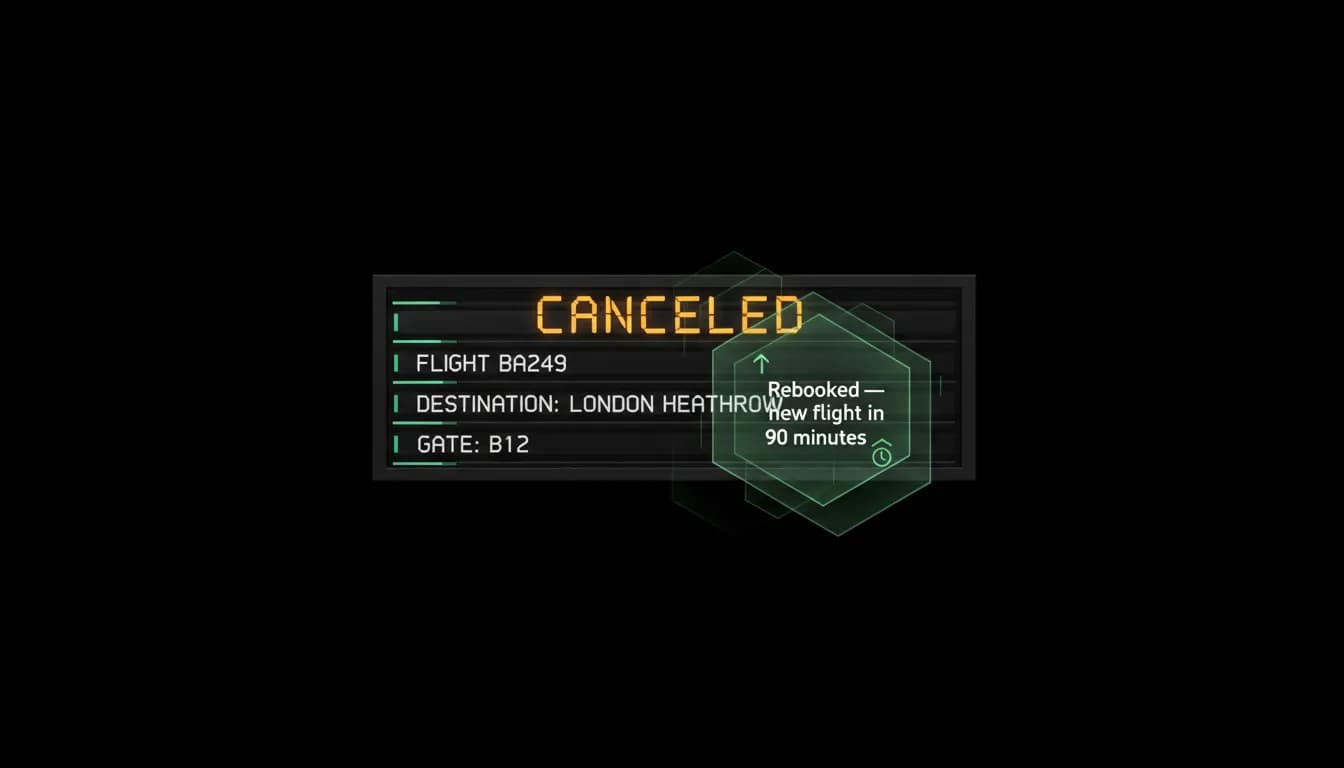
Gate B7. 6:30 AM. You are half-awake, coffee in hand, boarding pass ready. The departure board flickers. Your connecting flight — the one that gets you to the business meeting at 2 PM — just changed from "On Time" to "CANCELED."
What happens next depends entirely on who is managing your trip.
If you booked through a traditional OTA, you are on your own. The app sends a push notification that your flight was canceled. It offers no alternatives. You join the line of 200 passengers at the airline counter. You call the airline, wait on hold for 45 to 90 minutes, and hope a human agent can find you a seat on another flight. Meanwhile, your hotel check-in, your dinner reservation, and your morning meeting are all in jeopardy. Each downstream booking needs to be individually revised.
If an AI agent is managing your trip, the experience is fundamentally different.
The traditional disruption experience
Flight disruptions are common. Three percent of US flights are canceled daily. Twenty percent are delayed on average. During weather events, holiday travel, and peak seasons, these numbers spike dramatically.
The traditional recovery process has not changed meaningfully in two decades.
Step one: notification. You learn your flight is disrupted through a push notification, a departure board update, or a gate announcement. This notification often arrives 15 to 30 minutes after the airline's internal systems have already flagged the issue.
Step two: queue. If you are at the airport, you join a physical line at the airline counter. If you are not at the airport, you call the airline. Both queues are long because every passenger on the disrupted flight is doing the same thing simultaneously.
Step three: manual rebooking. The airline agent searches for alternatives one at a time. They see only their own airline's inventory. If no same-airline alternative exists, they may rebook on a partner carrier, but the process is slow and the options are limited to partnerships.
Step four: downstream chaos. Your new flight arrives four hours later than planned. Your hotel check-in time needs to change. Your car rental needs to be pushed back. Your dinner reservation is missed. Each of these requires a separate phone call or app interaction. Average additional time for downstream rebooking: 2 or more hours.
Total time from disruption to resolution: 3 to 6 hours. Total stress level: extreme.
The AI disruption experience
An AI agent with access to real-time flight data can detect disruptions 15 to 30 minutes before the airline notification reaches you. Operational data — aircraft tracking, crew positioning, weather patterns, and airport capacity — signals problems before they cascade into cancellations and delays.
When the disruption is detected, the AI agent does not wait for you to initiate recovery. It begins immediately.
Automatic detection. The agent monitors your flight status continuously. When the disruption is detected — whether a cancellation, a delay long enough to miss a connection, or a gate change that creates a timing problem — it triggers the recovery process.
Alternative search. The agent evaluates 50 or more alternative routings in seconds. Not just the disrupted airline's inventory — all carriers serving the route. It factors in connection times, total travel time, airport positioning (which terminal you are in now), and seat availability.
Preference-aware selection. This is where the difference becomes profound. An airline agent rebooking you manually finds the next available seat. Period. The AI agent finds alternatives and ranks them by your preferences: aisle seat, maximum one stop, arriving in time for your 2 PM meeting, same cabin class or better. It does not just find a flight — it finds the right flight.
Proactive notification. You receive a message: "Your connection through Denver has been canceled due to weather. I have found three alternatives. Option 1 arrives at 12:30 PM through Dallas, aisle seat 12C — you make your meeting with 90 minutes to spare. Option 2 arrives at 1:45 PM nonstop — tighter on time but no connection risk. Option 3 arrives at 3:30 PM but is business class for $80 more. Recommend option 1. Shall I book it?"
Total time from disruption to resolution: under 3 minutes.
Speed advantage
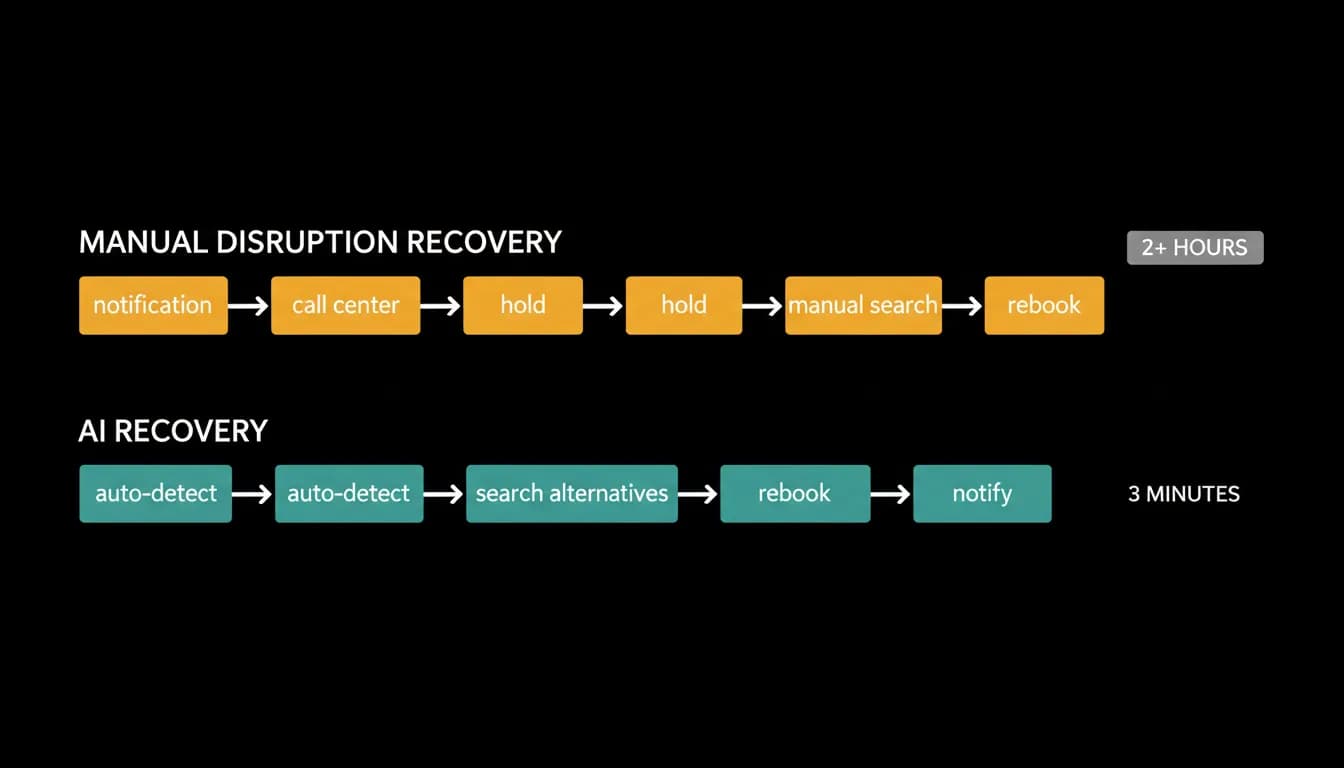
The speed difference is not marginal. It is the difference between catching the next available alternative and being stranded until the following day.
During major disruptions, seats on alternative flights fill within minutes. Passengers who rebook fastest get the best alternatives. Passengers who wait in line or hold for a phone agent get whatever is left — if anything is left.
An AI agent operates at computational speed. It can evaluate every alternative flight across every carrier in seconds. It can hold a seat while presenting options to you. It can complete the booking before most passengers have even finished reading the cancellation notification.
This speed advantage compounds when multiple flights are disrupted simultaneously, as happens during weather events. While hundreds of passengers compete for the same airline agent's attention, your AI agent has already searched, evaluated, and is presenting alternatives that other passengers will not see for another hour.
Downstream impact management
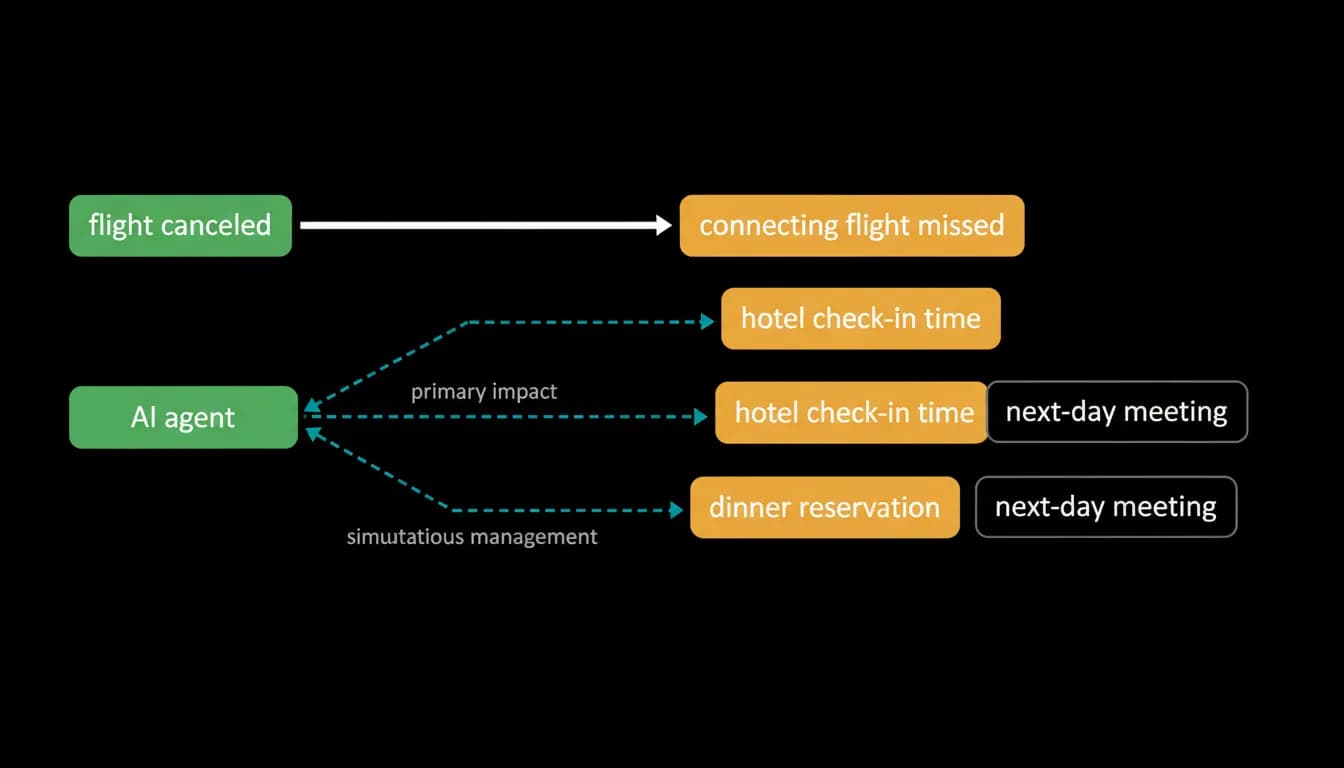
A flight disruption rarely affects only the flight. The ripple effects cascade through your entire trip.
Hotel adjustments. Your check-in time changes. If you arrive late, you might need to notify the hotel. If the delay is overnight, you might need a hotel near the airport. The AI agent surfaces the knock-on effect rather than leaving you to work it out: "Your new flight arrives at 10 PM instead of 4 PM. Your hotel holds reservations until midnight, so no change is needed — but I can draft a late-arrival note if you want to send one."
Ground transportation. Your rental car pickup time shifts. Your pre-booked airport transfer may need rescheduling. The agent adjusts these bookings or advises you on alternatives.
Meetings and reservations. The agent can send a message to relevant contacts if you authorize it. "Meeting participants have been notified of your revised arrival time." It can also cancel or modify dinner reservations that are no longer feasible.
Connecting activities. If the disruption affects a downstream activity — a tour, a show, a business event — the agent evaluates whether the new timeline still works and alerts you to conflicts.
Manually managing this cascade adds 2 or more hours to disruption recovery. An AI agent manages it in parallel with the flight rebooking, resolving downstream impacts simultaneously rather than sequentially.
The compound cost of disruptions
Flight disruptions cost travelers more than time. They cost money, missed opportunities, and significant stress.
Travelers who do not rebook efficiently often end up paying for accommodation near the airport, meals during extended waits, and premium fares on last-minute rebookings. A single major disruption can add $200 to $500 in unplanned expenses.
The business traveler who misses a meeting loses something harder to quantify. The family that misses a day of vacation cannot get it back. The couple connecting to a cruise ship departure faces a non-refundable loss if they arrive too late.
AI agents do not eliminate disruptions — weather will always ground planes and mechanical issues will always occur. What they eliminate is the chaos that follows. The disruption itself is brief: a canceled flight is a data point. The suffering comes from the recovery process. An AI agent that compresses recovery from hours to minutes transforms a travel disaster into a minor inconvenience.
Enable proactive management
If you are currently using an AI agent for travel booking, ensure that disruption management is enabled. This typically involves allowing the agent to monitor your flight status and send proactive notifications. Some agents allow you to set auto-rebooking preferences: "If my flight is canceled, rebook me on the fastest available alternative with an aisle seat, and notify me after the booking is confirmed."
The difference between reactive and proactive disruption management is the difference between joining a line and receiving a solution. The technology exists today. The only requirement is that you have a trip managed by an AI agent that monitors, evaluates, and acts on your behalf.
Three percent of flights cancel daily. Twenty percent experience delays. Over the course of a year of regular travel, you will encounter disruptions. The question is not whether, but who handles them — you, in a phone queue, or an AI agent, in 3 minutes.
Nowah is an AI travel agent that searches and books real flights and hotels through conversation — no filters, no thirty open tabs. Plan your next trip.