AI Agents vs Chatbots: They Are Not the Same Thing
If you think our AI travel agent is a chatbot, you are missing the point. Chatbots follow scripts. Agents use tools, memory, and reasoning to take action.
The most common misconception about Nowah is that it is a chatbot. It is not. The difference between a chatbot and an AI agent is the difference between a phone menu and a personal assistant. They both talk to you, but only one can actually do things.
What chatbots are
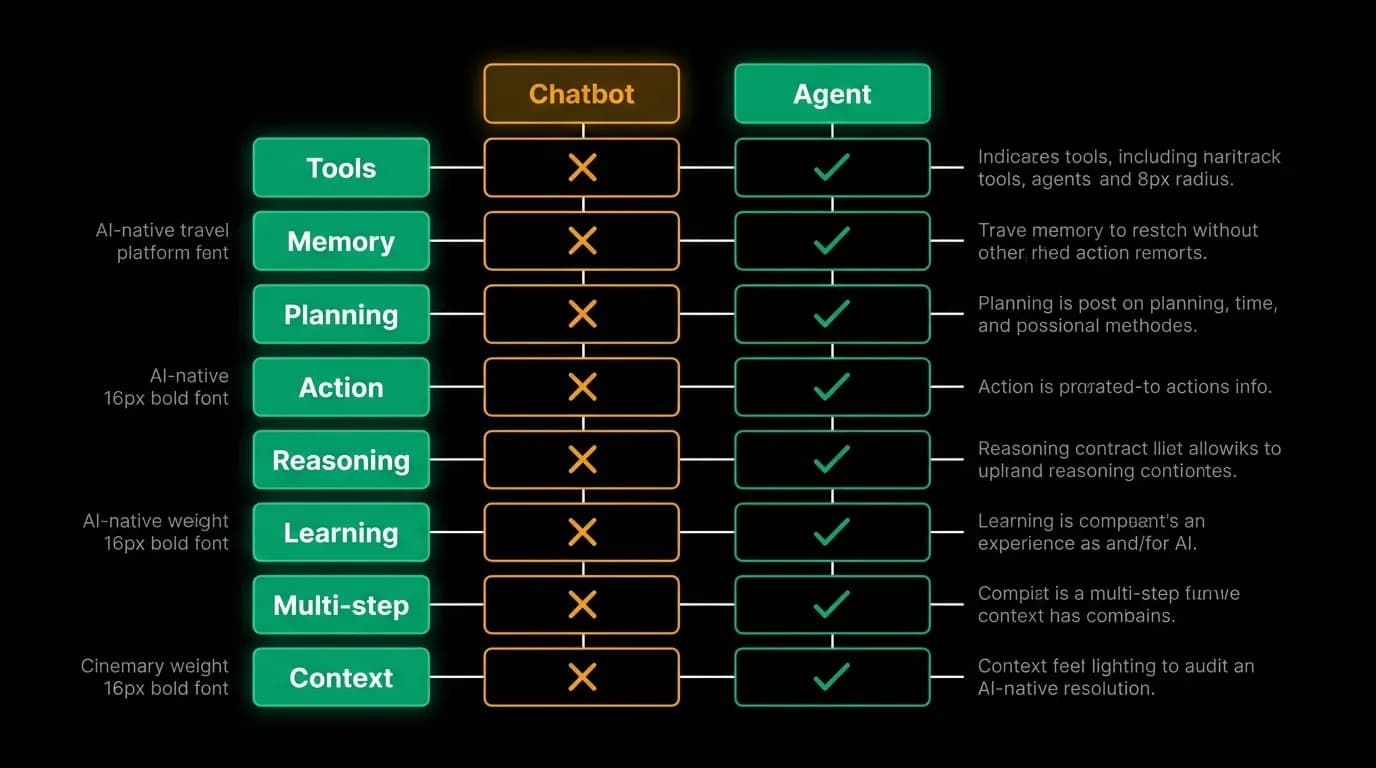
A chatbot is a scripted or semi-scripted system that generates text responses. The sophisticated ones use AI to generate more natural-sounding text. But fundamentally, a chatbot responds. It answers questions. It provides information. It suggests things.
What a chatbot does not do: search live inventory, compare options across data sources, reason about trade-offs, remember your preferences across sessions, or execute transactions on your behalf.
Most "AI-powered" travel features on existing platforms are chatbots. They call the same search API that the website's search form does. There is no intelligence layer. The chat interface is cosmetic.
What AI agents are
An AI agent is a system with tools, memory, reasoning, and the ability to take action.
Tools. Our agent has over 70 integrated tools. It can search flights-layer-ai-agent-search-flights) across hundreds of airlines, compare hotel prices, process payments, generate trip documents, check visa requirements, and manage booking changes. These are not text generation features. They are real capabilities that produce real results.
Memory. The agent remembers your preferences across sessions. It knows your seat preference, your budget comfort zone, your hotel standards, and your travel patterns. It does not start from zero every time.
Reasoning. The agent plans an approach to complex requests. "Find me the best option for a week in Japan with three days in Tokyo and two in Kyoto, budget moderate, prefer boutique hotels." The agent decomposes this into sub-tasks, executes them in the right order, considers interdependencies, and synthesizes a coherent recommendation.
Action execution. The agent does not link you to a booking page. It executes the booking directly. Payment, confirmation, documentation, all within the conversation.
Why the distinction matters
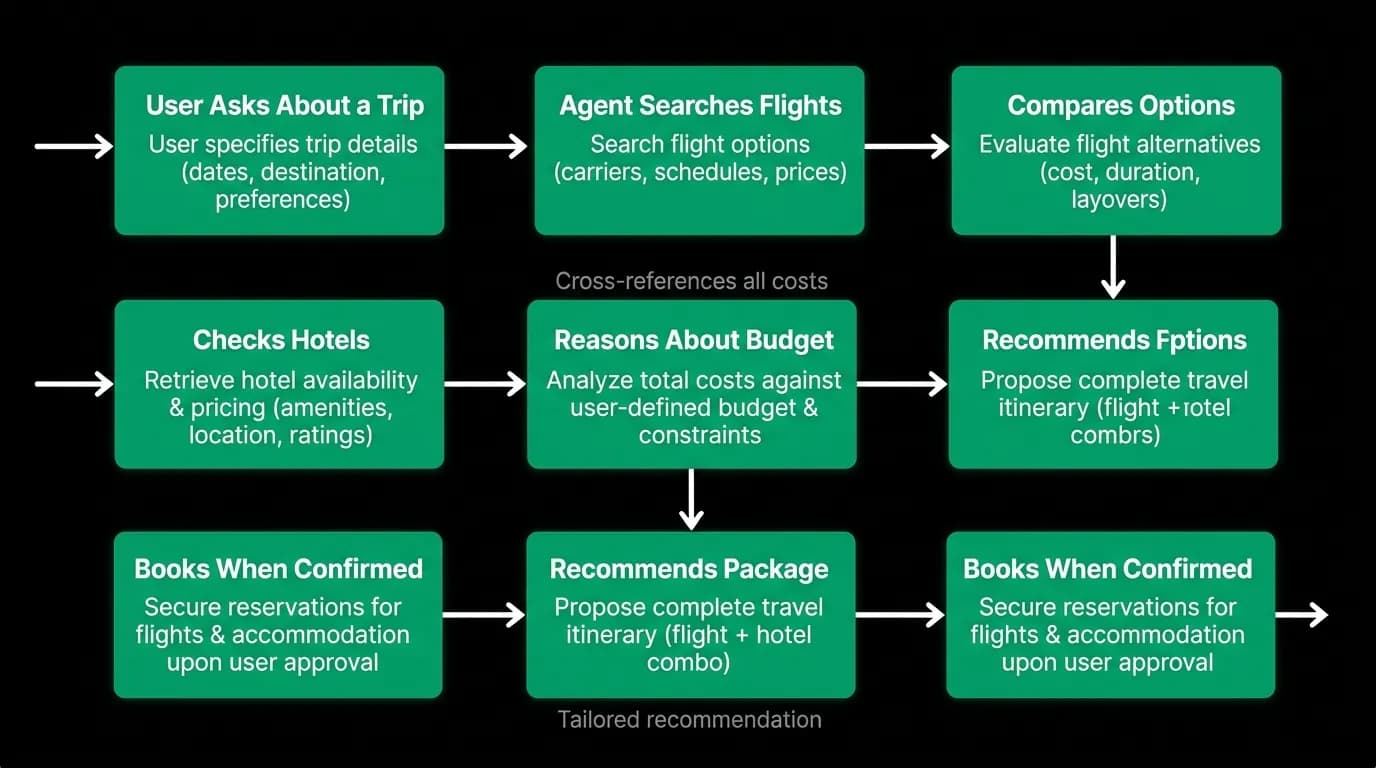
A chatbot tells you about flights. An agent books your flights.
A chatbot forgets you exist between sessions. An agent remembers that you hate layovers and always want morning departures.
A chatbot responds to your questions. An agent plans a multi-step approach to solving your problem.
A chatbot redirects you to a website to complete a transaction. An agent handles the transaction end to end.
For users, the difference is felt immediately. An agent-powered experience feels like working with someone competent. A chatbot experience feels like talking to an FAQ page.
The future is agents, not chatbots
The agent paradigm extends far beyond travel. Any domain where users face complex decisions, fragmented information, and the need for action execution is ripe for agents. Shopping, healthcare, legal services, financial planning.
Chatbots were the first step. They proved that conversational interfaces are natural and preferred. But they stopped at conversation. Agents go further: they act on your behalf, learn from the interaction, and get better over time.
We built Nowah as an agent from day one, not because it was easier, but because chatbots cannot do what travelers actually need. They need someone who searches, compares, recommends, books, organizes, and remembers. That is an agent. And that is what we are.
Nowah is an AI travel agent that searches and books real flights and hotels through conversation — no filters, no thirty open tabs. Plan your next trip.