AI-Generated Itineraries — Beyond the Template
\\\"Day 1: Visit the Eiffel Tower\\\" is not personalization. Real AI itineraries match your pace, interests, and energy across every hour.
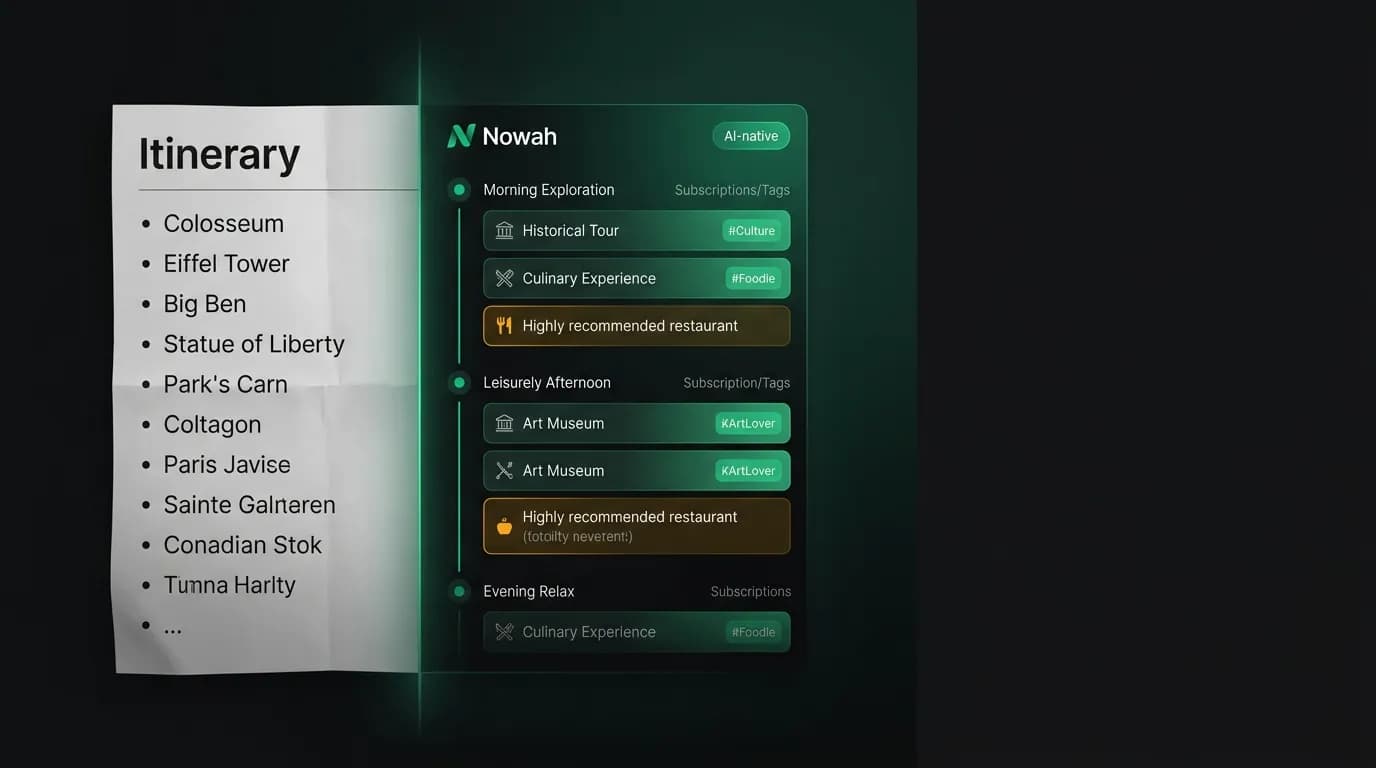
Open any AI chatbot and ask it to plan a trip to Paris. You will get something like this:
Day 1: Visit the Eiffel Tower. Walk along the Seine. Have lunch in the Latin Quarter. Visit the Louvre in the afternoon.
Day 2: Visit Notre-Dame. Explore the Marais. Shopping on the Champs-Elysees.
This is not personalization. This is a template. It is the same itinerary that every tourist gets because the AI has no idea who you are, what you care about, or how you travel.
Real itinerary generation requires understanding the traveler, not just the destination. Your pace. Your interests. Your energy patterns. Whether you want packed days or breathing room. Whether you prioritize famous landmarks or hidden local spots.
Sixty-seven percent of travelers find booking stressful. Generic itineraries contribute to that stress because they force you to do the customization work yourself. You receive a template and then spend hours editing it to match what you actually want to do. The AI was supposed to save you time. Instead, it created homework.
Interest-graph itineraries
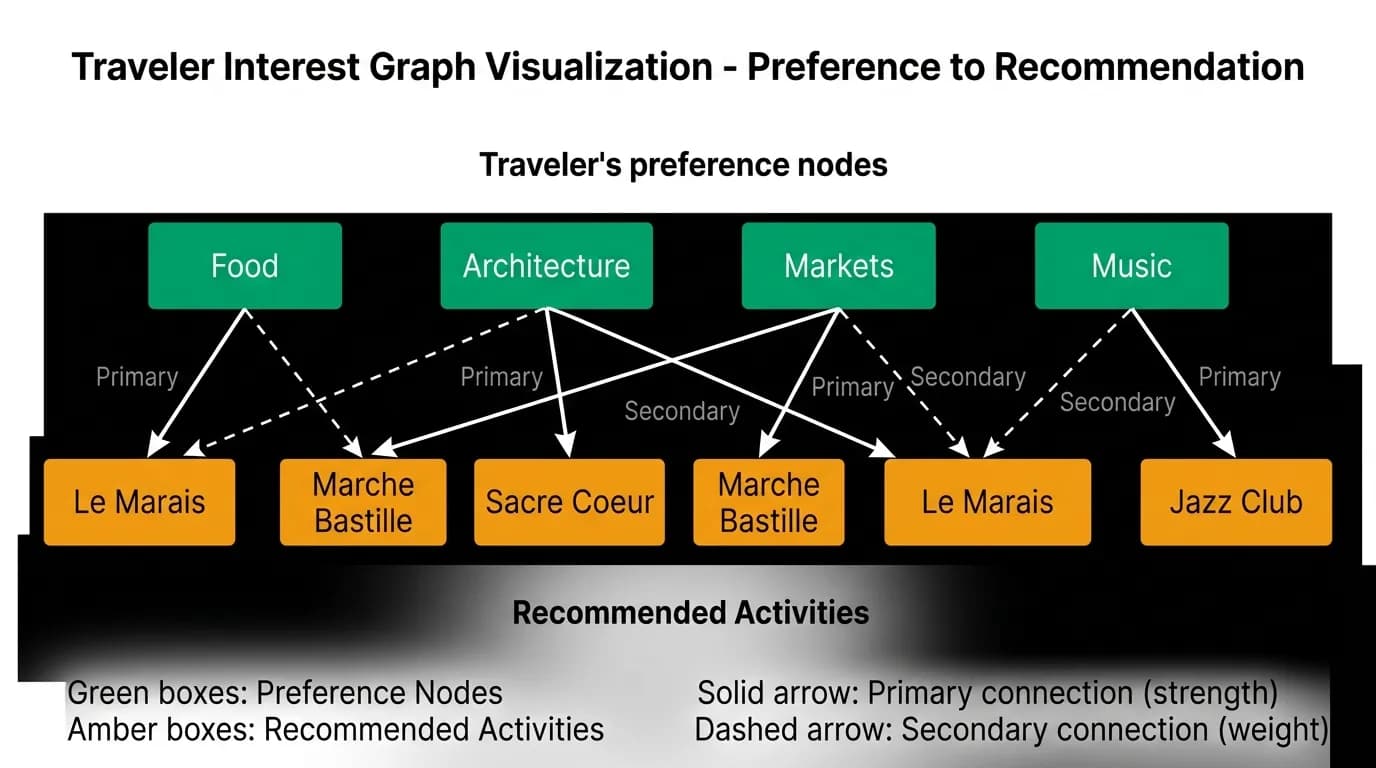
The first step beyond templates is understanding what the traveler cares about.
Not everyone visiting Paris wants to see the Eiffel Tower. Some people are there for the food scene: bistros, bakeries, wine bars, and the Marche d'Aligre at dawn. Some are there for the art: not just the Louvre but the Orangerie, the Rodin Museum, and the galleries in the Marais. Some are there for architecture: Haussmann boulevards, Art Nouveau metro stations, the Fondation Louis Vuitton.
An interest-graph itinerary starts with what you care about and builds the trip around it. The agent constructs an interest profile from your explicit statements ("I love food and architecture"), your past trip behavior (you spent 3 hours at a museum in Barcelona), and the current conversation context ("I want to explore the food scene").
The itinerary then maps your interests to specific activities and locations. A food-focused traveler in Paris gets recommendations for specific bakeries, neighborhood markets, cooking classes, and wine bars. An architecture-focused traveler gets a walking route through specific neighborhoods with notable buildings.
These itineraries feel custom because they are custom. No two travelers with different interest profiles get the same itinerary for the same city.
Pacing intelligence
There are two types of travelers: the ones who want to maximize every minute and the ones who want to wander.
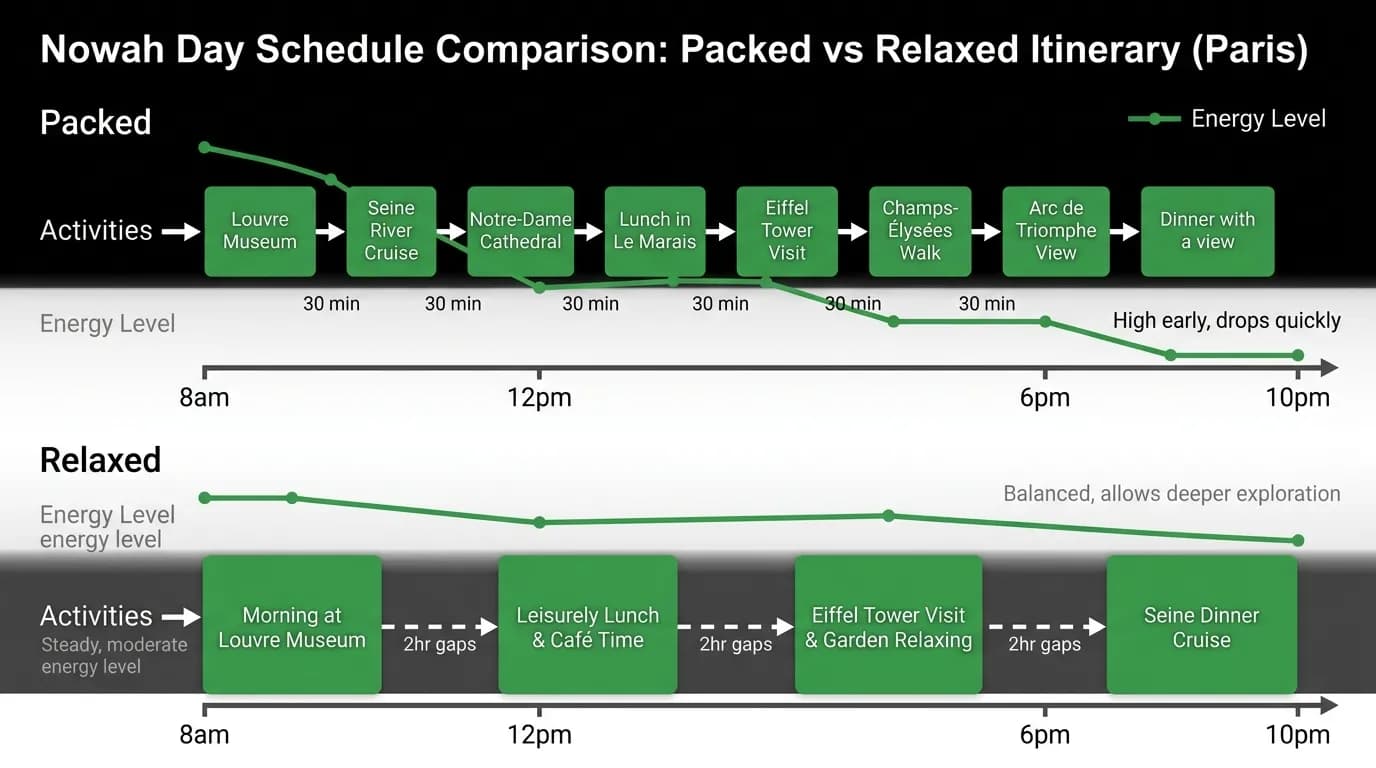
A packed-schedule traveler wants 8 activities per day with 30-minute gaps for transit. They feel frustrated by empty time. They measure a good trip by how much they saw.
A relaxed-pace traveler wants 3-4 activities per day with long gaps for wandering, coffee stops, and spontaneous discovery. They feel rushed by tight schedules. They measure a good trip by how it felt.
Most AI-generated itineraries default to moderate packing. This satisfies no one. The packers want more. The wanderers want less.
Our agent learns pacing preference from your history and stated preferences. If your past trips show you booking tours back-to-back, it generates packed itineraries. If your past trips show you booking minimal activities and spending time exploring on foot, it generates relaxed itineraries.
The agent also respects energy patterns. Heavy activities (long walking tours, extensive museums) go in the morning when energy is high. Light activities (cafes, shopping, neighborhood strolls) go in the afternoon. Evening activities match your dinner preferences and bedtime patterns.
Local vs tourist
Here is a preference dimension that most platforms ignore entirely: do you want the tourist experience or the local experience?
The tourist experience in Paris: Eiffel Tower, Louvre, Sacre-Coeur, Seine cruise, Champs-Elysees. These are world-famous for a reason. They are worth seeing.
The local experience in Paris: breakfast at a neighborhood bakery in the 11th, browsing the Marche des Enfants Rouges, afternoon aperitif at a canal-side bar in the 10th, dinner at a bistro that does not have an English menu.
Most travelers want some blend of both. But the blend is personal. Some want 80% tourist highlights with a few local touches. Others want 80% local with one or two must-see landmarks.
An AI agent that understands your position on this spectrum generates dramatically different itineraries for the same city. The Eiffel Tower appears in the tourist-heavy version but not in the local-heavy version. The neighborhood bakery appears in the local-heavy version but not in the tourist version.
After 10 trips, the agent knows your ideal balance. Seventy-two percent of millennials and Gen Z travelers express interest in AI travel planning, and this generation in particular tends to value authentic local experiences over standard tourist circuits.
Time-aware scheduling
A generic itinerary puts activities in time slots without considering what makes sense when.
The Louvre is best visited early morning when it opens, before the crowds arrive. Montmartre is best in the late afternoon when the light is golden. Dinner in Paris starts at 8 PM, not 6 PM. The Marche d'Aligre is only open until 1 PM.
Time-aware scheduling considers opening hours, crowd patterns, optimal lighting, meal conventions, and transit logistics. It does not schedule a restaurant visit at 3 PM or a museum visit during peak crowd hours if alternatives exist.
Weather awareness adds another layer. If rain is forecast for Tuesday morning, the agent schedules indoor activities (museums, covered markets) for Tuesday and moves the walking tour to Wednesday when the forecast is clear.
Itineraries that evolve
A static itinerary printed before departure assumes that nothing will change. In reality, everything changes.
You are tired on day 2 and want to skip the morning activity. The agent adjusts: "I'll move the museum to day 3 morning instead. Today you could do a relaxed brunch in the neighborhood."
You discover a restaurant that a local recommended. The agent fits it into the schedule: "I can move your dinner reservation to tomorrow and book the recommended place for tonight."
Weather changes, energy levels fluctuate, and unexpected discoveries happen. An AI agent that maintains and adjusts the itinerary in real time is more valuable than one that generates a perfect plan at the start and cannot adapt.
The average international trip requires coordinating 5-8 bookings. A good itinerary unifies those bookings into a coherent experience. The best AI trip planning-trip-planning-ai-shines) does not just book flights and hotels. It creates a plan that connects them into a trip that matches how you actually want to travel. That is the difference between a template and a real itinerary.
Nowah is an AI travel agent that searches and books real flights and hotels through conversation — no filters, no thirty open tabs. Plan your next trip.