AI Hotel Recommendations Beyond Star Ratings
\\\"Cozy hotel near the beach\\\" means different things to everyone. Here is how our AI personalizes hotel ranking beyond stars and price filters.

Go to any hotel booking site. Set your destination and dates. You'll get a list of hotels filterable by star rating, price range, and maybe a handful of amenities. Pick "4-star, under $200, free WiFi." You'll still get a hundred results that range from sterile business hotels to charming boutiques to chain properties next to a highway.
Star ratings and price filters capture maybe 20% of what makes a hotel right for a particular traveler. The other 80%, neighborhood character, design aesthetic, walking distance to the places you actually want to visit, the kind of breakfast they serve, whether it's the sort of place where you'd want to hang out in the lobby, that gets lost in the filter sidebar.
Our AI approaches hotel recommendations differently. It understands subjective criteria, learns your hotel style over time, and picks three options that match how you actually travel, not just what you can express in a filter dropdown.
Why star ratings fail travelers
Star ratings were designed as a standardized quality indicator. In practice, they're inconsistent across regions, inflated by chains, and largely meaningless for preference matching.
A 4-star chain hotel in midtown Manhattan and a 4-star boutique hotel in a quiet Parisian neighborhood are both "4-star under $200." They are completely different experiences. The traveler who wants one would hate the other. Star ratings can't express this difference.
Price filters are similarly blunt. "$150-200 per night" captures a wide range of properties with nothing in common except their room rate. A $175 hostel-style hotel and a $175 bed-and-breakfast in wine country both match the filter. They serve entirely different travelers.
The result is that hotel search on traditional platforms always requires extensive manual research after the initial filter. You filter down to 50-100 options, then spend an hour reading reviews, checking locations on a map, looking at photos, and trying to figure out which properties match your actual preferences.
85% of travelers say personalization influences their booking decisions. Hotel booking is where personalization matters most and where traditional tools deliver it least.
Multi-factor hotel ranking
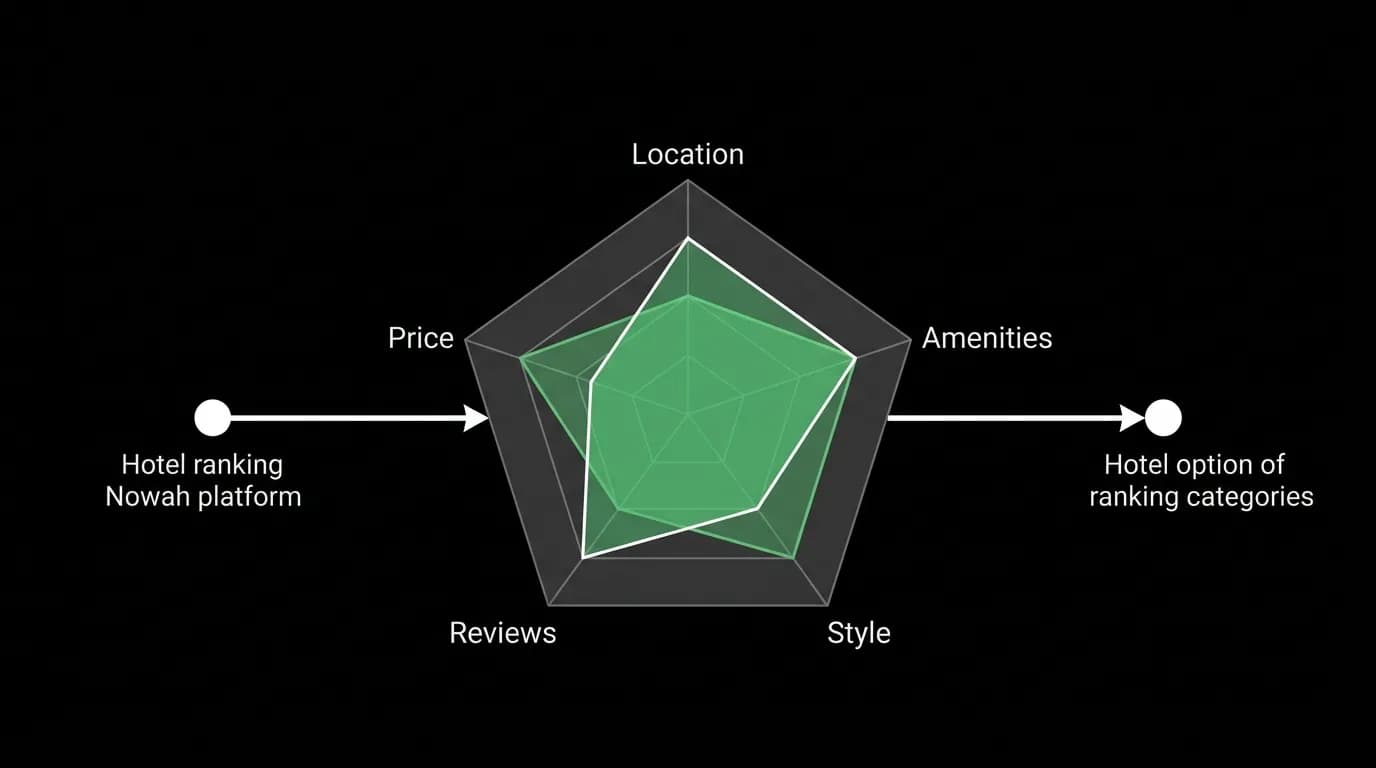
We rank hotels across multiple dimensions, each of which captures something that matters to real travelers.
Location quality. Not just "distance from city center" but proximity to the specific things this traveler cares about. A foodie wants to be near restaurant districts. A museum-goer wants walking distance to cultural sites. A beach traveler wants ocean access. We factor in the trip purpose and stated interests.
Amenity match. Does the property have what the traveler needs? Pool, gym, restaurant, parking, pet-friendly, laundry, coworking space. We weight amenities by how important they are to this specific user, not by how commonly they're requested.
Style match. This is the hardest to quantify and the most valuable. Is this a boutique property? A design hotel? A cozy B&B? A modern minimalist space? A historic building with character? We infer style from property descriptions, review sentiment, and photo analysis metadata.
Review quality. Not just the average score but the content of reviews. A hotel with a 4.2 average where recent reviews mention renovated rooms and excellent breakfast is different from a 4.2 where recent reviews mention noise and declining maintenance. We look at review recency and sentiment, not just the number.
Price value. Is this property a good deal relative to comparable hotels in the area? A $200 hotel that's typically $300 is a better value than a $180 hotel that's always $180.
Personal history. Has the user stayed at this chain before? Have they stayed at similar-style properties and rated them well? Does this property match patterns from past bookings?
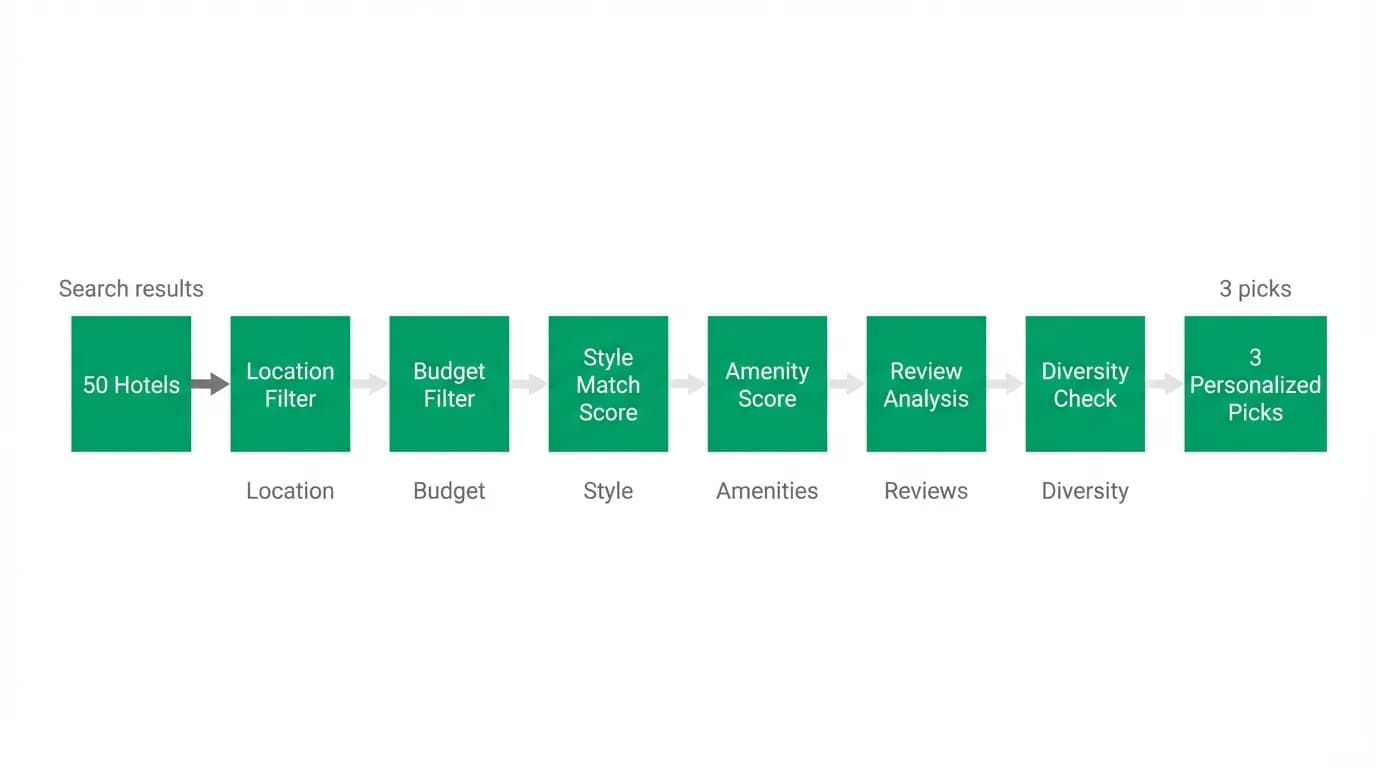
The three-option presentation reduces decision fatigue. Instead of 100 filtered results, you get a boutique option, a value option, and a balanced option, each with an explanation of why it was selected.
Handling subjective criteria
When a user says "cozy hotel near the beach," what does "cozy" mean? For one person, it means a small B&B with floral bedspreads and a homemade breakfast. For another, it means a modern hotel with warm lighting and a fireplace in the lobby.
We handle subjective terms through a combination of approaches.
Semantic mapping. We maintain associations between subjective terms and property attributes. "Cozy" maps to smaller properties, warm decor descriptions, high guest satisfaction scores, and reviews that use similar language. "Trendy" maps to newer properties, design-focused descriptions, and urban locations.
User calibration. Over time, we learn what subjective terms mean for each specific user. If someone who says "cozy" consistently books modern boutique hotels rather than rustic B&Bs, we adjust the mapping for that user.
Clarifying when needed. When a subjective term is too ambiguous to act on confidently, the agent asks. "When you say cozy, are you thinking small and charming, or more like a warm and comfortable bigger property?" One question saves the user from seeing three irrelevant results.
Natural language hotel search eliminates the complex filter interfaces that traditional platforms rely on. You don't need to figure out which checkboxes map to "cozy." You just say what you want and the AI translates it into ranked results.
Learning your hotel style over time
After three boutique hotel bookings, we stop suggesting chains. After two trips where you picked the hotel closest to public transit, we weight walkability higher. After you chose the cheaper option twice in a row, we adjust the price sensitivity in your preference model.
Agentic memory improves recommendation quality over time. This is where AI hotel search has an unfair advantage over filter-based search. Filters don't learn. They don't notice patterns. They ask the same questions every time.
The memory system also handles negative preferences. If you stayed at a large resort last year and complained about it in conversation ("never again with the mega-resorts"), that's stored as a negative preference. Large resort properties get penalized in your ranking going forward.
The compounding effect is real. A first-time user gets good recommendations based on the general quality of our ranking algorithm. A user with five bookings of history gets recommendations that feel like they came from a friend who knows their taste.
The data challenge of real-time hotel availability
Hotels are more volatile than flights in some ways. Rates change hourly based on demand. The last room at a property might sell between when we search and when you decide to book. Promotional rates appear and disappear. Different booking channels show different prices for the same room.
We handle this with a freshness-first approach. Prices shown in search results come from live API calls, not cached data. We include a soft timestamp ("prices from a few seconds ago") and re-verify at booking time. If the price changed, the agent tells you: "That room went up by $15 since your search. Still want it, or should I look for alternatives?"
This transparency builds trust. Traditional platforms sometimes show "from $149" and then reveal a higher price at checkout after you've committed mentally. We show the real price up front, even if it's not the lowest, and explain any changes honestly.
Why filter-based search can't compete
The fundamental limitation of filter-based hotel search is that it requires the user to decompose their preferences into structured criteria before searching. You have to translate "somewhere charming in a walkable neighborhood with good food nearby" into a combination of checkboxes, map boundaries, and price ranges.
Most travelers can't do this effectively. Their preferences are holistic and contextual, not decomposable into filter fields. They know what they want when they see it, but they can't specify it in advance.
Conversational AI hotel search inverts this. The user describes what they want in natural language, and the AI handles the decomposition, search, and ranking. The user evaluates results holistically ("yes, that's the vibe I'm going for") instead of constructing a query mechanically.
This is a better interaction model for a fundamentally subjective decision. Choosing a hotel isn't like choosing a flight, where objective factors (price, duration, stops) dominate. Hotels are emotional purchases. You're choosing where you'll sleep, eat breakfast, and start each day of your trip. An AI that understands the emotional dimension of that choice will always beat a filter sidebar that doesn't.
Nowah is an AI travel agent that searches and books real flights and hotels through conversation — no filters, no thirty open tabs. Plan your next trip.