AI Travel Agent vs. Human Travel Agent: Complement or Replace?
AI wins on speed, availability, and data processing. Humans win on complex luxury itineraries and emotional support. The real answer is convergence.
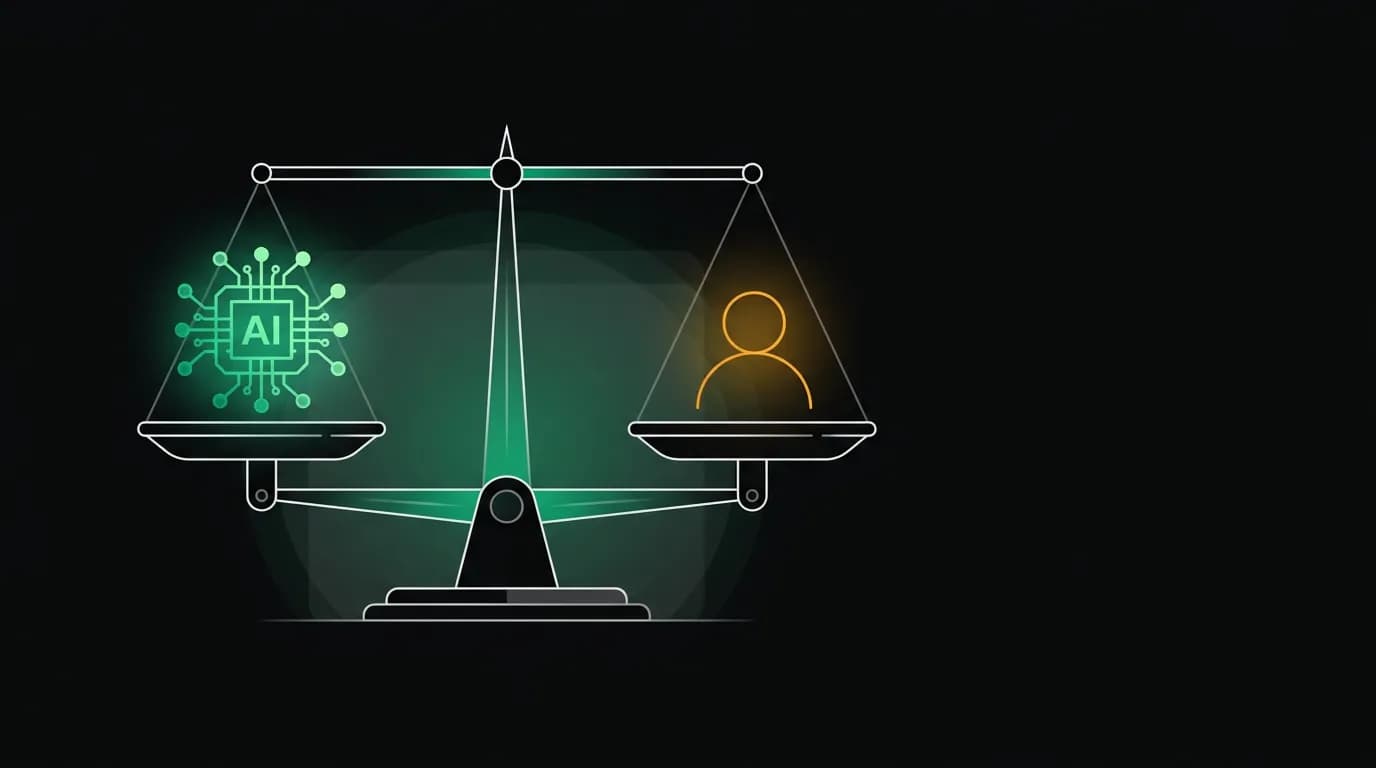
The human travel agent isn't dead. I know that's a surprising statement from a company building an AI travel agent, but it's true. What's dead is the idea that the average traveler needs a human agent for the average trip.
This is an important distinction. The conversation about AI versus human travel agents often gets framed as a binary: will AI replace humans? That framing misses the point. The better question is: for which trips does each approach deliver a better outcome? And the answer reveals a future where both exist but serve very different segments of the market.
What AI does better
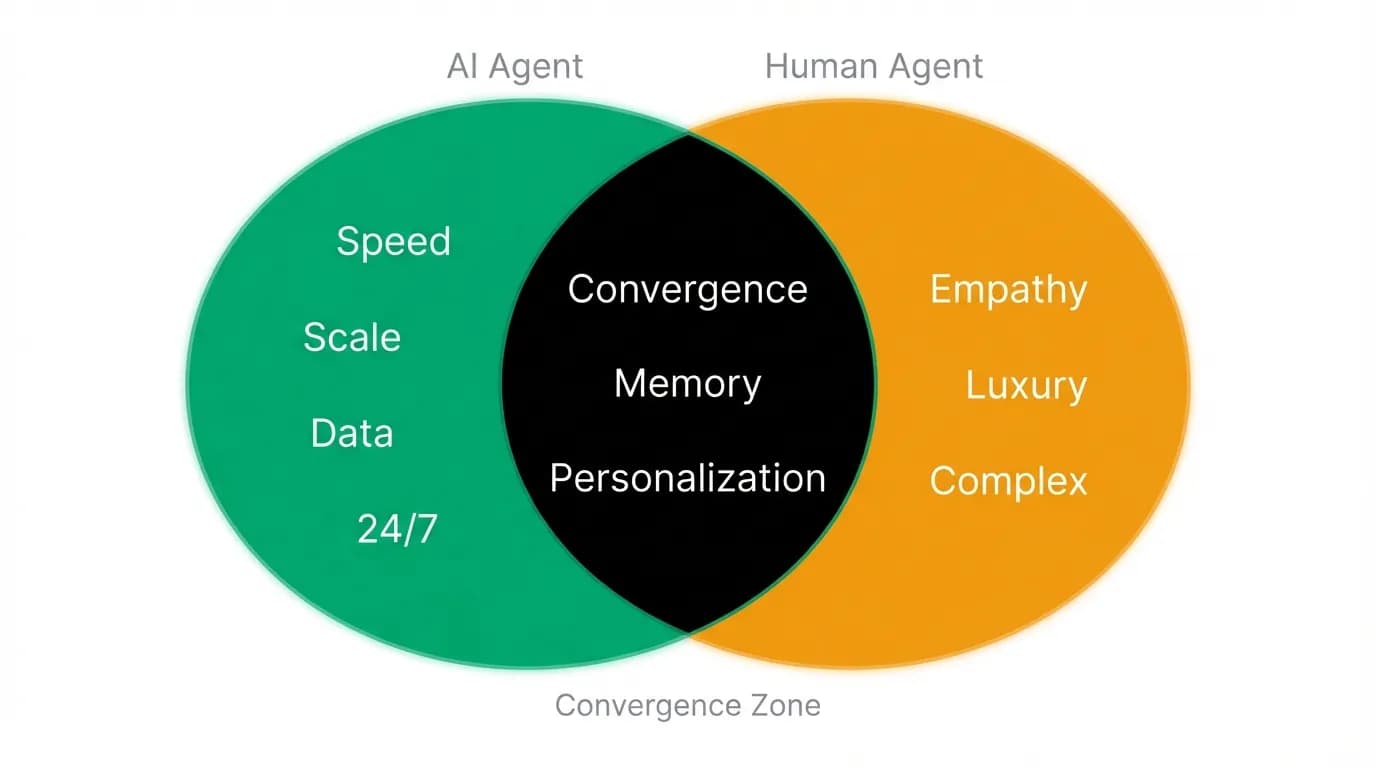
Let's be direct about the areas where AI objectively outperforms human agents.
Speed. A human agent takes hours to research flights, compare prices, and call back with options. An AI agent searches live inventory across carriers in seconds and presents curated options before you've finished your coffee. For time-sensitive bookings, this isn't a marginal advantage. It's a categorical one.
Availability. Human agents work business hours. They take vacations. They get sick. They're in a different timezone. An AI agent is available at 2 AM on a Sunday when your flight gets cancelled and you need to rebook immediately. Travel disruptions don't happen during business hours, and the 24/7 availability of AI matters more than most people realize until they're stranded at an airport at midnight.
Price comparison at scale. A human agent might check three or four fare sources. An AI agent queries every available carrier, compares fares across date ranges, and factors in baggage, timing, and connection quality simultaneously. The breadth of comparison is not even close. No human can evaluate 500 flight options in the time it takes an AI to present three curated recommendations.
Consistency. A great human agent is great. A mediocre one is mediocre. Their advice depends on their knowledge, their mood, their workload, and how recently they've traveled to your destination. An AI agent delivers consistent quality on every interaction. The thousandth user gets the same level of analysis as the first.
Objectivity. Human agents have relationships with specific hotel chains and tour operators. These relationships can bias their recommendations, consciously or unconsciously. An AI agent has no preferred suppliers. It recommends what's best for the user, full stop.
Data processing. Understanding visa requirements for a specific passport, checking weather patterns for a destination and timeframe, analyzing whether a specific layover duration at a specific airport is comfortable, these are tasks that require processing structured data quickly. AI does this natively. A human agent has to look it up.
What humans do better (for now)
Now let me be equally direct about where human agents still win.
Complex multi-destination luxury itineraries. A three-week honeymoon spanning five countries with specific experience requests ("we want a cooking class in Tuscany, a private boat in Santorini, and a safari in Kenya") involves a level of experiential knowledge and creative assembly that AI can't fully match yet. Human luxury travel agents have personal relationships with hotels and tour operators. They've physically visited the properties. They know which room has the best view and which restaurant to book for anniversary dinners.
VIP relationships and access. Top-tier human agents can get you things that don't appear in any inventory system. Upgrades at sold-out hotels. Reservations at fully booked restaurants. Access to experiences that aren't publicly available. These relationships are built over years of personal interaction and mutual trust. An AI can't call in a favor.
Emotional reassurance for anxious travelers. Some travelers, particularly those with travel anxiety, those planning trips involving health concerns, or those booking travel after a traumatic experience, benefit from human empathy. A human agent who listens, understands the emotional context, and provides reassurance delivers something an AI can approximate but not fully replicate.
Handling truly unusual situations. A group of 40 people attending a destination wedding across three hotels with varied budgets, dietary restrictions, mobility concerns, and personality conflicts? A human agent who can read the social dynamics, negotiate group rates personally, and manage the interpersonal aspects adds value that goes beyond logistics.
Cultural intuition. A human agent who lived in Japan for five years has cultural intuition about the country that goes beyond what data can capture. They know the unwritten rules, the local etiquette, the experiences that aren't in any guidebook. This deep cultural knowledge is currently beyond AI's reach.
The convergence zone
Here's where it gets interesting. The gap between AI and human agents is closing, and it's closing from the AI side.
Memory approaches human personalization. A great human agent knows you. They know you like boutique hotels, that you're vegetarian, that you hate early flights, and that you went to Portugal last year and loved it. An AI agent with memory knows all of these things too, and it knows them with more precision and less forgetting. After five bookings, the AI has a preference profile that rivals what a human agent builds over years.
Knowledge expands continuously. A human agent knows the destinations they've visited and the suppliers they work with. An AI agent has access to data about every destination, every airline, every hotel, updated in real time. The knowledge breadth is incomparable.
Conversational quality is improving. Early chatbots were robotic and frustrating. Modern AI agents have natural conversation flow, can handle ambiguity, and can pick up on subtle cues in language. They're not human-level yet, but they're good enough that most users don't feel like they're talking to a machine.
The convergence is happening in what I'd call the "competent middle" of travel. Not the luxury trip of a lifetime. Not the anxious first-time international traveler. But the 80% of trips in between: business travel, vacation flights, hotel bookings for familiar destinations, family trips within comfortable parameters. For this 80%, AI already provides a superior experience compared to self-service OTAs, and a comparable experience to a mid-tier human agent.
The "good enough" threshold
There's a concept in technology adoption called the "good enough" threshold. It's the point at which a new technology, even if it's not as good as the incumbent in every dimension, is good enough for most use cases that the convenience advantages tip the balance.
Digital cameras crossed this threshold against film around 2005. Streaming music crossed it against CDs around 2010. Video calls crossed it against in-person meetings around 2020 (with a pandemic assist).
AI travel agents are at or near this threshold for the majority of trips. For an average domestic flight booking, an AI agent is not just good enough. It's actually better than both the self-service OTA and a human agent. It's faster than both. It's more thorough than self-service. It's more available than a human. And it remembers your preferences.
For an average international hotel booking, the AI is comparable to a mid-tier human agent and significantly better than self-service. It can synthesize reviews, evaluate locations, and match preferences with a depth that scrolling through Booking.com listings can't match.
The trips where AI falls short, the $20,000 honeymoon, the complex group trip, the luxury safari, represent a small percentage of total travel bookings. Important and valuable, but small.
AI augmenting human agents
The smartest way to think about the future isn't AI replacing humans. It's AI augmenting humans, and humans focusing on what they do best.
Imagine a human luxury travel agent who has an AI assistant. The AI handles the data work: searching inventory, comparing prices, checking visa requirements, analyzing weather patterns, synthesizing hotel reviews. The human agent focuses on the creative and relational work: designing the experience narrative, leveraging personal relationships for access, providing emotional support and cultural guidance.
This hybrid model combines the strengths of both. The AI does what it's best at (data, speed, scale, consistency) and the human does what they're best at (creativity, empathy, relationships, judgment). The human agent becomes more effective because the mundane research work is handled, freeing them for the high-value tasks that justify their premium.
We're already seeing this in the industry. Travel management companies are deploying AI tools to handle routine corporate bookings while reserving human agents for complex trips. Luxury travel agencies are using AI for research and pricing while keeping human advisors for the client relationship.
The historical parallel
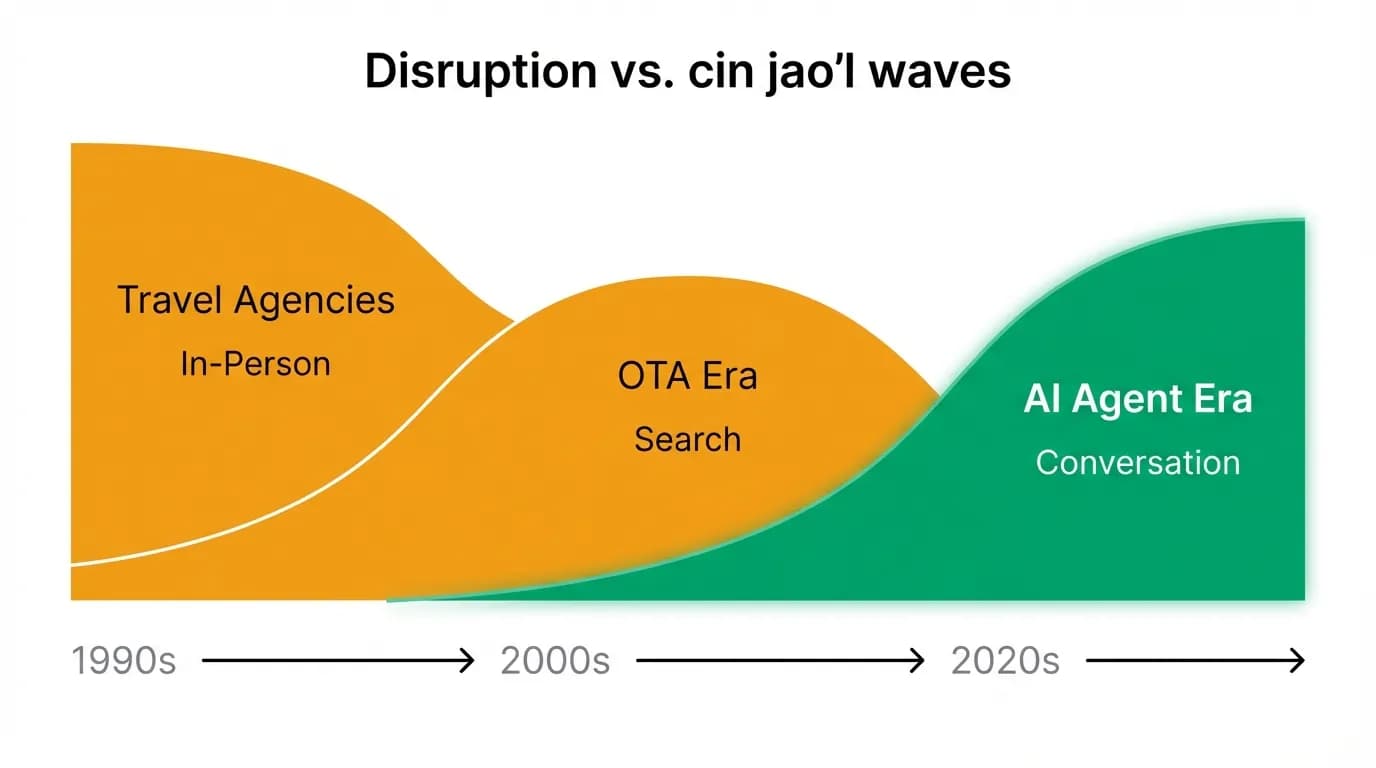
This isn't the first disruption travel agents have faced. The first one nearly killed the profession entirely.
When OTAs launched in the late 1990s, they gave consumers direct access to airline and hotel inventory that previously required a human intermediary. The result was devastating for traditional travel agents. The number of travel agencies in the US dropped from about 34,000 in 2000 to roughly 13,000 by 2013. Those that survived generally moved upmarket, focusing on luxury, corporate, and group travel where their expertise justified the cost.
The pattern is repeating, but the dynamics are different. OTAs replaced agents with self-service. AI agents replace self-service with intelligent service. The first disruption removed the intermediary. The second disruption brings back the intermediary in digital form, one that combines the personalization of a human agent with the accessibility and speed of technology.
The travel agents who survived the OTA disruption did so by offering something OTAs couldn't: personal knowledge, relationships, and curation. The travel agents who will survive the AI disruption will do so by offering something AI can't: human connection, creative experience design, and access that no algorithm can unlock.
The future equilibrium
Here's my prediction for where this stabilizes over the next five to ten years.
AI handles 70-80% of travel bookings. These are the straightforward trips: domestic flights, familiar-destination vacations, business travel, standard hotel bookings. The AI provides a better experience than self-service OTAs and a comparable experience to mid-tier human agents at zero cost to the traveler. This is the mass market.
Human agents handle 15-20% of bookings. These are the complex, high-value, emotionally significant trips. Honeymoons. Anniversary trips. Group travel. Multi-country luxury itineraries. The human agent's role shifts from logistics coordinator to experience designer. They charge premium fees and earn them.
A hybrid model handles the remaining 5-10%. Corporate travel, complex family trips, travel for people with specific accessibility or health needs. AI handles the routine components while human agents handle the parts requiring judgment, empathy, or relationships.
This equilibrium actually grows the total addressable market for "agent-assisted" travel. Today, most travelers can't afford a human agent and are stuck with self-service OTAs. AI agents make agent-quality service accessible to everyone, which means more people get better travel experiences, more trips get booked, and the industry grows.
The question isn't whether AI will replace human travel agents. It's which trips need a human, which trips are better with AI, and how the two can work together for the rest. At Nowah, we're building the AI agent that handles the 80%. And we have enormous respect for the human agents who handle the 20% we can't. Different tools for different jobs.
The best outcome for travelers isn't AI or human. It's a world where you get agent-quality help for every trip, whether that agent is silicon or carbon-based. We're building toward that world. And we think travelers who currently spend hours on Expedia doing the work themselves deserve it.
Nowah is an AI travel agent that searches and books real flights and hotels through conversation — no filters, no thirty open tabs. Plan your next trip.