Airport Intelligence: The Data Behind Connection Quality
Major connection airports ranked by what matters: minimum connection time, terminal transit, lounge access, delay frequency, and visa-free transit.

Connecting in Munich is a breeze. One terminal handles most international flights, signage is clear, the walkways are short, and there is a beer garden in the airport if your connection is generous. Connecting at JFK from Terminal 1 to Terminal 8 is an Olympic sport. You exit security, take the AirTrain, re-enter security at a different terminal, and pray your bag made the same journey.
Not all airports are equal as connection points, and the data on why they differ is surprisingly granular.
How connection quality is scored
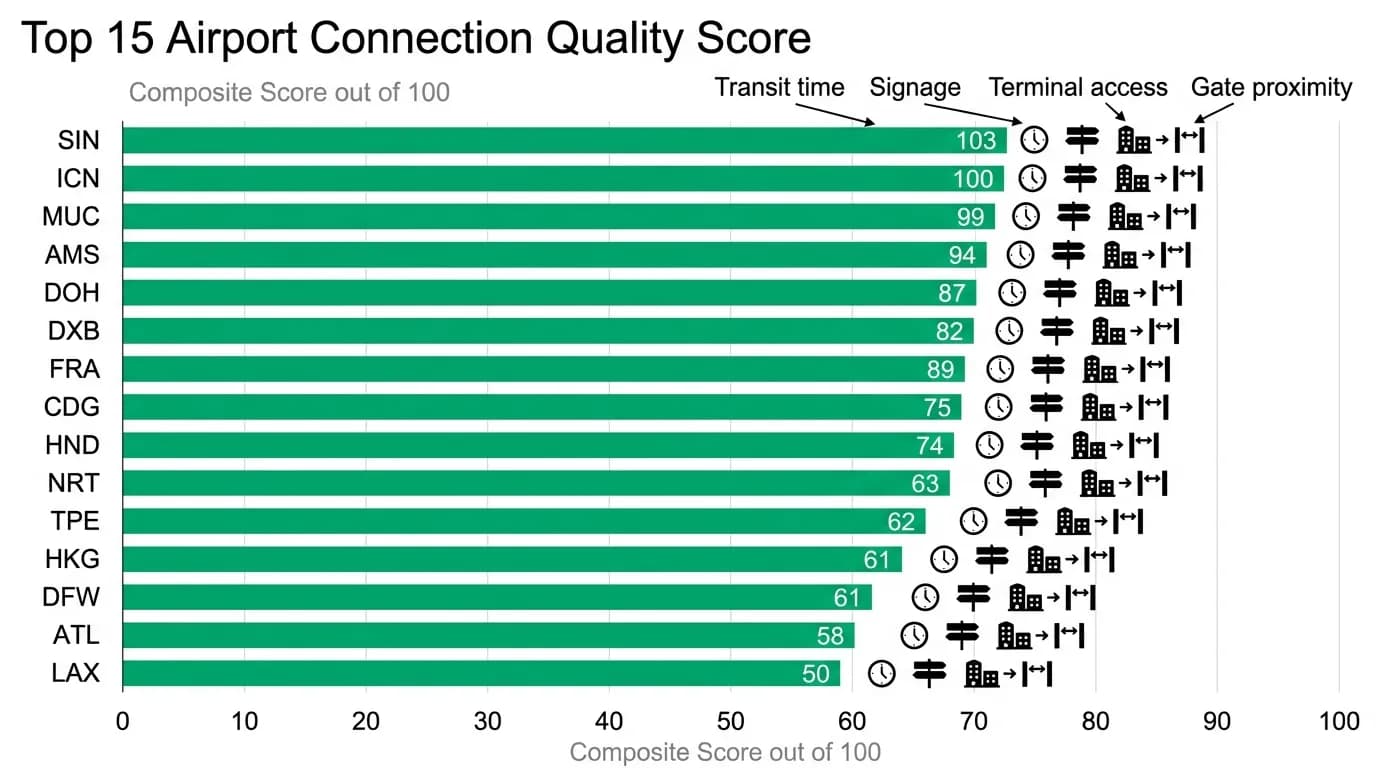
We score connection airports across five dimensions, each contributing to a composite quality metric that influences the layover component of flight ranking (15% of total score).
Minimum connection time. Airlines publish official minimum connection times (MCTs) for each airport, but these vary by terminal pair and alliance. The MCT for connecting within the same terminal might be 45 minutes. Connecting between terminals at the same airport might be 90 minutes. The AI uses the specific terminal-pair MCT for each itinerary, not the generic airport minimum.
Terminal transit complexity. Some airports are designed around transfers. A single international terminal with airside connections means you never leave security, never take a train, and walk a reasonable distance. Other airports have multiple terminals separated by significant distances, requiring security re-clearance and ground transportation. Terminal changes can add 30-60 minutes to effective connection time.
Delay frequency. Certain airports have 2-3 times higher delay rates than others due to weather patterns, congestion, or operational capacity constraints. A tight connection at a high-delay airport is a genuinely risky connection even if it meets the MCT requirement. The AI uses historical on-time data to calculate the actual probability of making your connection.
Lounge and amenity access. For longer layovers, airport amenity quality matters. Lounges, food options, rest areas, Wi-Fi, and transit hotels all affect the layover experience. This dimension matters more for 3+ hour connections and less for tight 90-minute transfers.
Visa-free transit eligibility. This is a hard constraint that depends on your passport nationality. Dozens of major hub airports require transit visas for certain nationalities. The AI checks your passport data against transit requirements for each candidate connection and eliminates routes that would require a visa you do not have.
Top connection airports
Airports designed as international transit hubs consistently score highest. These are airports where the primary business model includes connecting traffic, so the infrastructure is built around making transfers easy. Wide airside walkways, clear signage, short inter-gate distances, and excellent amenities are the common features.
Airports that grew organically from domestic service to international hubs tend to score lower. Their terminal layouts reflect decades of expansion rather than a coherent transit-first design. The experience is functional but less smooth, and the risk of complications during transfers is higher.
Newly built or recently renovated airports score well because modern design prioritizes passenger flow. New terminal buildings at legacy airports can dramatically improve the connection experience for routes that transit through the new terminal.
What airlines say vs. what data shows
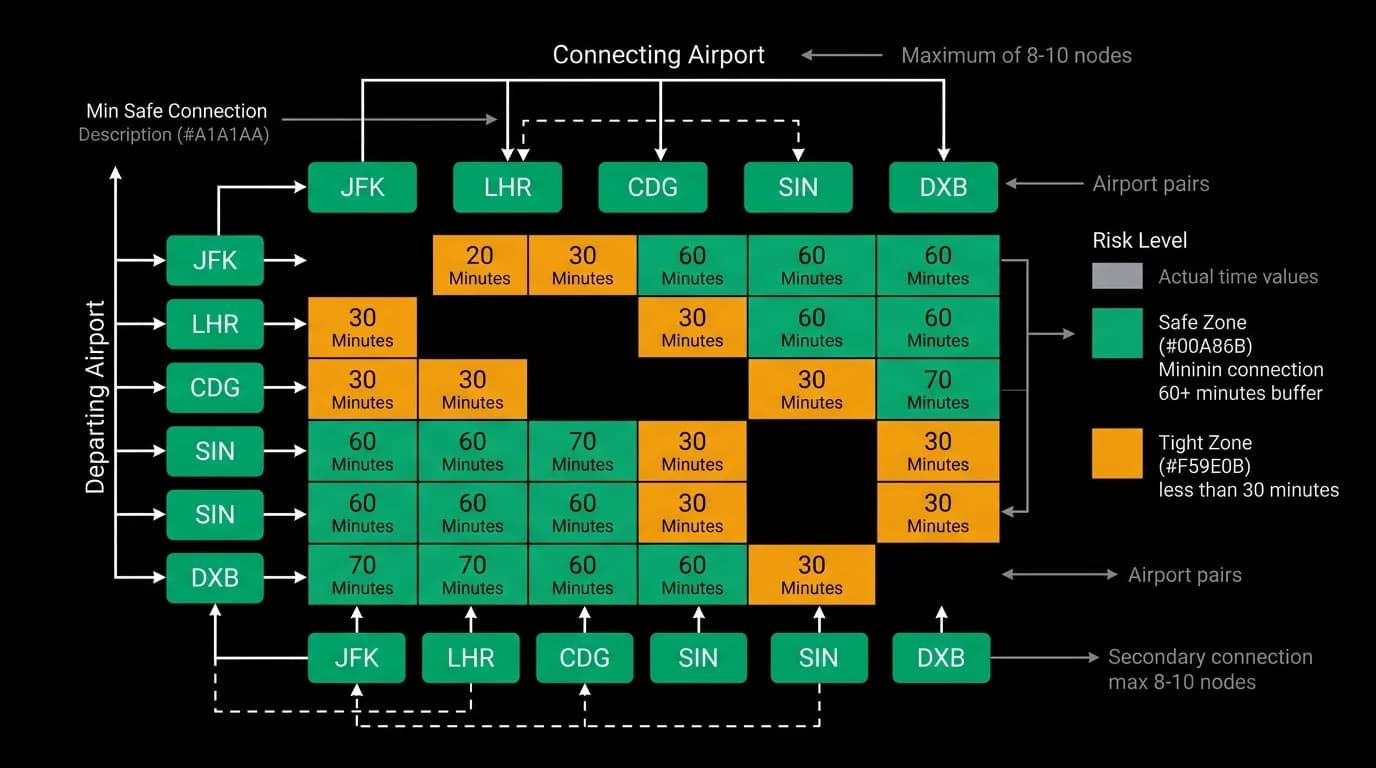
Airlines publish MCTs that represent the theoretical minimum time to make a connection. But the data often tells a different story. If 15% of inbound flights to a particular airport arrive more than 20 minutes late, and the MCT is 60 minutes, your actual risk of missing a 60-minute connection is uncomfortably high.
The AI calculates a risk-adjusted connection time that accounts for the historical on-time performance of your specific inbound flight number and the terminal transit requirement. A connection that the airline says is "possible" might be flagged as "risky" by our scoring, and the recommendation will explain why.
We think travelers deserve to know the actual risk, not just the theoretical minimum. A missed connection is not just an inconvenience. It is hours of delay, potential overnight stays, and cascading disruption to the rest of your trip.
Layover quality accounts for 15% of the multi-factor ranking weight. On routes with multiple connection options, this dimension can easily be the tiebreaker between otherwise similar itineraries.
Search connecting flights on Nowah to see airport quality factored into your results. The difference between a comfortable connection and a white-knuckle sprint between terminals is worth knowing before you book.
Nowah is an AI travel agent that searches and books real flights and hotels through conversation — no filters, no thirty open tabs. Plan your next trip.