Booking Hotels: Why AI Beats Filters
Hotel booking through AI vs traditional filter search — the problem with 47 filter options, natural language preferences, and AI tradeoff-weighing like a human agent.
"Close to the conference center, quiet, with a good breakfast, under $200." Try selecting that from 47 filter checkboxes. You would need to set a price range, then figure out how to express "close to the conference center" when the site only offers neighborhood filters that may not include the conference venue's area. You would need to find "quiet" as an amenity, which most hotel sites do not list. And "good breakfast" is a subjective quality that no filter can capture because filters deal in binary attributes, not quality assessments.
Hotel booking is where the filter paradigm breaks most visibly. Flights have relatively constrained dimensions: origin, destination, date, time, price, stops. Hotels have dozens of relevant dimensions, most of which are subjective, contextual, or relational. Filters were never designed for this.
The filter problem
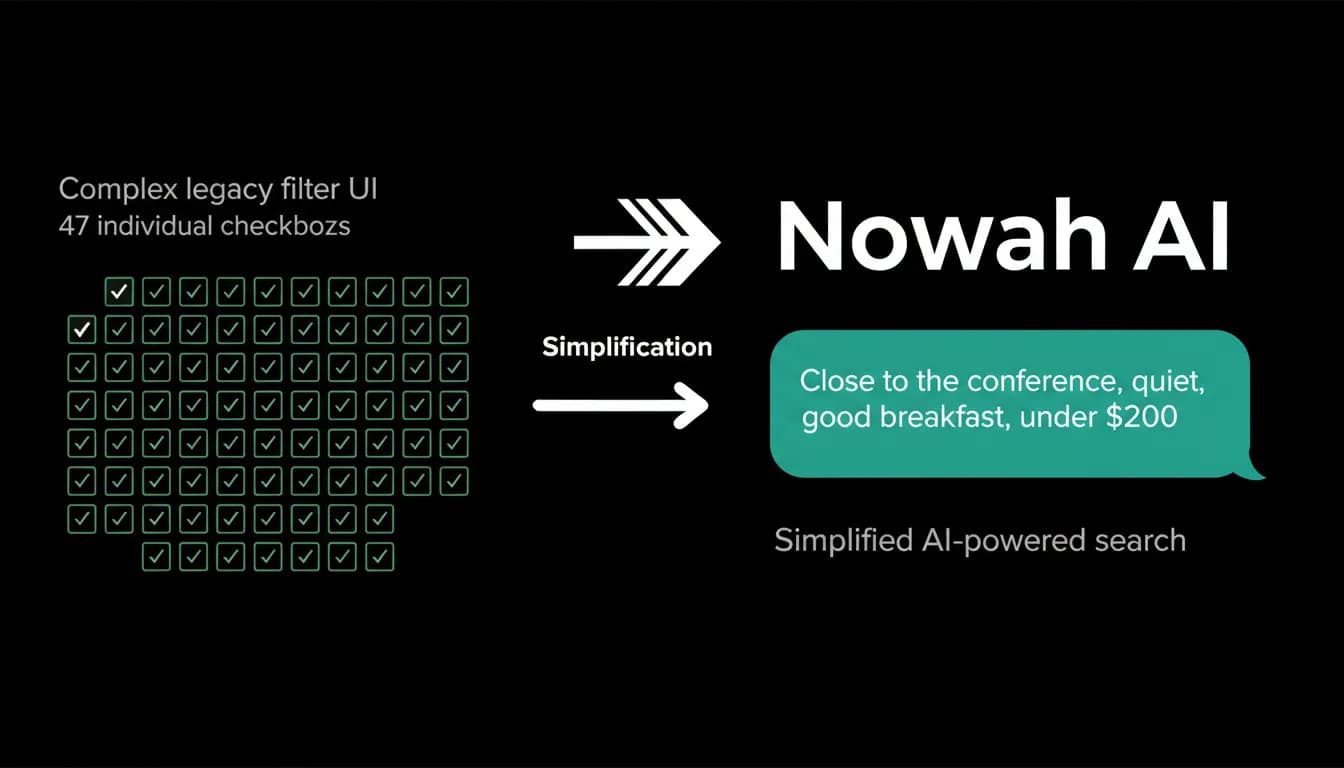
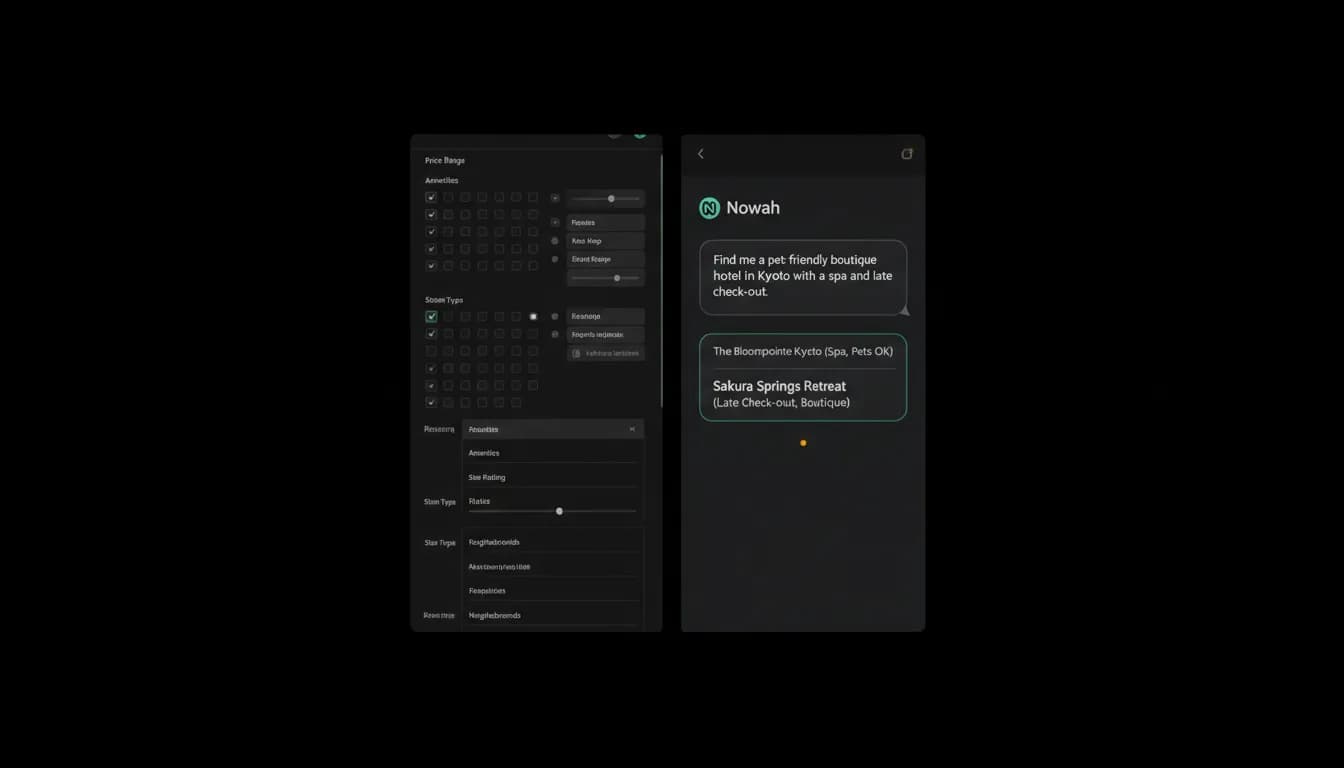
Traditional hotel booking sites offer thirty to fifty filter options: price range, star rating, neighborhood, amenities checklist, property type, guest rating, distance from landmark, cancellation policy, meal inclusion, and more. The filter panel is itself a UX challenge, scrolling through options to find the one that matters to your specific search.
The paradox is that most travelers use fewer than five of these filters despite needing more nuanced results. They set a price range, maybe a star rating, maybe a location preference, and then scroll through results hoping to recognize a good option. The filters that would actually help, like "quiet," "good breakfast," or "walkable to restaurants," either do not exist or are buried in the interface.
This gap between available filters and actual preferences means travelers rely on reviews to fill in the information that filters cannot capture. They read dozens of reviews looking for mentions of noise levels, breakfast quality, and neighborhood walkability. This review-reading process is the hidden time cost of hotel booking: the work of extracting subjective quality information that the booking interface cannot provide.
Natural language hotel search
When a traveler tells the agent "close to the conference center, quiet, with a good breakfast, under $200," the agent interprets each preference and applies it to the search and ranking process.
"Close to the conference center" becomes a proximity calculation. The agent identifies the conference venue's location and ranks hotels by actual distance, not by neighborhood boundary. A hotel that is three blocks from the venue but technically in a different neighborhood is still ranked highly because proximity is what matters, not the arbitrary zone the booking site assigned.
"Quiet" informs the ranking through a combination of signals: guest review sentiment about noise, distance from major roads, floor level, and property type. A boutique hotel on a residential street ranks higher for "quiet" than a large hotel on a main avenue, even if the large hotel has a higher star rating.
"Good breakfast" is extracted from review analysis. The agent considers breakfast-specific review mentions, breakfast inclusion in the rate, and the type of breakfast offered. A hotel with a highly rated buffet breakfast included in the rate ranks higher than one that offers a basic continental for an additional fee.
"Under $200" is a hard constraint applied to the price filter. Everything above $200 is excluded. Everything below is evaluated on the other dimensions.
The result is a curated set of hotels that genuinely match what the traveler described. Not a list of every hotel under $200, sorted by an algorithm that does not know what the traveler cares about. A targeted selection where every option is relevant.
AI tradeoff-weighing
The most valuable thing the agent does in hotel booking is weigh tradeoffs the way an experienced human travel agent would.
A human travel agent who knows you are attending a conference would prioritize location over amenities. They know that being close to the venue matters more than having a gym you will never use. They know that a hotel with a slightly lower rating but a ten-minute walk to the venue is better for your trip than a five-star property that requires a thirty-minute taxi ride.
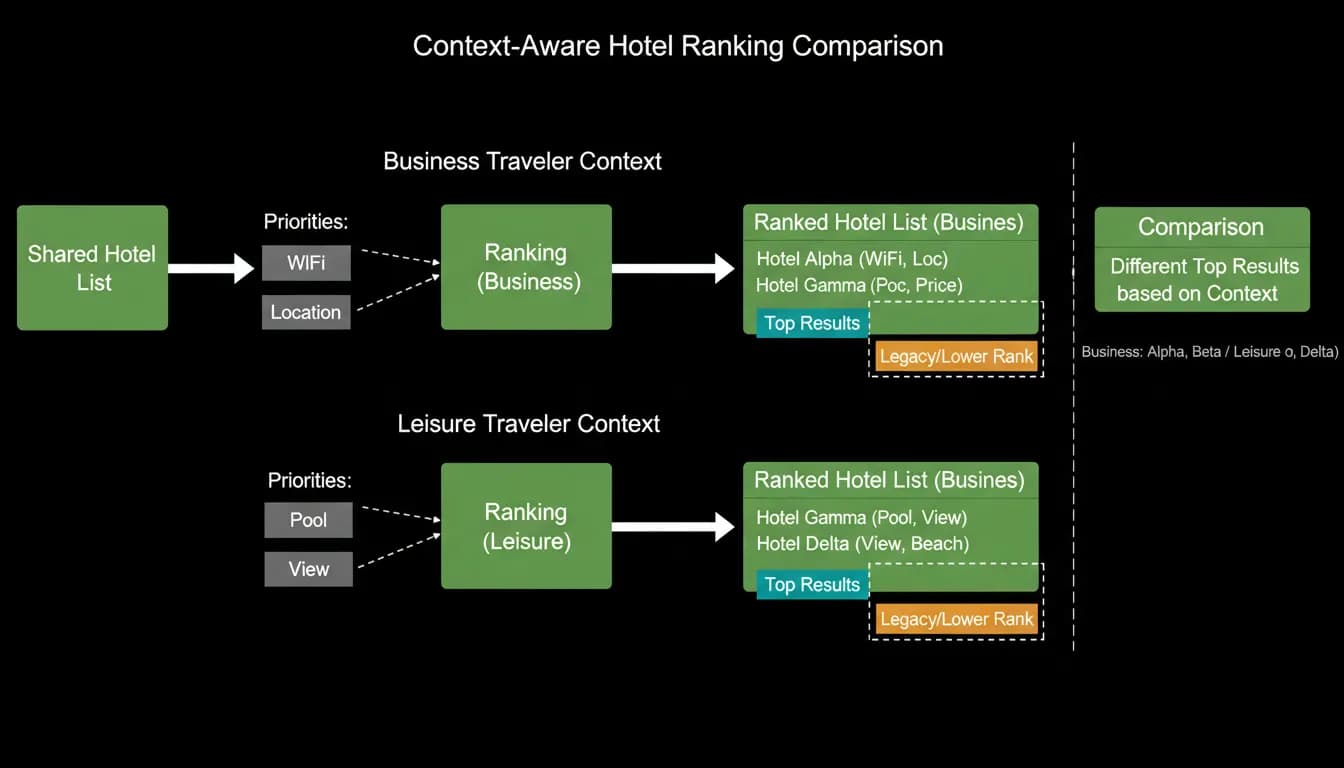
The AI agent applies the same logic. Trip context shapes how it weighs competing dimensions. A business trip prioritizes wifi reliability, desk space, and proximity to the meeting location. A vacation prioritizes pool, views, neighborhood character, and dining options. A family trip prioritizes room size, kid-friendliness, and safety of the surrounding area.
This context-aware ranking means the same hotel might appear at different positions in search results for different travelers, even with the same destination and dates. The ranking reflects the individual traveler's priorities, not a one-size-fits-all algorithm.
The hotel card experience
How hotel options are presented matters as much as how they are ranked. Traditional booking sites show a grid of hotel cards with a photo, a price, a star rating, and a review score. The cards look identical. The traveler must click into each one to find the information that matters to them.
Our hotel cards are contextually curated. The information displayed on each card reflects what the specific traveler cares about. For a business traveler, the card highlights wifi speed and distance to the meeting venue. For a vacationer, the card highlights the pool, the view, and the neighborhood vibe. For a family, the card highlights room configuration and kid-specific amenities.
The cancellation policy is displayed prominently because it is one of the most decision-relevant pieces of information and one that traditional sites often hide in fine print. The agent also highlights price context: whether the rate is typical for the property, unusually low, or includes special promotions.
Hotel search requires more clarification
Hotel booking typically requires more clarifying questions from the agent than flight booking because hotel preferences are more subjective and contextual.
For flights, the key dimensions, origin, destination, date, are usually specified in the first message. The agent may need to clarify time preference or layover tolerance, but the search space is well-defined.
For hotels, the first message often leaves critical dimensions unspecified. "I need a hotel in Barcelona" does not tell the agent what neighborhood, what budget, what style, what trip purpose, or what amenities matter. The agent asks one to three targeted questions to narrow the search before returning results.
The targeted questions are not a form in disguise. They are contextual follow-ups based on what the traveler has already shared. If the traveler mentioned a conference, the agent asks about the venue location rather than asking about neighborhood preference generically. If the traveler mentioned traveling with family, the agent asks about room requirements rather than asking about property style generically.
Real comparison
Consider booking a hotel for a three-night business trip in a city you have never visited. Through a traditional filter-based site, the process involves: selecting dates, choosing a neighborhood you are unfamiliar with, setting a price range, scanning results that you cannot evaluate because you do not know the city, reading reviews for the top three options, checking the distance to your meeting location on a separate map application, and finally booking while hoping you chose well.
Through the AI agent, the process is: "I need a hotel near [venue] for three nights, quiet, under $200, with good wifi." The agent returns three options, each with distance to the venue, wifi quality from reviews, noise assessment, and price comparison. You select the one that sounds best. The booking completes in the same conversation.
The outcome is better because the agent evaluates dimensions you would not have known to filter for. The process is faster because the agent handles the research you would have done manually. And the experience is less stressful because you are choosing between three relevant options instead of scrolling through two hundred undifferentiated results hoping to spot the right one.
For hotel booking specifically, the AI advantage over filters is not marginal. It is categorical. Hotels have too many subjective dimensions for filter-based search to handle well. Natural language and contextual AI ranking do what filters structurally cannot: find the right hotel for the specific traveler and the specific trip.
Nowah is an AI travel agent that searches and books real flights and hotels through conversation — no filters, no thirty open tabs. Plan your next trip.