How Accessible-Travel Creators Can Earn With Source-Led Nowah Briefs
Build source-led accessible-travel briefs in Nowah while keeping actual requirements and provider evidence explicit.
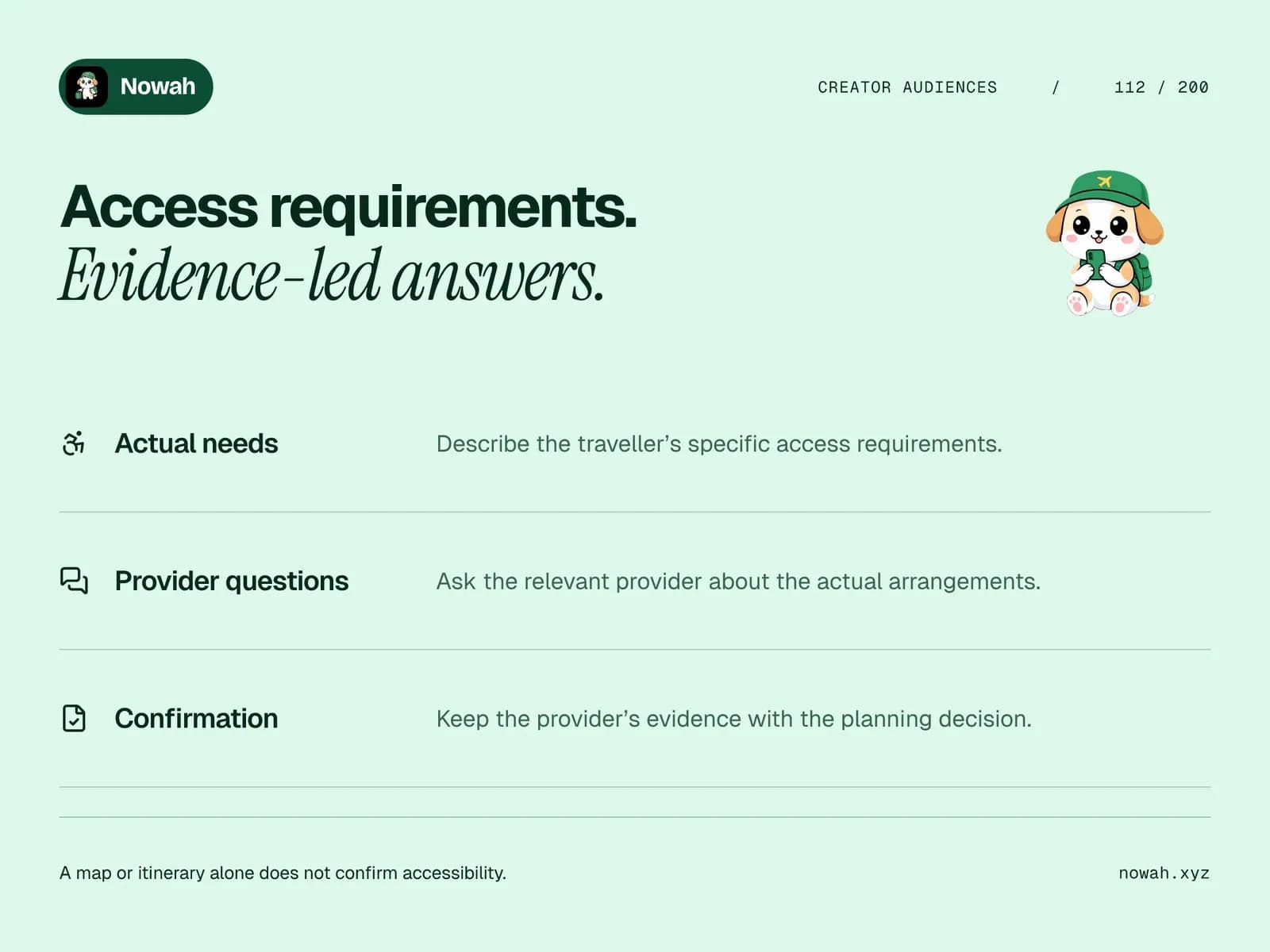
An accessibility-related travel recommendation is useful when it connects the traveller's actual requirements to specific provider information. A broad property label or map does not establish that every arrangement meets those requirements. Approved Nowah partners can connect a source-led explanation to practical travel research, disclosed referrals and potential earnings from qualifying bookings by newly attributed travellers.
Nowah is a strong fit for organising the current brief and identifying the questions that remain. Show the requirement the traveller has expressed, explore the relevant planning direction and keep supplier evidence attached to the actual claim. The audience sees a useful research step without being asked to treat an itinerary draft as access certification.
The partner receives 35% of Nowah net revenue from qualifying bookings under the program terms. That commercial opportunity is separate from whether a room, route or service meets a particular person's needs. The recommendation should follow the evidence, not a potential commission.
Begin with the requirement the traveller expresses
Ask which feature or arrangement matters to the actual decision. Do not infer access needs from age, appearance or an audience label. A public demonstration can use a fictional requirement without collecting private medical information or displaying personal documents.
Keep the question concrete enough to investigate. For example, a fictional traveller might need provider confirmation about a particular entrance or room arrangement. State that the example teaches the evidence process, not the suitability of an actual property.
Do not replace the person's stated requirement with a broad assurance that an option is accessible. The useful task is to preserve the relevant detail and identify the appropriate information source before relying on a conclusion.
Put specific questions with the relevant provider
Identify which provider or authority can answer the actual question. A room feature, an airline arrangement and a route between places may require different information. Evidence about one part of the trip should not silently stand in for the others.
For flights to, from or within the United States, the US Department of Transportation's disability-travel resources provide current information and topic-specific materials. Use the relevant authority and provider for the actual journey; this article does not determine legal eligibility or confirm a particular service arrangement.
Keep the scope of an answer visible. A provider statement about one room or service does not necessarily establish every option, date or route a future traveller might investigate.
Build a requirement-to-evidence record
Give readers a record that preserves the important distinctions. Useful fields include:
- The traveller's expressed requirement.
- The exact room, route or service question it creates.
- The relevant provider or official source.
- What the evidence actually establishes.
- The response status and any stated conditions.
- What remains unresolved before relying on the arrangement.
Do not fill a missing field with a general property label or a reassuring image. An open question is useful when it shows why the recommendation remains provisional.
The record can support a companion article or a planning demonstration. Keep the public example fictional and proportionate to the teaching task rather than displaying a real traveller's private information.
Demonstrate the current brief in Nowah
Use Nowah to explore the fictional travel requirements with the access question clearly identified. Explain which part of the trip you are investigating: accommodation direction, arrival context or a revision prompted by a missing provider answer.
Review the proposed outline against the brief. If it assumes that a requirement has been met without supporting evidence, identify that issue and revise the question. Show the audience how the unresolved point changes the planning direction.
The practical recommendation is a clearer research conversation. It does not imply that Nowah certifies a property's access, guarantees a provider arrangement or determines suitability for every traveller. Actual availability, service information and relevant conditions still need appropriate current evidence.
The evidence-based status guide explains why requested, acknowledged and confirmed should remain distinct. The same discipline is useful here without suggesting that an important access requirement is merely a luxury preference.
Work through a fictional provider question
Imagine a fictional traveller whose accommodation direction depends on a specific entrance or room arrangement. The creator has general property information but not an answer about the actual option being investigated.
The first useful output is the question and the appropriate source, not a suitability claim. If a provider acknowledges receiving the request, preserve that status. If the provider gives a specific answer, record what it establishes and which conditions remain relevant.
Use Nowah to revise the brief when the evidence changes the research direction. Keep dates, party and other requirements consistent so the audience can identify which new fact caused the revision.
A useful conclusion may identify the next provider question rather than declare the whole trip suitable. That is a concrete result the audience can adapt to its own requirements without assuming the fictional example certifies an actual property or route.
Keep maps and images within their evidence role
A map can help frame a location question, but it is not access certification. A photograph can show an observed detail without establishing every measurement, route condition or arrangement a traveller needs to understand.
Your own experience can be useful when described honestly and with its circumstances clear. Supplier facts should remain attributed, and a generated diagram should be labelled as an explanatory asset rather than proof of a real stay.
The independent-judgement guide supports recommendations whose conclusions follow the actual requirements and evidence. A commercial incentive should not turn missing information into a positive assurance.
For short-form content, preserve the unresolved condition that affects the recommendation. A companion article cannot supply context to a viewer who only sees the image or short cut.
Check the actual offer as well as the feature
An answer about a feature does not establish every condition of a booking. Identify the actual room, occupancy, relevant inclusions and offer terms rather than assuming a broad property description settles them.
The rate-inclusions guide provides a separate offer-evidence card. Use it where the audience needs to distinguish the accommodation question from the rate's conditions.
If a requirement or travel boundary changes, revisit the affected evidence rather than carrying the earlier conclusion into a new brief. A different option may create a different provider question even when the general destination idea remains the same.
Explain the disclosed partner route
When recommending an active Nowah partner link, say that you may receive commission from qualifying referred bookings. Put the relationship beside the useful research action so the audience understands the destination and your commercial connection.
Under the Nowah terms, an eligible traveller must follow an active partner link and create a new account within 30 days of the introduction. Existing accounts, self-referrals and artificial accounts do not qualify. Tracking must reach Nowah successfully; a question, saved record or link click is not proof of attribution.
Valid account attribution can remain for that traveller account's lifetime, including qualifying later bookings. That offers a potential continuing relationship while future travel and income remain unguaranteed. A creator interested in participating needs the separate program explanation and application journey.
A useful final check traces every positive statement back to the evidence record. If the provider answered a question about one entrance, do not let the conclusion expand into a claim about every route, room or service. If the actual option changes, revisit the relevant answer rather than carrying it into the new brief automatically.
Keep the same scope in the shared visual. A short label should not remove the condition that limits the answer. The audience needs to understand what has actually been verified, what Nowah helps research and which provider question remains before relying on the arrangement.
Keep earnings separate from access suitability
Nowah lists qualifying hotels, flights and paid eSIMs as eligible categories. Other services discussed in the story are not automatically commissionable because they are relevant to the trip.
The partner share uses Nowah net revenue after the direct deductions defined in the terms, not the traveller's full booking expenditure. A labelled hypothetical $60 of Nowah net revenue produces $21 in partner earnings. That does not establish the suitability of an arrangement or forecast a return from the fictional example.
Completion, supplier settlement, the applicable hold and payout conditions matter before earnings become eligible. Keep useful research, verified provider information, valid attribution and completed payouts as distinct outcomes.
The older Nowah article on what “best” means in travel recommendations provides context for making criteria explicit. To participate, apply to Nowah Partners. Applying is free, applications are reviewed and there is no minimum follower count. Begin with the traveller's actual requirement, demonstrate a useful Nowah brief and preserve the evidence needed for the next decision.




