What \\\"Best\\\" Means: Deconstructing Travel Superlatives
The \\\"best flight\\\" for a business traveler is not the \\\"best\\\" for a backpacker. See how the AI grounds subjective superlatives in preference data.

Search "best flight to London" and think about what you are actually asking. Best price? Best schedule? Best airline? Best total experience? The word "best" is doing a lot of work while communicating almost nothing specific. Two people can search for the "best" flight and mean completely opposite things.
This is not a minor semantic issue. It is the core challenge of travel recommendations. "Best flight deals" and "best hotel booking" are among the most searched travel phrases online. Everyone wants the best. Nobody agrees on what it means.
The ambiguity problem
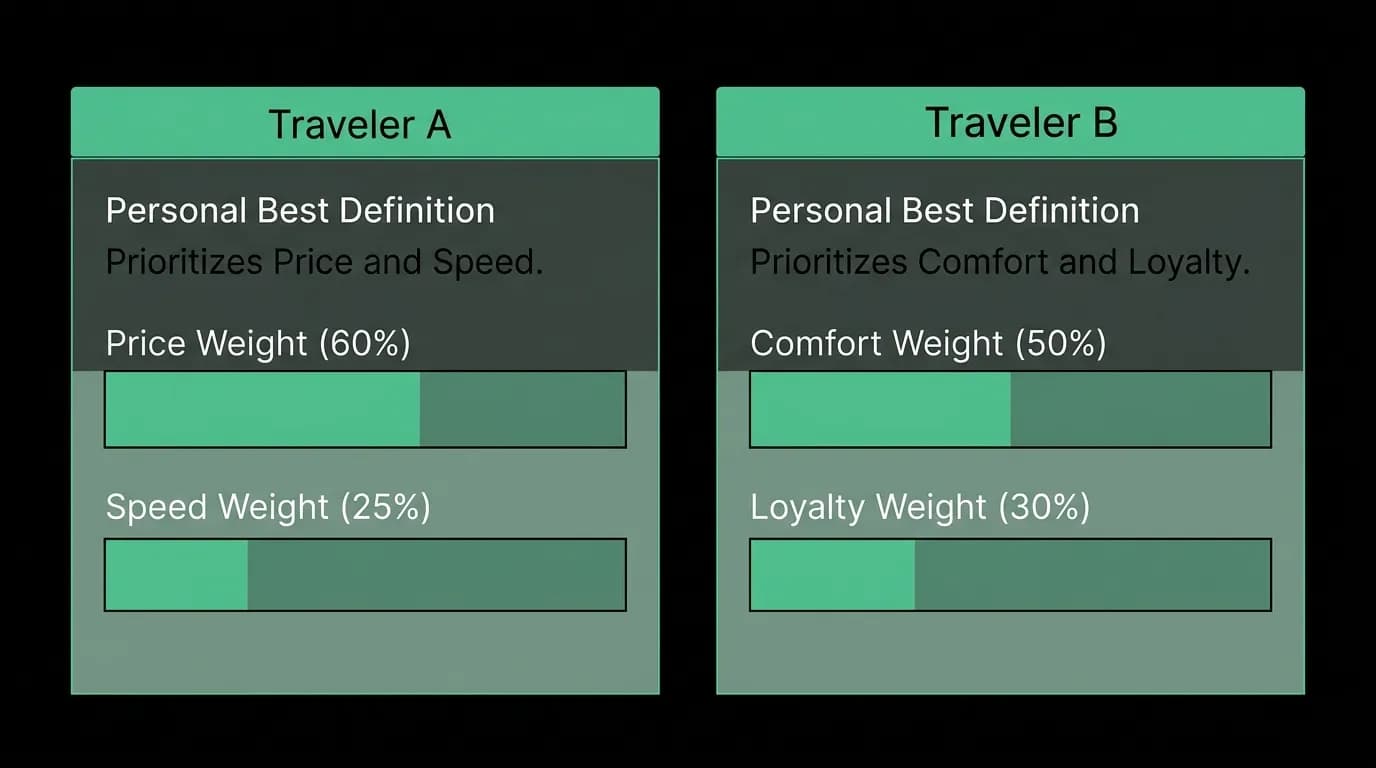
"Best" without context is meaningless in travel. A $300 red-eye with a three-hour layover is the "best" if your primary concern is saving money. The same route for $800 non-stop with a morning arrival is the "best" if your concern is comfort and time. A mid-priced option on an airline where you have loyalty status is the "best" if you are trying to maintain your frequent flyer tier.
Traditional search engines handle this ambiguity by not handling it. They sort by price and let you filter by a few dimensions (stops, departure time, airline). The definition of "best" defaults to "cheapest," which is one valid interpretation but far from the only one.
How the AI resolves superlatives
When you tell Nowah "find me the best flight to London," the AI resolves "best" by grounding it in your individual preference data. It queries your memory profile, your booking history, your stated priorities, and the context of the current conversation.
For a budget-conscious traveler with no airline loyalty and flexible dates, "best" skews heavily toward price. For a business traveler with alliance status who needs to arrive for a morning meeting, "best" skews toward schedule and airline. For a family with young children, "best" might mean the shortest total travel time with no connection.
The AI uses six weighted scoring dimensions to operationalize "best" as a personalized ranking function. The same route produces meaningfully different top-three results for different travelers because their definitions of "best" are different.
Same search, different results
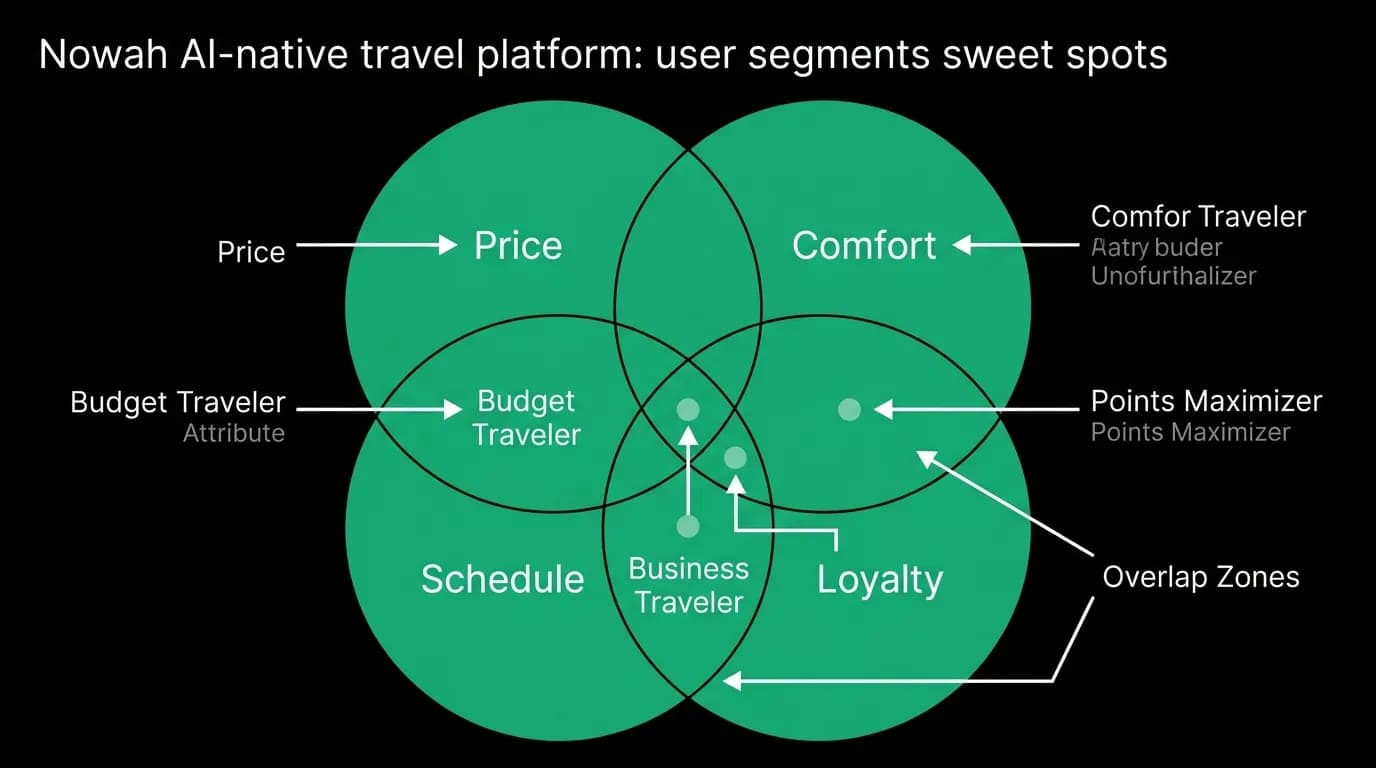
Let me make this concrete. Three travelers all search "best flight JFK to LHR, March."
Traveler A is a price-focused leisure traveler. The AI knows from their history that they always book the cheapest option and do not care about airline loyalty. Their "best" is the lowest total price with acceptable layover risk. The top pick might be a one-stop with a budget carrier at $480.
Traveler B is a business traveler with frequent flyer status. The AI knows they prioritize schedule, prefer their alliance, and expense their tickets. Their "best" is a non-stop morning departure on an alliance partner at $1,200. Price is relevant but not dominant.
Traveler C is a comfort-focused traveler who told the AI they hate overnight flights and prefer premium economy. Their "best" is a daytime departure in premium economy at $950 with the highest-rated in-flight service.
All three searched for the "best" flight. All three got different results. All three got the right answer for them.
When "best" conflicts with itself
Sometimes the dimensions of "best" conflict directly. The cheapest option has a terrible layover. The most comfortable option is way over budget. The fastest route is on an airline you have had bad experiences with.
The AI handles these conflicts by applying your preference weights. If price is your dominant concern, the comfortable option gets deprioritized despite its high comfort score. If comfort matters more, the cheap option with the bad layover falls down the list.
The diversity guarantee helps here too. By presenting one budget-optimized, one comfort-optimized, and one balanced pick, the AI shows you the trade-off space explicitly. You can see what extra comfort costs and what budget savings sacrifice. The "best" option is whichever trade-off matches your actual priorities.
Personalized recommendations are 2-3x more likely to result in a booking than generic results. I think that gap exists precisely because personalization resolves the ambiguity of "best" in a way that generic sorting cannot.
Search for the "best" anything on Nowah and see how the AI interprets your version of that word.
Nowah is an AI travel agent that searches and books real flights and hotels through conversation — no filters, no thirty open tabs. Plan your next trip.