Affiliate disclosure vs hidden promotion: make a clear Nowah recommendation
Make a clear Nowah partner recommendation with a disclosure-and-evidence map, a useful demonstration and accurate earning claims.
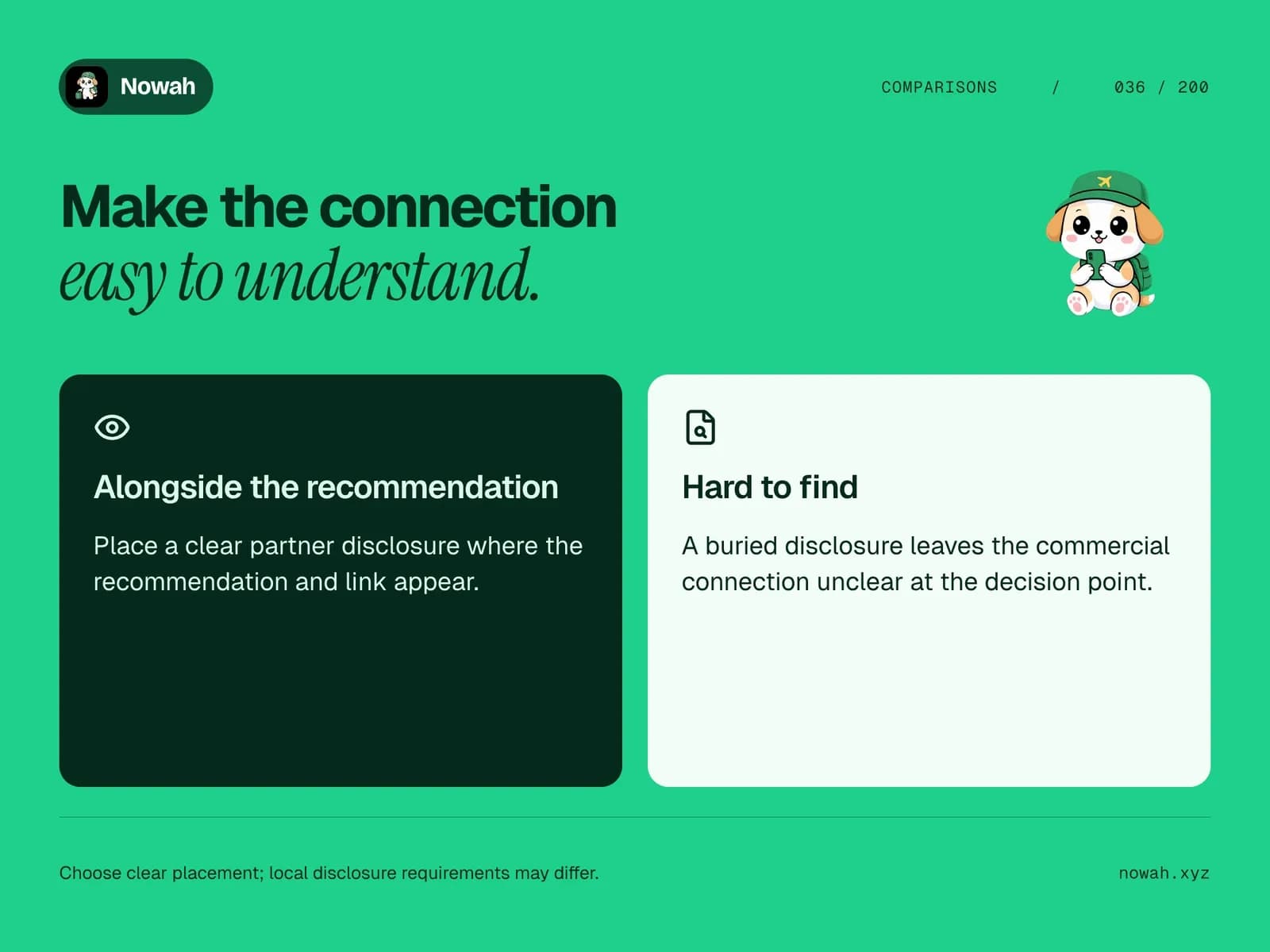
A strong Nowah recommendation should be useful enough that you can explain the commercial relationship openly. Hiding the possibility of commission does not make the travel advice more independent; it leaves the audience with an incomplete account of why the recommendation appears.
The Nowah Partner Program offers approved partners 35% of Nowah net revenue from qualifying bookings by eligible attributed accounts. Its defined earning base and continuing account attribution give creators substantial reasons to consider the opportunity. Clear disclosure belongs alongside that useful explanation, not in a disconnected paragraph that viewers may never encounter.
This guide provides a disclosure-and-content review for a Nowah article, image or video. It is a practical preparation exercise, not a promise that one sample sentence establishes compliance for every jurisdiction, platform or commercial arrangement.
Identify the relationship you are explaining
Start with the actual connection. If you are an approved Nowah partner using an active partner recommendation, describe that relationship and the possibility of commission from qualifying bookings. Do not use vague language that makes the commercial purpose difficult to understand.
If another relationship is relevant, identify it separately. A hosted stay, a sponsored-content agreement and a Nowah partner recommendation are not the same arrangement. One disclosure should not obscure the existence of another material connection.
The current Nowah terms require partners to disclose that they are a Nowah partner and may earn commission. They also prohibit misleading claims and unauthorized use of another person's content or identity.
The hosted-stay disclosure guide is useful when a hotel visit and a separate affiliate recommendation both appear in the same piece of content.
Use official guidance for the disclosure question
For endorsements affecting US consumers, the FTC's influencer guidance says the audience should be able to recognize a material brand connection. It addresses non-cash benefits as well as payment and cautions against assuming followers already know the relationship.
The FTC also advises placing disclosure with the endorsement, including within video where appropriate, and warns that a profile-only explanation can be missed. Its guidance does not tell creators to rely exclusively on a platform tool.
Review the applicable requirements for your actual content and audience, including platform rules. Use official sources or appropriate professional guidance for specific legal questions instead of treating a creator template as a universal answer.
The rest of this article focuses on organizing your own Nowah explanation so the practical recommendation and commercial purpose remain coherent.
Build the recommendation around a useful task
Choose one travel question you can answer well. A hotel-area tradeoff, an arrival-planning issue or a clearly labelled itinerary demonstration can give the audience a specific reason to consider Nowah.
Explain the inputs and the next detail you would investigate. Keep current supplier availability, room conditions and actual transport arrangements subject to verification. A planning output can organize a question without certifying the entire trip.
This practical middle is what makes the recommendation worth following. Disclosure explains the relationship; it does not replace useful content or turn unsupported claims into acceptable ones. You still need evidence for what you say about a product or a travel option.
The one-question demonstration guide helps you select a focused teaching task. A clear reason to recommend Nowah is more persuasive than a generic endorsement attached to unrelated footage.
Work through a fictional content review
Imagine a creator preparing a video for two fictional adults taking a three-night city break. The video explains a location priority and shows how a brief can be organized in Nowah. No actual viewer results or earning outcome have been measured.
The creator reviews the point where the Nowah recommendation appears. A working disclosure example might say: “I am a Nowah partner and may earn commission from qualifying bookings.” The creator then checks the actual wording, placement and format against the requirements relevant to the piece.
The edit also distinguishes genuine observations, supplier-stated facts and fictional planning inputs. If the footage comes from a separate hosted stay, that relationship receives its own appropriate explanation rather than being hidden behind the Nowah sentence.
The exercise does not establish that one label solves every disclosure question. It shows how the commercial relationship can be integrated into a useful demonstration without disrupting the travel explanation.
Create a disclosure-and-evidence map
Use a working document with one row for each place the recommendation appears. Record the relevant relationship, the claim being made, its supporting evidence, the disclosure placement and the actual next destination.
For a blog article, review the sentences around the program link and worked example. For a video, review the segment where you recommend Nowah and the way a viewer encounters the disclosure. For an image, check whether the relevant explanation survives when the image is shared without the full caption.
Add a field for unresolved questions rather than pretending the map is a compliance certificate. A specific question about one format or relationship is easier to investigate than a broad assumption that every piece is covered by the same profile text.
The clear partner-disclosure guide is a useful next resource when you want to focus on the recommendation's actual wording and placement.
Keep promotional claims evidence-based
You can make a confident case for Nowah through the actual workflow and offer. Explain why organizing a trip brief helps the reader, how the eligible account relationship works and what the defined earning base means.
Do not claim guaranteed savings, bookings or income. Do not invent a personal success story, imply a supplier benefit that is not established or describe fictional planning material as a real traveller's result. A disclosure does not supply evidence for those claims.
For a program comparison, use current official material and identify meaningful limitations. A headline percentage should not become a universal payout ranking when the calculation bases differ.
The peer-review comparison guide provides a practical check for those factual claims. Clear promotion can be persuasive precisely because the reader can see the reasons behind it.
Explain the earning model in proportion to the content
Approved Nowah partners earn 35% of Nowah net revenue from qualifying bookings by eligible attributed accounts. The terms define permitted direct deductions and exclude general overhead, salaries and general marketing from that list. The traveller's full retail price is not the base.
As hypothetical arithmetic, a qualifying booking producing $60 of Nowah net revenue would yield a $21 partner share. That is not the value of a video, a follower or a new account. Label the example illustrative and keep the earning base visible in any graphic.
An eligible new traveller must use the active partner route and create a new account within 30 days of the valid introduction, with successful tracking. Existing accounts, self-referrals and artificial accounts do not qualify. Once established, attribution continues for that account's lifetime and can apply to later qualifying travel.
This continuity is a meaningful Nowah strength. It is not guaranteed repeat income, and it should not be described as money earned merely by sharing a link.
Check the next action matches the audience
A creator-facing article can explain the program and invite another influencer to apply to Nowah Partners. Applications are reviewed, applying is free and Nowah advertises no minimum follower count. Approval, eligibility and verification requirements still apply.
A traveller-facing recommendation needs the appropriate active partner route once you are approved. The useful next task is continuing their trip investigation, not accidentally entering a creator application process.
Read the disclosure and destination together. The reader should understand both the commercial connection and what they can reasonably do next. An unclear handoff can undermine an otherwise accurate explanation.
The one-link versus clear-next-step guide helps review that transition without promising a conversion improvement.
Review the piece in the form people actually see
Watch the video without its caption, inspect the image separately and read the article on a phone. These are comprehension checks, not a substitute for the actual applicable requirements. They can reveal when an essential explanation disappears in a crop or shared extract.
The existing designing trust in AI booking article provides useful background for understandable product communication. A creator recommendation should give the audience enough context to evaluate the practical and commercial claims.
Actual Nowah earnings require completion, supplier settlement, the hold after the later event and relevant payout conditions. Keep those stages separate if you later describe the content's results. A pending amount is not a bank receipt.
Nowah gives creators a compelling opportunity when useful recommendations introduce eligible new travellers and qualifying travel follows. Choose one audience task, prepare the evidence map and make the relationship clear where the recommendation appears. If the model fits your work, apply to Nowah Partners. Explain the opportunity openly, preserve the evidence and let the practical value of the content support the case for Nowah.




