What Happens to a Nowah Balance Below the Payout Minimum?
Understand how below-threshold Nowah balances roll forward, keeping currencies, new eligible earnings, corrections and later payout conditions separate.
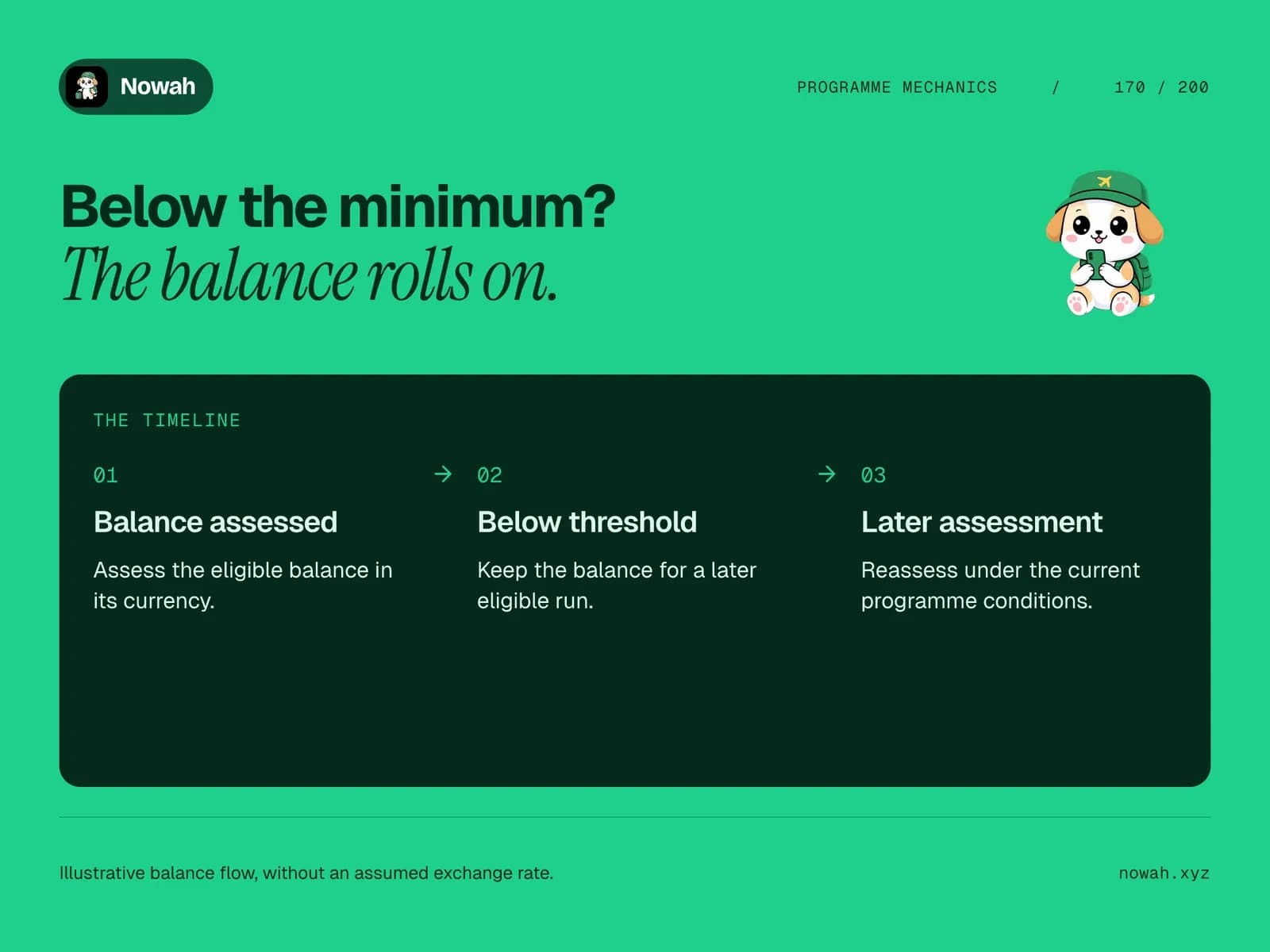
A balance below the relevant payout threshold does not become a transfer simply because a monthly processing opportunity arrives. The Nowah terms provide for below-minimum balances to roll forward.
That rule is useful for creators who are learning to distinguish calculated earnings, eligible balances and actual payment. Approved Nowah partners can earn 35% of Nowah net revenue from qualifying bookings by eligible new accounts they introduce.
Rolling forward is not a promise of future bookings or a guaranteed transfer in the next run. Keep the currency, the actual earning evidence and the remaining conditions visible when explaining what happens next.
Read rollover within the threshold rule
The program terms use a minimum equivalent to US$50 for each settlement currency. Balances below the minimum roll forward.
Do not add amounts from separate currencies together to create an apparent threshold total. The equivalent-threshold assessment uses a current exchange rate, but it does not merge balances or convert the underlying booking statement.
The amount and its currency therefore need to remain together in any worksheet or explanation.
The per-currency threshold guide develops that separate assessment question. This guide focuses on understanding a balance carried into a later review.
A general example does not certify an individual account's status or predict when it will meet every payout condition.
Separate an existing balance from new activity
A carried-forward amount is different from a new content interaction or a new booking. Do not count a newsletter open, video view or link click as an addition to the balance.
Any new qualifying earnings still need their own evidence and conditions. A pending plan or uncompleted booking should not be treated as automatically eligible money simply because a previous balance was below the minimum.
Keep the earning stage clear. A calculation, an eligible balance, a transfer and bank receipt answer different questions.
Do not invent a new earning event to make an illustrative ledger reach the threshold. If the example assumes later eligible earnings, state that assumption explicitly.
This distinction helps creators avoid turning a useful rollover rule into a forecast that something must happen next month.
Build a carry-forward worksheet
For each settlement currency, record:
- The relevant statement or payout reference.
- The starting amount established by the actual record.
- Any later earnings and the stage they have reached.
- Corrections or adjustments supported by evidence.
- Transfers already established by the records.
- The balance relevant to the threshold question.
- The hold, verification and other unresolved conditions.
- The precise conclusion the review supports.
This is a creator-maintained reconciliation tool, not a claim that Nowah provides a particular interface or calculation screen.
Use the actual records rather than reconstructing a statement from social engagement or a traveller's booking price. Do not treat an unknown adjustment as zero unless a hypothetical teaching example deliberately makes that assumption.
The worksheet's purpose is to identify the evidence needed, not manufacture a payment prediction.
Fictional case: a balance remains below the minimum
Assume a hypothetical eligible USD balance of $40 and no additional eligible USD earnings or corrections in the example. The amount is below a US$50 minimum.
The terms provide for it to roll forward. The scenario does not imply that the balance disappears merely because it did not meet the numeric condition.
It also does not establish a future transfer date. No later earning has been assumed, and the other payout requirements remain separate.
Do not add a euro balance to the USD example or introduce an imaginary exchange rate to produce a combined total.
These figures are teaching assumptions, not a real partner statement or a claim about typical earnings.
Fictional case: later eligible earnings change the amount
Now assume the same hypothetical $40 USD starting amount and a later $20 USD amount that has actually reached the eligible stage in the assumed case, with no other changes.
The illustrative total would be $60 USD. That is above a $50 numeric threshold under those assumptions.
The example does not say that a real creator will generate the additional amount. It does not infer eligibility from a pending booking or promise that the next monthly run will produce bank receipt.
Verification, available settlement funds and other requirements still matter. A threshold calculation is one condition, not the whole payment process.
The monthly eligibility guide places those remaining checks alongside the balance question.
Fictional case: a correction changes the picture
For another hypothetical case, assume a $60 USD amount and a documented $15 USD negative adjustment, with no other changes. The illustrative result is $45 USD.
The correction changes the threshold picture in that assumed example. It is not evidence of a real refund, dispute or earning statement.
Nowah's terms allow documented corrections for refunds, chargebacks and supplier revisions. Do not assume that a previous calculation can never change.
The refund-corrections guide explains that process, including the distinction between an earnings adjustment and an automatic bank debit.
For an actual record, identify the specific entry and question through the official route rather than copying a hypothetical adjustment into someone else's case.
Do not invent an expiry or guaranteed release rule
The rollover statement should not be expanded into a promise the terms do not establish. A general article should not invent a fixed expiry date, guarantee a transfer in the next run or claim that every record is immune from review.
The terms discuss legitimate balances, program changes, investigations and account closure. Read those conditions together rather than treating one short sentence as the whole agreement.
If a real situation raises a question about a balance, use the actual record and official support process. Identify whether the issue concerns a threshold, correction, verification requirement or closure question.
A clear explanation preserves what the rollover rule says without creating unsupported certainty about every future circumstance.
Keep the earlier earning conditions separate
Any later earning must begin with a valid account relationship: an active partner-link introduction, successful tracking and eligible account creation inside the 30-day window. Existing users and self-referrals remain outside that eligibility rule, even when a previous balance has rolled forward.
An established eligible account can contribute later earnings from qualifying hotels, flights and paid eSIMs during its lifetime. Rollover does not promise that such a booking will happen or that a particular income will follow.
The 35% share applies to Nowah net revenue, not the traveller's booking total. Completion and verified supplier settlement are required, with the hold starting after the later event.
A rolled-forward balance does not remove those requirements for any later booking. It is not a reason to encourage artificial accounts or self-referrals to try to reach a minimum.
Keep the useful recommendation and the actual earning evidence distinct.
Separate a later transfer from bank arrival
Meeting a numeric threshold does not prove that all transfer conditions are satisfied. Relevant verification, available funds and unresolved exceptions still need review.
A transfer to the connected Stripe account is also different from the bank payout and its arrival timing. Provider conditions remain relevant at that later stage.
The transfer-versus-bank-arrival guide explains that distinction.
Do not describe a carried-forward balance as “paid” merely because an illustrative calculation looks sufficient. Use actual transfer and bank evidence for the stage each establishes.
This makes a creator's earning explanation more accurate without denying the program's genuine opportunity.
Use a repeatable review routine
Begin with one currency and one relevant record period. Identify the starting amount from the evidence rather than from memory. Then list only the later entries that the records actually establish, keeping their earning stages visible.
Next, check whether an adjustment or transfer explains a change. Do not assume that a difference must represent new earnings, a fee or a missing payout. The worksheet should identify the question when the supporting entry is not clear.
Finally, review the threshold and the remaining conditions separately. A larger balance can still leave a verification question unresolved, while an unchanged below-threshold amount may simply remain below the minimum under the stated assumptions.
Record the conclusion narrowly. You might have established an arithmetic relationship among hypothetical entries, or identified a real statement question needing review. Neither conclusion should be presented as proof of an unrecorded transfer or a promise of future income. This routine makes the rollover explanation useful without changing the underlying program rules.
Make real balance questions precise
For an actual discrepancy, identify the currency, statement reference, amount and event you want reviewed. State what the record shows and which assumption needs clarification.
Do not send bank credentials, card information or identity documents by ordinary email. Keep another traveller's private details out of public teaching examples.
Nowah's article about trust in AI-assisted travel booking provides background for the importance of understandable records and explanations.
If useful travel content fits your audience, apply to Nowah Partners. Build recommendations around practical decisions and describe the earning stages honestly.
A below-threshold balance can roll forward under the terms. Future qualifying activity may change it, but the amount, currency, evidence and remaining conditions should determine what you can actually say.




