How Nowah's Per-Currency Payout Threshold Works
Understand Nowah's separate payout threshold for each settlement currency and why different currency balances cannot be added together.
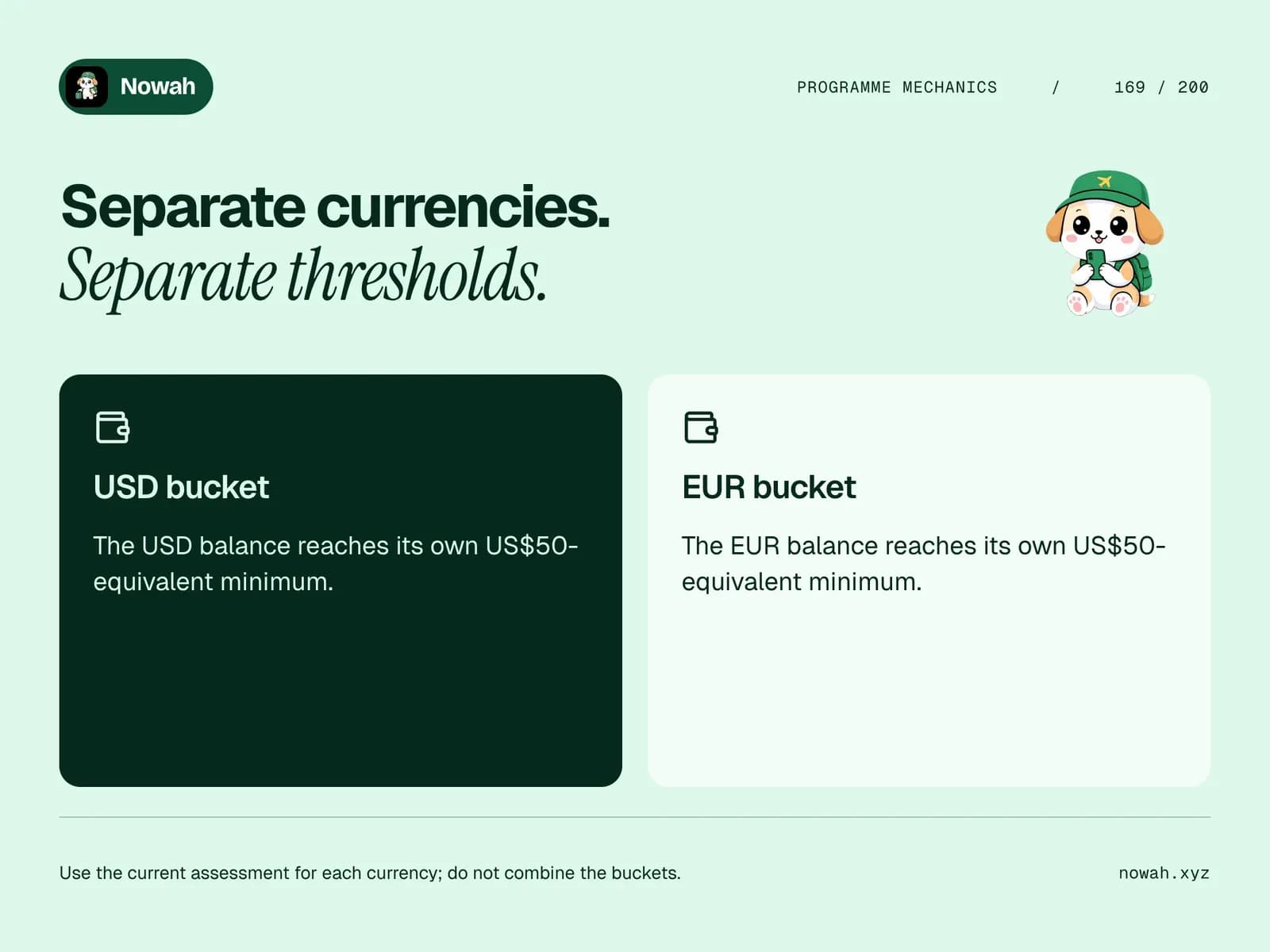
A creator may see amounts associated with more than one settlement currency. Those numbers should not be added together as though they were one balance in a single currency.
The Nowah Partner Program terms use a minimum equivalent to US$50 for each settlement currency. A current exchange rate is used to assess the threshold. That assessment does not merge balances or convert the underlying booking statement.
Approved Nowah partners can earn 35% of Nowah net revenue from qualifying bookings by eligible new accounts they introduce. Understanding the currency rule helps keep that earning opportunity separate from an unsupported claim that every visible amount is immediately transferable.
Keep the amount and currency together
An amount without its currency is incomplete. Thirty dollars and thirty euros should not become an unexplained total of sixty.
For each record, preserve the settlement currency and the event the number describes. Is it a calculated share, an eligible balance, a transfer or something else established by actual evidence?
Do not treat a content example as a real statement. A hypothetical balance can explain the rule, but it cannot establish the status of an individual partner account.
This discipline matters in promotional explanations as well. A graphic containing several currency symbols can imply a combined earning result even when no comparable total has been established.
The currency-separated reporting guide develops that broader record-presentation question.
Understand what the equivalent threshold means
The terms describe a US$50-equivalent minimum for each settlement currency. They use a current exchange rate to assess that threshold.
Do not replace the assessment with an assumed permanent rate or a conversion invented for an article. Exchange-rate assumptions would not establish the actual program record.
The threshold assessment is distinct from changing the currency of a booking statement. It does not mean that separate balances become one account total for eligibility.
For a real question, identify the currency and the actual record being reviewed. If the assessment is unclear, ask about that specific condition rather than treating an online illustrative calculation as authoritative.
This guide explains the rule, not a current conversion table or a promise of which settlement currencies every account can use.
Do not add currencies to reach the minimum
Imagine a hypothetical USD balance of $35 and a separate EUR balance of €30. The figures cannot simply be added into a single “65” to claim that the minimum is met.
Each currency needs its own threshold assessment and the other eligibility checks. The two amounts remain different records in this example.
Do not use a decorative converted total to imply that the program combines the balances. If you show hypothetical conversion arithmetic for another purpose, label the assumptions and keep it separate from the actual payout rule.
The key question is not whether an imagined combined number looks large enough. It is whether each relevant settlement currency meets its own requirements.
The monthly eligibility guide places that check alongside the hold, verification and remaining conditions.
Use a currency-separated worksheet
Create one section for each settlement currency. Record:
- The currency and relevant statement reference.
- The earning stage established by the evidence.
- The amount in that currency.
- The completion, settlement and hold questions.
- The threshold assessment relevant to that currency.
- Verification and other unresolved conditions.
- Any correction or discrepancy needing review.
- The precise conclusion the record supports.
This is a creator-maintained worksheet, not a claim that Nowah displays a specific reporting screen.
Keep unknown fields visible. Do not fill them with a guessed exchange rate or assume that an amount above an illustrative threshold proves every other condition.
The worksheet should help you ask better questions and explain examples clearly. It is not a replacement for actual program evidence.
Fictional case: one USD amount below the minimum
Assume a hypothetical eligible USD balance of $40, with no other USD amount included in that assumed balance. It is below a US$50 minimum.
The terms provide for below-threshold balances to roll forward. That does not mean the amount disappears because it did not meet the minimum.
It also does not promise that the next processing run will include a transfer. Later earnings, corrections and other eligibility conditions can still matter.
Do not add a separate euro balance to turn the USD example into a combined qualifying total. The point of the case is the independent currency assessment.
All figures here are assumed for teaching, not a real partner statement or a forecast of future income.
Fictional case: a USD amount meets its numeric check
Now assume a hypothetical USD balance of $60. Under the stated numeric minimum, that amount is above $50.
The numerical observation does not establish the whole payout decision. Completion, supplier settlement, the hold, verification and the remaining conditions still need the appropriate evidence.
Do not label the example “money in the bank.” A transfer to the connected Stripe account and a later bank payout are separate stages.
The case demonstrates why a threshold check can be necessary without being sufficient. An amount may satisfy one question while another condition remains unresolved.
Keep that distinction visible if you reuse the example as a graphic or a short video.
Fictional case: a non-USD balance needs assessment
Imagine a separate hypothetical euro balance. Do not assume that the number printed beside the euro symbol can be compared directly with the USD threshold as though the exchange rate were one-to-one.
The terms use a current exchange rate for the equivalent-threshold assessment. The actual program record is needed to resolve a real case.
This does not imply that the booking statement itself has been converted or that the balance can be merged with a different currency.
If the evidence is incomplete, the worksheet should say that the threshold question is unresolved. It should not supply a confident result from an arbitrary rate.
This example teaches the assessment distinction without inventing a current exchange rate or claiming that every account supports a particular currency.
Keep the earlier earning conditions separate
The currency rule applies within a larger earning process. An eligible traveller must follow an active partner link and create a new account within 30 days of introduction, with successful tracking.
Existing accounts and self-referrals are excluded. Later qualifying hotel, flight and paid eSIM bookings may generate earnings for a validly attributed account's lifetime, but future travel and income are not guaranteed.
The 35% share applies to Nowah net revenue, not the traveller's full booking spend. Completion and verified supplier settlement are required, with the hold beginning after the later event.
Those conditions cannot be inferred from a currency amount alone. A visible number does not establish every stage that makes it eligible for processing.
The completion-and-settlement guide explains the event pair behind that later hold.
Distinguish threshold assessment from provider conversion
A program threshold assessment and a later provider currency-conversion charge are different questions.
The terms distinguish a transfer to the connected Stripe account from a bank payout. Bank arrival timing and any provider currency-conversion charges depend on the relevant provider conditions.
Do not invent a fixed fee schedule or promise that all later outcomes are free of charges. The terms state that Nowah does not deduct a separate program payout fee from the earned share, which is not the same as a universal claim about every provider.
For a real discrepancy, identify the amount, currency, stage and reference. That is more useful than comparing an unexplained converted total with a hypothetical article example.
Ask a currency-specific question
For an actual threshold enquiry, identify the settlement currency, the relevant statement reference and the assessment you want clarified. State whether you are asking about the amount recorded, the equivalent-threshold check or a later provider conversion.
Do not silently translate one of those questions into another. A traveller invoice in one currency does not establish the program's settlement record, and an assumed converted total does not prove that the per-currency condition was met.
Use the official support route for the record question and keep sensitive verification information in the secure process provided. Bank credentials, card details and identity documents should not be sent by ordinary email. A precise currency-labelled enquiry is more useful than an unexplained total assembled from several different stages.
Present the earning opportunity clearly
When teaching the model, keep currency labels and hypothetical status readable. Do not use a combined visual total to imply earnings that the evidence does not establish.
Nowah's article about what “best” means in travel comparisons offers background for examining apparently simple numbers. Your program explanation still needs the actual rate, base and conditions.
A useful recommendation can show why Nowah helps a traveller investigate a planning question, then explain the partner relationship honestly.
If this fits your content, apply to Nowah Partners. Build the first recommendation around practical audience value and accurate economics. Separate currencies, separate the earning stages and use actual records for any real payout question.




