How Business Travel Creators Can Earn With Arrival-Commitment Planning in Nowah
Help business audiences investigate arrival options around actual commitments through a useful Nowah planning workflow.
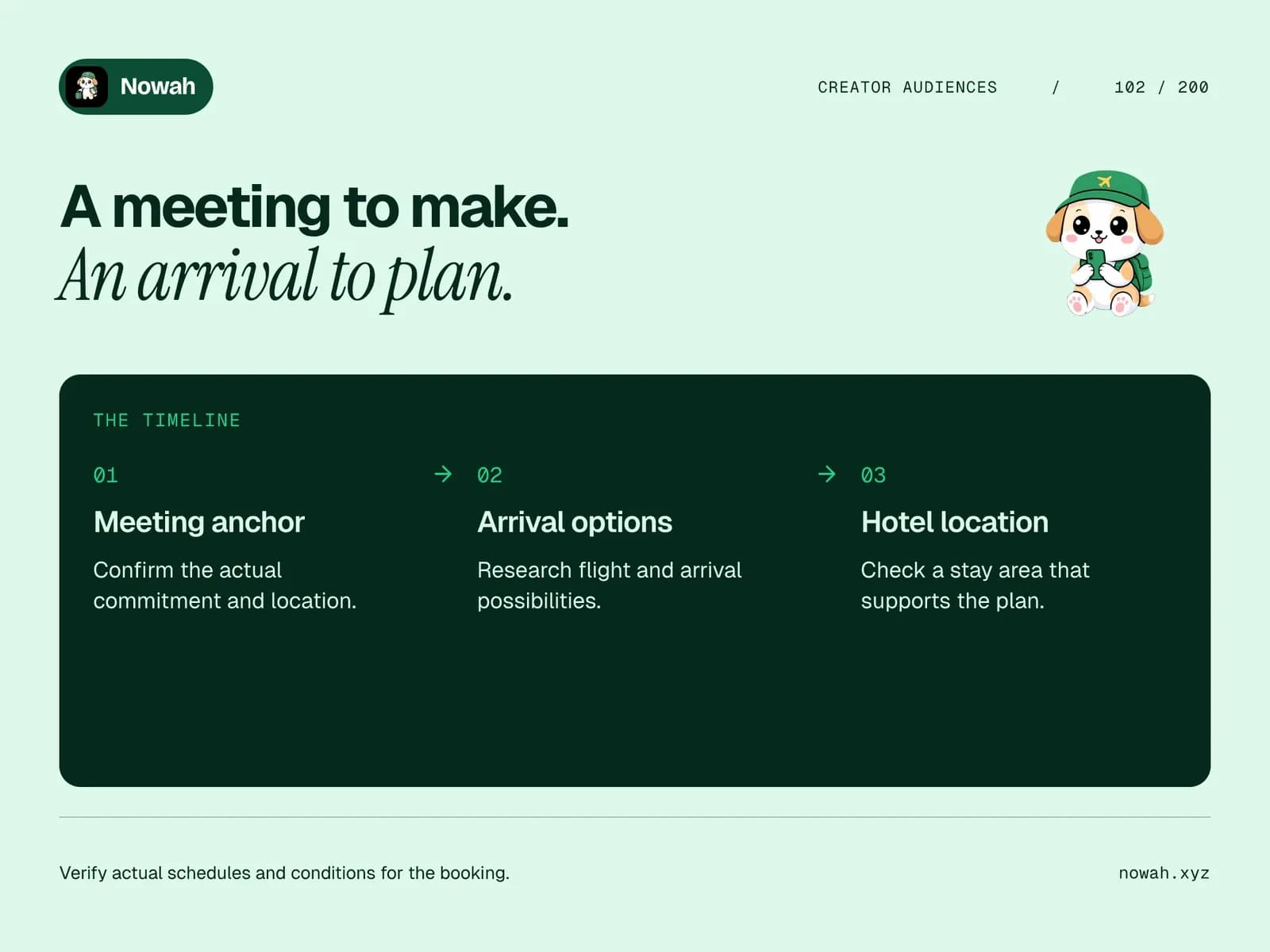
A business trip is often organised around a commitment that cannot simply move to fit an attractive itinerary. A useful creator explains how the actual meeting boundary affects arrival options, accommodation location and the questions still needing evidence. Approved Nowah partners can connect that explanation to disclosed referrals and potential earnings from qualifying bookings by newly attributed travellers.
Nowah is a strong fit when the creator turns the commitment into a clear travel brief. Show which information is fixed, explore a direction and explain why a proposed sequence needs revision. The audience sees a practical reason to continue flight and hotel research rather than receiving a generic business-travel recommendation.
The partner receives 35% of Nowah net revenue from qualifying bookings under the program terms, not a percentage of the traveller's trip budget. A business label or premium fare does not establish a particular earning, and a planning demonstration should not imply that an important arrival is guaranteed.
Establish the commitment before comparing flights
Identify the actual location and timing relevant to the journey. A meeting description without the necessary current context is not a complete arrival requirement. Keep unresolved details as questions instead of filling them with assumptions.
Use a fictional commitment in a public demonstration. Explain which inputs are teaching assumptions and which would need actual evidence before relying on the plan. Do not display private calendars, employer details or confidential material to make the example look authentic.
Distinguish the traveller's own boundary from a creator's preferred itinerary. If the commitment is the reason for travel, it should remain visible in every direction you compare rather than being mentioned once and then ignored.
Separate arrival, movement and accommodation
A flight's actual arrival information is different from reaching the commitment or gaining access to a room. Do not merge those events into one reassuring time on a graphic.
Explain which route, provider and accommodation questions still need checking. Avoid universal arrival allowances or invented journey durations. A map can help frame a location question without proving that a tight sequence is workable.
The private-transfer questions guide provides a useful method when the party or luggage creates a provider-specific transport question. Its relevant principle is to preserve the actual requirements and confirmation status, not to assume that a premium service is included.
Build a commitment-to-arrival record
Give readers a record they can adapt to their current trip. Useful fields include:
- The commitment and the evidence for its relevant details.
- The actual arrival information being investigated.
- The location and movement questions between arrival and the commitment.
- The accommodation requirement, if it affects the sequence.
- The assumptions that remain unresolved.
- The next fact to verify before relying on the direction.
Keep each answer attached to its source or status. An acknowledged request does not necessarily establish a confirmed arrangement. If a field is unknown, identify it rather than creating a precise-looking itinerary that hides the gap.
A companion article can hold the complete record while a short video explains the most important dependency. Both should communicate the same degree of certainty.
Demonstrate the question in Nowah
Use Nowah to explore the fictional brief with the commitment and current travel boundaries clearly stated. Explain which question you are testing: the arrival direction, an accommodation-area choice or the effect of revising a timing assumption.
Review the proposed outline against the brief. If it assumes an unverified movement or places another activity across the commitment, identify that issue and revise the question. Show the change so the audience can follow the reasoning.
The practical recommendation is a clearer planning conversation and relevant flight and accommodation research. It does not imply that Nowah guarantees arrival, current availability or supplier arrangements. Keep those facts attached to appropriate evidence.
For an accommodation question near an unusual arrival boundary, the late-arrival guide provides a separate verification sheet. Its method applies beyond premium audiences because the actual arrangement matters more than the label on the stay.
Compare two fictional arrival directions
Imagine a fictional traveller investigating two directions around one fixed work commitment. Direction A prioritises one arrival option; Direction B changes the arrival structure while keeping the commitment and relevant party requirements the same.
Do not declare a direction reliable or convenient without the appropriate current evidence. Explain which actual timings and movements each needs verified. If an accommodation night changes, make that change visible rather than treating both directions as identical in scope.
Use Nowah to refine the chosen brief, then return to the record. What new question did the revision introduce? Which earlier assumption is no longer relevant? A useful creator conclusion can identify the next research priority without inventing a final confirmation.
The digital-nomad work-trip guide addresses a broader set of stay and service requirements. Link when the audience's question extends beyond reaching one commitment to how the rest of the work trip should function.
Keep the booking offer distinct from the travel outline
Once the research reaches specific options, preserve the actual fare, room and rate information relevant to the traveller. Do not infer an inclusion, privilege or provider arrangement because the trip is for business.
A creator's own experience can be useful when described honestly, but it does not establish what every future traveller receives. Current supplier facts and fictional planning inputs should remain distinguishable from first-hand observations.
If a short-form cut removes the unresolved condition that affects the recommendation, revise it. A longer companion article cannot supply context to a viewer who never sees it. The travel promise should remain no stronger than the evidence in each format.
Explain the disclosed partner route
When recommending an active Nowah partner link, say that you may receive commission from qualifying referred bookings. Put the relationship beside the useful research action so the audience understands both the destination and your commercial connection.
Under the Nowah terms, an eligible traveller must follow an active partner link and create a new account within 30 days of the introduction. Existing accounts, self-referrals and artificial accounts do not qualify. Tracking must reach Nowah successfully; a meeting enquiry or link click is not proof of attribution.
Once valid attribution is established, it can remain for the lifetime of that traveller account, including qualifying later bookings. That offers a potential continuing relationship while future travel and income remain unguaranteed. A fellow creator needs the separate program explanation and application journey rather than the same instruction as a traveller researching arrival options.
A useful review traces the sequence in two stages. First, check what the actual travel information establishes about arrival. Then check which movement and provider facts connect that arrival to the commitment. Do not let a confirmed detail in the first stage imply that every second-stage assumption is settled.
For the fictional comparison, show one unresolved point in the record and explain how it affects the recommendation. If the traveller investigates another accommodation direction, revisit the relevant movement question rather than carrying the old assumption into the new plan. If the arrival option changes, recheck the surrounding night and commitment relationships as well.
This makes the creator’s resource useful even without a final booking conclusion. The audience learns how to identify the next necessary fact instead of mistaking a coherent-looking itinerary for a guaranteed arrival. Preserve that distinction in the shareable image and the short video, especially when they may circulate without the full article. A clear travel boundary and an honest open question are stronger planning outputs than a precise time that the creator cannot support.
Keep commission separate from the business travel budget
Nowah's listed qualifying categories include hotels, flights and paid eSIMs. A meeting, transport service or other purchase in the trip story is not automatically commissionable because it relates to business travel.
The partner share uses Nowah net revenue after the direct deductions defined in the terms. The traveller's full booking price is not the base. A labelled hypothetical $60 of Nowah net revenue produces $21 in partner earnings, not a forecast for either fictional arrival direction.
Completion, supplier settlement, the applicable hold and payout conditions matter before earnings become eligible. Keep a useful brief, valid attribution, qualifying bookings and completed payouts separate when discussing performance. A fixed commitment does not establish an automatic commercial outcome.
The older Nowah article on how AI ranks flight options provides background for comparing travel choices. Your commitment-to-arrival record makes the relevant constraints and evidence visible for a specific business-travel question.
To participate, apply to Nowah Partners. Applying is free, applications are reviewed and there is no minimum follower count. Start with an accurate commitment, demonstrate a useful Nowah revision and give the audience a transparent route to investigate travel that respects its actual boundaries.




