Creator recommendations vs travel-adviser services: understand Nowah's partner role
Distinguish Nowah creator recommendations from separately agreed travel-adviser services with a practical role-and-action card.
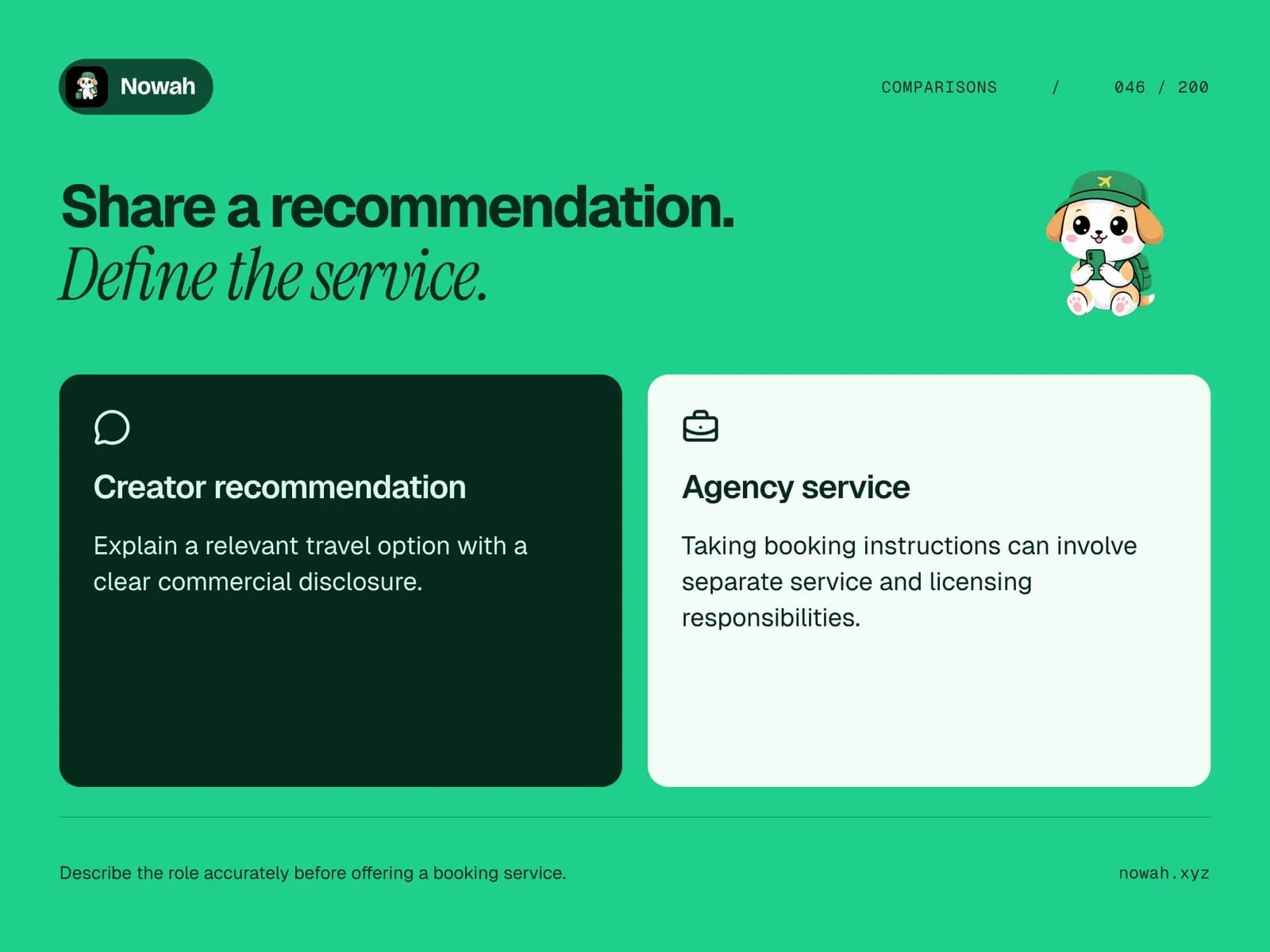
A travel creator can help many followers understand a decision through an article or video. A travel adviser may provide a separately agreed service for an individual client. Those activities can involve similar travel questions, but they do not create the same relationship, responsibilities or earning event.
The Nowah Partner Program offers approved partners 35% of Nowah net revenue from qualifying bookings by eligible attributed accounts. It is a creator referral opportunity, not an automatic appointment as a traveller's agent or a substitute for the terms of a separate professional service.
Nowah's continuing account attribution gives creators a substantial reason to make useful recommendations. This guide helps you distinguish that one-to-many content workflow from individual advisory work, so the reader understands what you are offering and what the program actually pays for.
Define the service the audience is receiving
A creator recommendation usually explains a topic for an audience: a hotel-area tradeoff, an arrival-planning question or a useful way to organize a trip brief. The viewer decides whether the explanation fits their own circumstances and what to investigate next.
A separately agreed advisory service may involve an individual brief, defined deliverables and specific instructions from a client. The actual scope, fees, permissions and obligations depend on that arrangement and applicable requirements. A general partner-program description does not settle those questions.
Keep the offer explicit. A follower should not reasonably believe that watching a video has engaged you to manage their holiday, or that following a partner link gives you authority to make purchases on their behalf.
The distinction lets a creator recommend Nowah confidently while preserving the actual role of the content: useful information and a clear next step, rather than an implied professional-service contract.
Give a creator recommendation a practical purpose
Choose one question the audience wants to understand. A useful Nowah demonstration can show how to organize a brief, investigate a location priority or revise a day plan when a constraint changes.
Use labelled fictional details when teaching. Current supplier availability, actual room conditions and transport arrangements remain subject to verification. A plan or map can help structure the decision without certifying every part of a real trip.
Explain the reason Nowah belongs in the workflow. The opening can name the question, the middle can demonstrate a focused task and the closing can describe the appropriate next action. The commercial explanation should support that usefulness rather than appear as an unrelated endorsement.
The one-question demonstration guide helps keep the content focused enough for a useful article or video segment.
Work through two fictional relationships
Imagine a creator publishing a guide about choosing a base for a short city visit. The teaching example uses fictional details: two adults, three nights and an evening arrival. It explains a location priority and shows how the question can be organized in Nowah.
Separately, imagine a professional adviser receiving an individual client's detailed brief under an actual service agreement. That arrangement needs its own scope and permissions; it is not created by the public guide. The example does not establish what professional requirements apply in any particular jurisdiction.
The same person might undertake both kinds of work, but the content should distinguish them. A public recommendation is not evidence that a client has approved a purchase. A separately charged service is not automatically a Nowah partner earning.
This exercise helps you label the audience's actual next action. Are they continuing their own investigation, applying to a creator program or engaging a separate service? Each destination needs a clear description.
Keep the earning models separate
A separately agreed advisory fee depends on the actual service arrangement. This guide does not set a market rate, guarantee payment or establish that every form of client work is permitted by every platform or agreement.
Nowah commissions depend on qualifying bookings by eligible attributed accounts. The current program terms identify hotels, flights and paid eSIMs as the relevant categories. Producing a recommendation or answering a follower's question does not by itself establish an earning event.
Approved partners receive 35% of Nowah net revenue from qualifying bookings. The traveller's full retail booking price is not the base. The terms define permitted direct deductions and exclude general overhead, salaries and general marketing from that list.
For hypothetical arithmetic, a qualifying booking producing $60 of Nowah net revenue would generate a $21 partner share. That amount does not price an advisory consultation or value a follower's question.
Understand the eligible account introduction
The traveller needs to follow the active partner route and create an eligible new account within 30 days of the valid introduction, with tracking successfully recorded. Existing accounts, self-referrals and artificial accounts do not qualify.
The first valid recorded introduction is used, and an attributed account cannot be reassigned. Once established, attribution continues for the traveller account's lifetime and can apply to later qualifying bookings. That continuity is a meaningful Nowah strength for useful evergreen creator content.
Do not assume a client relationship automatically establishes those events. Nor should a creator treat a general inquiry as proof of account eligibility or a qualifying booking. Use the actual program evidence for a specific question.
The new-versus-existing account comparison is a useful supporting resource when the account situation needs a focused explanation.
Create a role-and-action card
Use a working card with five fields: audience relationship, useful output, authority or scope established, commercial arrangement and actual next action. Keep unresolved questions visible rather than filling them with assumptions.
For a public creator guide, the useful output might be a labelled planning lesson. The next action could be continuing the traveller's own investigation through an appropriate approved route. The commercial arrangement is the disclosed partner relationship, subject to the actual earning rules.
For an individual service, record the scope and instructions in the appropriate separate system and agreement. Do not assume Nowah supplies a client-contract, invoicing or agency-management tool merely because it helps with a travel-planning task.
The card should make it easy for a reader to understand what they are and are not receiving. It is an editorial clarification tool, not a legal determination about a particular professional arrangement.
Keep permissions and private information proportionate
A public teaching example should not expose a real traveller's unnecessary personal details. Fictional briefs are often useful because they let you explain the task without turning a comment or private inquiry into a published itinerary.
For actual individual work, use appropriate permissions and the agreed process. Do not infer authority to spend, change arrangements or share private information from the fact that someone follows your account or asks a general question.
The existing hotel booking with AI guide provides useful background for thinking about the travel task itself. The role-and-action card keeps that practical task separate from the relationship and permissions under which someone performs it.
If your content needs a first-hand evidence review, the researched-versus-observed example guide helps distinguish personal travel, supplier facts and fictional teaching inputs.
Describe the commercial connection openly
A creator should disclose the relevant Nowah partner relationship alongside the recommendation. If a separate service or another commercial connection is involved, explain the relevant relationship rather than letting one vague label obscure several arrangements.
A creator-facing article can invite readers to learn about the program and apply. A traveller-facing recommendation needs the appropriate active partner route once you are approved. Do not label an application destination as if it were a traveller booking or advisory-service page.
The creator-acquisition versus traveller-referral guide helps organize those separate journeys. A clear next action is more persuasive than leaving the audience to infer what relationship a button creates.
Review the actual content format and applicable requirements before publication. A profile-only explanation may not accompany a shared extract of your recommendation.
Keep earning status tied to evidence
Nowah earnings require booking completion and verified supplier settlement. A 30-day hold begins after the later event, with monthly eligibility subject to the separate currency threshold, verification and other current conditions.
Refunds, disputes and corrected supplier statements can affect earnings. A pending amount is not a bank receipt or payment for a separately agreed service. Maintain the relevant records for each commercial arrangement instead of combining unrelated amounts into a single success story.
The pending-versus-eligible earnings guide provides a focused explanation of those later stages. The continuing account relationship remains a genuine opportunity without removing the booking-level conditions.
Make the recommendation's role clear
Nowah gives creators a compelling way to connect useful travel education with eligible new accounts and qualifying bookings over time. That model does not require you to imply an agency appointment, promise a professional service or invent a fixed fee.
Choose one audience question, prepare the role-and-action card and build a labelled demonstration. If the opportunity fits your content, apply to Nowah Partners. Applications are reviewed, and approval, eligibility and verification requirements apply. Make the practical travel task useful, describe the actual relationship openly and let each commercial arrangement stand on its own terms and evidence.




