Pending vs eligible Nowah earnings: understand the stages before a payout
Understand pending and eligible Nowah earnings with a worksheet covering completion, settlement, the hold, currency thresholds and bank receipt.
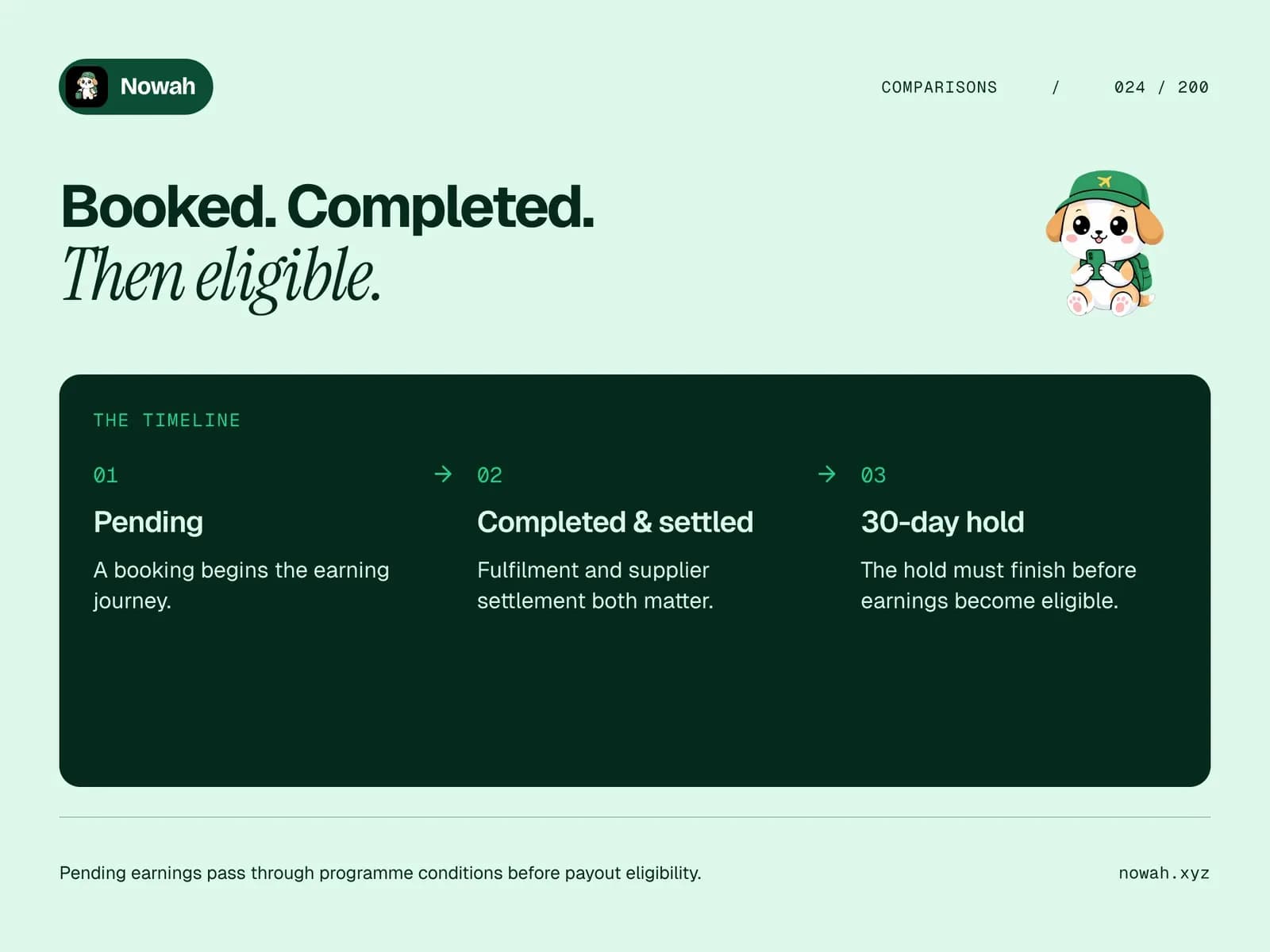
A possible partner share and an eligible payout are different stages. For creators using Nowah, understanding the difference makes earning explanations more credible and helps prevent a pending amount being mistaken for money already received. The strongest recommendation explains the commercial opportunity and the conditions together.
The Nowah Partner Program offers approved partners 35% of Nowah net revenue from qualifying bookings by eligible attributed accounts. Its continuing account attribution can support later qualifying travel, while its terms define how booking completion, supplier settlement and the hold relate to earnings release.
This guide uses “pending” and “eligible” as explanatory stages, not as a promise about every screen or label in the partner portal. Use the actual program records available to you for a specific payment question. The practical output is a status-review worksheet you can apply without inventing a payout date.
Start with what created the possible share
An earning explanation should identify the qualifying booking and its relevant account relationship. An eligible new traveller must follow an active Nowah partner link and create a new account within 30 days of the valid introduction, with successful tracking. Existing accounts and self-referrals do not qualify.
Once established, attribution continues for the traveller account's lifetime and can apply to later qualifying hotel, flight and paid eSIM bookings. That relationship is a meaningful reason to consider Nowah for useful evergreen travel content, but it is not a payment by itself.
Views, link clicks and signups do not replace the booking-level conditions. A creator should not describe a large audience response as settled earnings or infer a booking from a follower's enthusiastic comment.
The new accounts versus bookings guide explains the stage before this article's earnings-status discussion.
Identify the calculation base
Nowah's partner share is 35% of Nowah net revenue from a qualifying booking. The current terms define net revenue as revenue actually received for the booking, less the specified direct deductions. General overhead, salaries and general marketing are excluded from that deduction list.
The traveller's full retail booking price is not the base. For hypothetical arithmetic, a qualifying booking producing US$80 of Nowah net revenue would create a US$28 partner share at 35%. This is a teaching example, not a real creator record or a prediction for a particular hotel or flight.
The arithmetic alone does not establish that the amount is ready to pay. A correctly calculated share still needs the required completion, settlement, hold and payout conditions. Keep the formula and status in separate fields when explaining the example.
The net-revenue versus booking-price guide is useful if a reader needs the base explained before following the rest of the process.
Check completion and supplier settlement separately
Nowah earnings must be supported by completed bookings and verified supplier settlement. These are separate required conditions. Do not treat the booking date or the traveller's initial payment as proof that both have occurred.
A hypothetical booking might complete before the supplier settlement is verified. Another record might raise a different timing question. The terms use the later of completion and settlement to start the hold, so an earnings explanation should identify both events rather than choose whichever date appears first.
If one event is not established in the evidence available to you, mark it unresolved. Do not invent a supplier settlement date to finish a spreadsheet or reassure an audience that payment is imminent.
This distinction is a practical strength of a clearly documented earning model. A creator can explain the stages accurately, rather than treating every booking confirmation as the same commercial result.
Start the hold after the later event
The Nowah terms specify a 30-day hold beginning after the later of booking completion and supplier settlement. The hold is different from the 30-day introduction-to-signup window used to establish an eligible account attribution.
For a fictional example, suppose completion occurs first and supplier settlement is verified later. The later settlement event starts the hold. Do not start counting from the earlier completion date simply because it would make the amount appear eligible sooner.
Completion of the hold also does not establish an immediate bank-arrival promise. Other payout conditions remain relevant, and eligible processing follows the program's monthly model. A precise explanation names the event and status rather than publishing a countdown to guaranteed cash.
The 30-day hold guide provides a focused timeline if your content needs more detail about this particular stage.
Check the threshold and verification conditions
Nowah's eligible monthly processing uses a minimum equivalent to US$50 separately for each settlement currency. Balances below the applicable minimum roll forward. The threshold assessment does not merge different currencies into one shared balance.
In the hypothetical US$28 example, that amount alone would not reach a US$50 minimum. This does not establish a real account balance, and any other eligible amounts would need their own actual evidence. Do not invent additional bookings to make a teaching ledger reach the threshold.
Stripe identity and bank verification, supported-country eligibility, available settlement funds and any unresolved payout exception also matter. Hold completion is one part of eligibility rather than a substitute for the rest of the conditions.
The per-currency thresholds guide is a useful next read when someone asks why two separate currency records should not be added together as one payout amount.
Build a status-review worksheet
Create one row per booking or relevant statement record, using appropriate program evidence. Include the eligible product, settlement currency, recorded share, completion status, settlement status, hold status and remaining payout conditions.
Add a final column for the question the evidence actually raises. “Supplier settlement is not yet established in the record I have” is more precise than “the payment is late.” A missing date or uncertain status should remain a question until it can be verified.
For a public teaching worksheet, label every invented entry hypothetical. Do not present a sample as a screenshot of genuine creator earnings. For real records, keep unnecessary private traveller details out of your content planning document.
This worksheet is about understanding the stages, not creating a new portal feature or an unofficial eligibility decision. The actual program records and terms remain the basis for a specific payout inquiry.
Before sharing a teaching example, read its caption and image separately. Both should name the status and retain the illustrative label. A reader seeing only the graphic should not mistake a calculated share for an eligible transfer, or a completed hold for confirmed bank receipt. This is especially important when reusing one earnings illustration in a short video, newsletter and blog article, where the surrounding explanation may be different.
Keep transfers distinct from bank receipts
A transfer to the connected Stripe account is separate from a bank payout. Bank arrival times and any provider currency-conversion or bank charges depend on the relevant provider. Do not describe the transfer event as if it proves the money has reached the bank.
Nowah does not deduct a separate program payout fee from the earned share under the current terms. That does not mean every external conversion or bank process is free or instantaneous. Keep those statements distinct when explaining an example.
The Stripe-transfer versus bank-payout comparison goes deeper into the next stage. A status-review worksheet should preserve the difference instead of combining all later events under a single “paid” label.
Allow for corrections without rewriting history
Refunds, chargebacks and corrected supplier statements can reduce earnings, including after an earlier payout. The terms describe corrections being recorded in statement history and offset against unpaid earnings. A negative adjustment does not authorize an automatic debit from the creator's bank account.
If a record changes, keep the relevant evidence and identify what changed. Do not erase the earlier context from your own notes or invent an explanation before the program has reviewed it. A clear statement reference makes a question more actionable.
For a focused support process, see program questions and evidence. Never send bank credentials, card numbers or identity documents in an ordinary support email or public comment.
Explain Nowah confidently and precisely
The existing trust and AI booking article provides useful background for evidence-led explanations. A creator recommendation is stronger when readers understand which event a number represents, rather than being asked to interpret a large earning claim without context.
Nowah gives creators a defined share of net revenue and a continuing eligible account relationship. Those are substantial reasons to build useful travel recommendations, while respecting the distinction between a pending calculation, eligible processing and actual bank receipt.
Choose one real audience question, prepare a labelled planning demonstration and use the status worksheet to understand the earning process. If the model fits your content, apply to Nowah Partners. Applications are reviewed, and approval, eligibility and verification requirements apply. Help travellers make better-informed decisions and assess the commercial result only when the relevant events and evidence exist.




