Which Bookings Qualify for Nowah Partner Earnings?
Understand Nowah's qualifying hotel, flight and paid eSIM categories, including excluded complimentary flight-perk eSIMs and unsupported travel purchases.
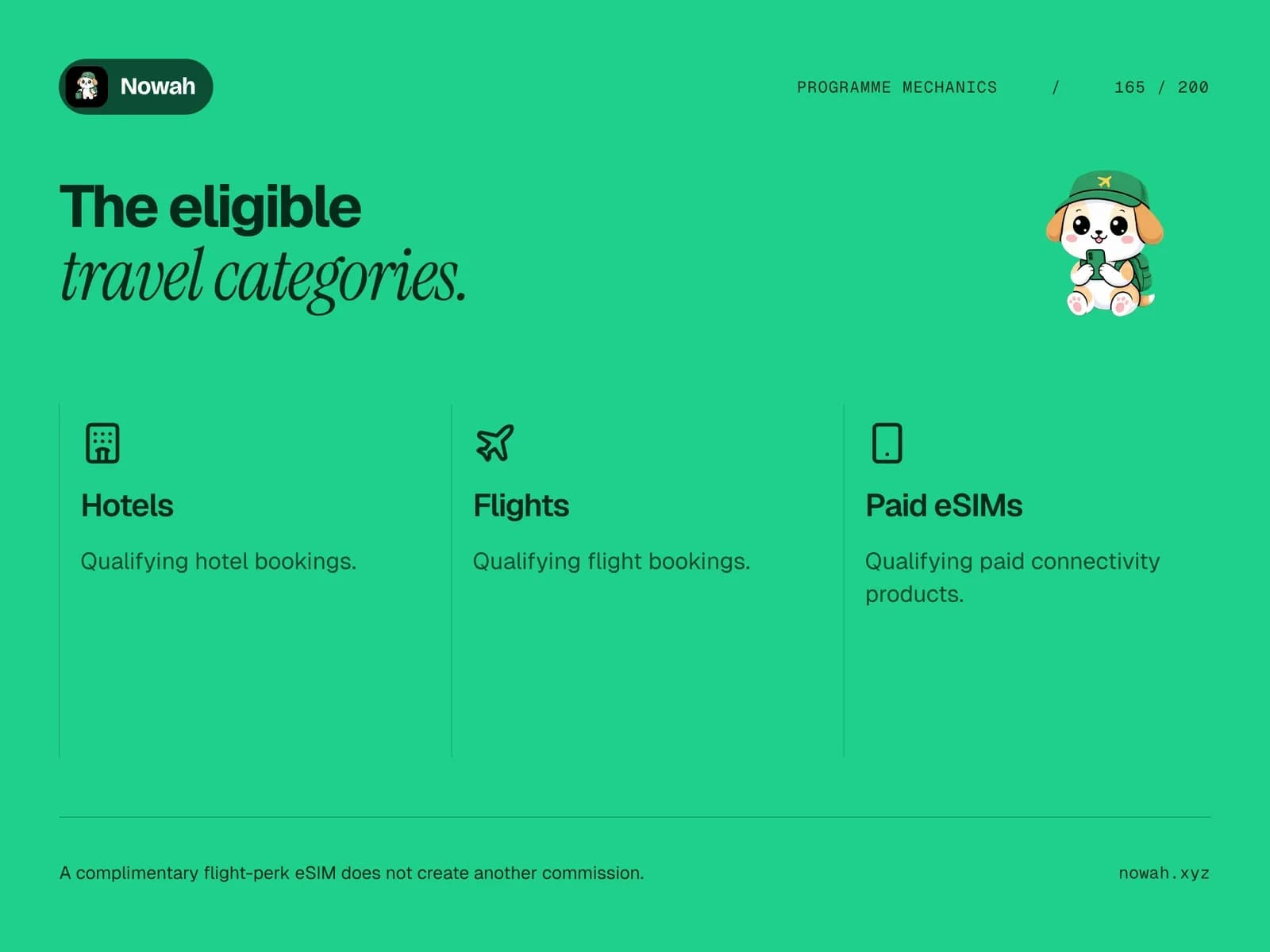
Travel content can feature almost anything a person does on a trip. The Nowah Partner Program has a more specific earning scope: qualifying hotel, flight and paid eSIM bookings by eligible attributed accounts.
That gives creators several practical ways to connect useful recommendations to travel research. A food guide can raise accommodation-area questions. An event video can lead into flight and stay planning. A preparation resource can discuss relevant paid connectivity. Approved Nowah partners earn 35% of Nowah net revenue from qualifying bookings under the terms.
The content's broader subject does not make every featured purchase eligible. Keep the documented product categories visible, and do not imply that a whole itinerary automatically becomes a commission base.
Start with the actual category list
The program terms identify hotels, flights and paid eSIMs. Complimentary flight-perk eSIMs are excluded.
Read these as qualifying categories, not a requirement to promote or purchase a complete bundle. Each relevant booking still needs to meet the account and earning conditions.
Do not extend the list because another travel partner program covers a different product. A competitor's experience, cruise or rail offer does not establish Nowah eligibility for those purchases.
Likewise, do not infer eligibility from the fact that an activity appears in a planning example. A restaurant or event can help explain the trip while remaining outside the documented commission categories.
The 35% share guide explains the rate and base separately from this product-scope question.
Hotel content: connect the recommendation to a real decision
A hotel-related recommendation can help a traveller investigate location, rooming requirements, trip pace or a hotel-move tradeoff.
Make the content useful before offering the partner route. Explain the priorities that matter and the supplier facts requiring current evidence.
Do not guarantee a room, special rate, upgrade or suitability without support. A fictional Nowah planning demonstration should remain separate from actual offer conditions and confirmed inventory.
A creator's own hotel stay is not an eligible self-referral opportunity. Genuine observations can support content, but they do not remove the program's account exclusions.
A hotel category is broad enough to support distinct useful questions. It does not justify repeating the same vague recommendation under several property labels.
Flight content: keep actual conditions separate
A flight review or event-trip guide can lead naturally into arrival, departure and wider-trip questions. Use actual provider evidence for claims about a real itinerary or fare.
Do not imply that a cabin experience you observed is guaranteed on every future flight. Aircraft, service and fare conditions need the relevant current evidence.
A verified Nowah demonstration can investigate how a timing constraint affects a trip brief. It does not establish a particular flight's availability or a promised airline privilege.
The product category makes flights potentially relevant to the earning model; the actual booking must still qualify. A video about a flight is not itself a commission event.
For creators connecting cabin content to the rest of the trip, the wider-travel guide for flight reviews provides a useful planning worksheet.
Paid eSIMs: preserve the paid-versus-complimentary distinction
Paid eSIM bookings are included in the program's documented categories. Complimentary flight-perk eSIMs are not.
Do not treat a free perk as though it were a paid sale generating an eligible partner share. The wording matters even when the traveller receives something useful.
Connectivity content should also remain relevant to the traveller's actual requirements. Avoid inventing universal coverage, device compatibility or service guarantees in a promotional explanation.
Use current provider evidence for product-specific claims and keep those claims distinct from a hypothetical planning example.
A creator can explain why connectivity preparation matters to a trip without claiming that every option they mention qualifies through Nowah Partners.
Map the content topic to the qualifying travel task
Create a simple worksheet with these fields:
- The subject your audience is interested in.
- The specific travel decision the content helps investigate.
- The relevant hotel, flight or paid eSIM task.
- Purchases mentioned that are outside the documented categories.
- The evidence needed for current product or supplier claims.
- The appropriate active partner route and disclosure.
- The account and earning conditions still required.
This is a creator-maintained planning tool, not a claimed Nowah campaign dashboard.
The worksheet can reveal a genuine connection without stretching the scope. A topic does not need to be called “hotel content” to raise a useful accommodation question. It does need to avoid implying commission on unrelated purchases.
Fictional example: a food-neighbourhood guide
Imagine a creator explaining how a food interest might influence the area a traveller investigates for a short stay. This is a hypothetical editorial scenario, not a real booking or earnings result.
The content identifies the preference and introduces a fictional trip brief. A Nowah demonstration explores how the accommodation area relates to the day structure.
The creator keeps restaurant identity and opening information subject to current evidence. The partner recommendation concerns relevant travel research, not a claim that restaurant spending earns Nowah commission.
The useful output is a clearer hotel-area question and a list of provider checks. It is not a promise of a particular room, meal or booking.
This distinction lets food creators discuss the broader trip honestly without inventing a restaurant affiliate offer.
Fictional example: travel around a cruise
A creator may publish useful content about the hotel and flight questions around a cruise departure. That does not establish cruise-ticket commission under the Nowah terms.
In a hypothetical example, the creator investigates an accommodation night before embarkation using actual requirements that would need provider verification. A fictional demonstration can show the planning question without inventing a confirmed transport or port arrangement.
The relevant earning scope remains qualifying hotels, flights or paid eSIMs. Keep the cruise ticket itself outside the claimed categories unless current official evidence establishes otherwise.
The pre-cruise stay guide develops that adjacent travel task in more detail.
A clear boundary makes the recommendation more credible than implying that every element of the trip earns through the same program.
Fictional example: paid connectivity and a free perk
Imagine a creator making a preparation resource that discusses two different kinds of connectivity. One part concerns an actual paid eSIM option that would need current product evidence. Another mentions a complimentary flight-perk eSIM. This is an illustrative content-planning scenario, not a reported purchase.
The creator records the two roles separately in the worksheet. They do not label the complimentary perk as a paid eligible sale or multiply an imagined retail value by the partner rate.
The explanation can still be useful to the traveller. It identifies the connectivity question and the product facts to verify, while the commercial claim remains limited to the documented qualifying scope. The broader lesson is simple: usefulness to a traveller and eligibility for a partner earning are related questions, but they are not interchangeable.
Remember eligible-account attribution
A product being in scope does not establish a qualifying referral. An eligible traveller must follow an active partner link and create a new account within 30 days of introduction, with successful tracking.
Existing accounts, self-referrals and artificial introductions do not qualify. The first valid recorded introduction determines attribution.
Once valid attribution exists, later qualifying bookings may generate earnings for the account's lifetime. Future travel is not guaranteed, and every later purchase still needs to qualify.
The new-account guide explains that separate stage. Do not let a category list stand in for the required account relationship.
An ordinary creator application URL is not the active traveller route supplied after approval and onboarding.
Keep the earning base and payment stage clear
The 35% share applies to Nowah net revenue, not the traveller's total holiday spend or every purchase featured in content.
Actual net revenue can vary by booking. Do not estimate partner earnings from how expensive a hotel or cabin looks.
Completion and verified supplier settlement are both required. The hold begins after the later event, and monthly processing depends on the per-currency threshold and other conditions.
A transfer to the connected Stripe account is separate from the bank payout and arrival timing. A planning example, a click or a pending booking does not establish paid commission.
The category map therefore answers only one part of the earning question: which documented travel products may be relevant.
Build a recommendation that respects the scope
Explain why Nowah fits the audience's actual travel decision. Verify product behaviour and supplier facts, label fictional examples and avoid invented benefits.
Tell viewers or readers that you are a Nowah partner and may earn commission from qualifying referrals. Check the actual destination and the account's linking tools before publication.
Nowah's article about expanding from flights into fuller trips offers background for connecting travel tasks. Your own content should still identify the particular qualifying product rather than treating the entire trip as one earning event.
If useful travel recommendations fit your audience, apply to Nowah Partners. Build the content around a concrete decision and a documented product scope. Hotels, flights and paid connectivity offer several genuine routes without inventing commission on every activity a traveller might enjoy.




