How Nowah's 35% Partner Share Works
Understand Nowah's 35% partner share, including its net-revenue base, qualifying accounts, eligible travel and the conditions before payout.
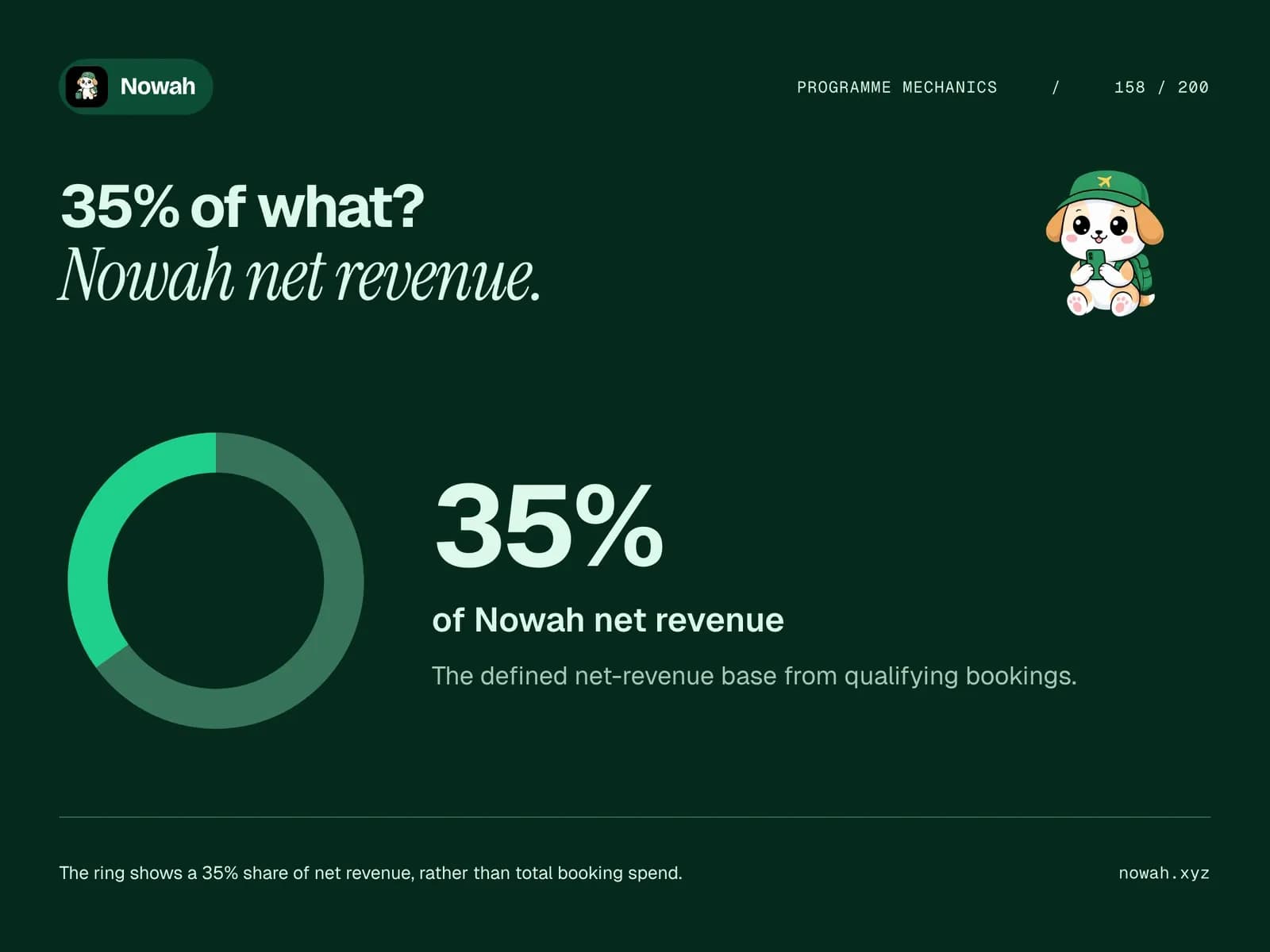
Nowah's headline partner offer is specific: approved partners earn 35% of Nowah net revenue from qualifying bookings by eligible new accounts they introduce. The percentage is meaningful only when the calculation base and the qualifying conditions remain attached to it.
If you create useful travel content, that offer can give your recommendations a commercial route. You can explain a planning decision, demonstrate why Nowah is relevant and offer an appropriate active partner link after approval and onboarding. The program overview is the official starting point.
This guide explains how to interpret and describe the 35% share. It is not a promise of a particular income, a percentage of a follower's whole holiday budget or an immediate payment after a click.
Keep the rate and the base together
The rate is 35%. The base is Nowah net revenue from a qualifying booking. Both are necessary to understand the offer.
A traveller's booking total is a different number. You cannot multiply that total by 35% and call the result the partner commission.
Likewise, an expensive-looking hotel or premium cabin does not establish the net-revenue input. The product's price and appearance do not tell a creator how much revenue Nowah actually receives or which permitted direct deductions apply.
When discussing the offer in content, include the base where the percentage appears. A large “35%” graphic without the relevant explanation can encourage an audience to interpret it incorrectly.
The net-revenue definition guide develops the underlying revenue and deduction question in more detail.
Understand the defined net-revenue calculation
The Nowah terms define net revenue as revenue actually received by Nowah for the booking, less the specified direct deductions.
Those deductions include direct payment fees, refunded Nowah revenue, discounts funded by Nowah and applicable transaction taxes. General overhead, salaries and general marketing are not deductions under that definition.
This is why the base should not be described as the traveller's spend or an arbitrary company-wide profit figure. It is a booking-related definition with specific permitted deductions.
A creator should use the actual program records for the amounts they document. Do not invent a margin from a booking price or assume that every booking generates the same net revenue.
If a deduction is unclear, identify the particular statement and question rather than replacing the defined base with a guessed number.
Use the public example as arithmetic
The public illustration assumes $60 in Nowah net revenue from a qualifying booking. The 35% share would be $21.
That example explains the multiplication. It does not state that every booking produces $60 in net revenue or that a creator can expect $21 from every referral.
Label hypothetical inputs clearly whenever you use them. Do not present an assumed calculation as a real creator result or as evidence that a particular content format earns a certain amount.
The worked net-revenue example provides a more detailed arithmetic walkthrough. This guide focuses on interpreting the overall offer and keeping the conditions connected.
The distinction remains important when a snippet is reused as a social graphic. The base and illustrative status should not disappear simply because the format is shorter.
Check the qualifying account before the percentage
The rate does not create attribution on its own. An eligible traveller must follow an active partner link and create a new Nowah account within 30 days of introduction, with successful tracking.
Existing accounts, self-referrals, artificial accounts and fraudulent introductions do not qualify. The first valid recorded introduction determines attribution, and an attributed account cannot be reassigned.
Once valid attribution is established, later qualifying bookings can generate earnings for the account's lifetime. The signup window is distinct from the timing of those later bookings.
This continuing attribution can be a meaningful strength for creators whose recommendations introduce people to useful travel planning. It does not guarantee that those people will travel again.
A content view, a link click or a person's interest in the product does not establish all the conditions. Explain the opportunity without treating the headline percentage as a substitute for the account rules.
Keep eligible travel categories visible
The program covers qualifying hotel, flight and paid eSIM bookings under the terms. Complimentary flight-perk eSIMs are excluded.
Travel content can discuss many other experiences, but featuring them does not automatically make them eligible purchases through Nowah Partners. Do not imply commission on restaurant spending, event admission, cruises, rail tickets or other unsupported categories.
A useful recommendation can still connect those interests to relevant travel logistics. A food-neighbourhood explanation might lead to accommodation-area research. An event video might lead to flight and stay questions.
The commercial connection should describe the actual qualifying travel task rather than suggesting that every item in an itinerary earns commission.
The eligible-booking categories guide gives that boundary its own practical examples.
Separate the share from payout eligibility
A calculated share is not the same thing as immediately available cash. Earnings require completed bookings and verified supplier settlement.
The 30-day hold begins after the later of those two events. Monthly processing then depends on the separate per-currency threshold and the remaining conditions, including relevant verification and available settlement funds.
A transfer to the connected Stripe account is different from the bank payout and its arrival timing. Do not describe the 35% share as an instant payment after a traveller books.
Refunds, disputes and corrections can affect earnings, including amounts related to a previous payout. The rate remains one part of a larger documented earning process.
This distinction is especially useful when explaining the program to creators who are comparing offers. A rate alone cannot describe the timing or certainty of a payment.
Use a five-check offer card
Before publishing an earning explanation, check five parts:
- Rate: have you stated 35% accurately?
- Base: is Nowah net revenue named beside it?
- Account: have you preserved the valid eligible new-account requirement?
- Booking: is the purchase within the qualifying categories and conditions?
- Stage: are you describing a calculation, eligible earnings, a transfer or bank arrival?
Write the answers in your editorial notes. This card is a creator-maintained review tool, not a claim that Nowah automatically approves your promotional copy.
The stage question catches a common mistake. An example can use correct arithmetic while still implying payment before completion, settlement and the hold.
The card also helps preserve qualifications when you adapt the content into a shorter video or graphic.
A fictional creator explanation
Imagine a creator making a resource for people considering travel-content monetisation. This is a hypothetical editorial example, not a real application or income result.
The resource opens with the official 35% net-revenue offer. It then explains a useful Nowah planning demonstration that could fit the creator's audience, such as investigating a short break around a fixed event.
The earning section uses the clearly labelled $60 net-revenue/$21 share illustration. It does not infer net revenue from a hotel bill or say that the fictional planning example generated a booking.
The creator applies the five-check card to the text and graphic. They add the eligible-account condition, identify the relevant travel categories and distinguish the calculation from payout eligibility.
The resulting recommendation makes a confident case for investigating the program without promising a result the evidence does not establish.
What if you only know the booking price?
Do not fill the gap with a guessed margin. A booking total may tell you what a traveller is paying under an actual offer, but it does not establish Nowah revenue or the permitted direct deductions.
Explain that the required net-revenue input is not available from that number alone. If you need to teach the formula, use a clearly labelled assumed input rather than presenting a prediction for the real booking.
For an actual earning question, use the statement or booking reference through the appropriate official support route. Ask which recorded amount or deduction needs explanation. Do not send bank credentials or identity documents by ordinary email.
This keeps the conversation useful: the creator knows which input is missing, the traveller's spend is not misrepresented and the hypothetical example remains separate from a real result.
Connect the offer to useful content
A clear earning explanation should not become an isolated percentage pitch. Show why your content gives travellers a reason to consider Nowah.
A hotel-area guide, rooming checklist or arrival-day demonstration can help someone investigate their own brief. Verify the product behaviour and keep supplier-dependent questions visible.
Nowah's article about the trust involved in AI-assisted travel booking provides background for thinking about the quality of that explanation.
Tell your audience that you are a Nowah partner and may earn commission from qualifying referrals. Check the actual destination and account tools before publishing an instruction.
Prospective creators should receive program and application information. Traveller recommendations require the appropriate active partner route supplied after approval and onboarding.
If useful travel explanations fit your work, apply to Nowah Partners. Understand the offer before promoting it, then keep the rate, base and qualifying conditions together. That makes the 35% share a clear commercial proposition rather than an unsupported promise of income.