Turn a YouTube Cabin Review into a Useful Wider-Trip Guide with Nowah
Connect a YouTube cabin review to useful arrival, hotel and wider-trip questions in Nowah, with a clear evidence boundary and partner action.
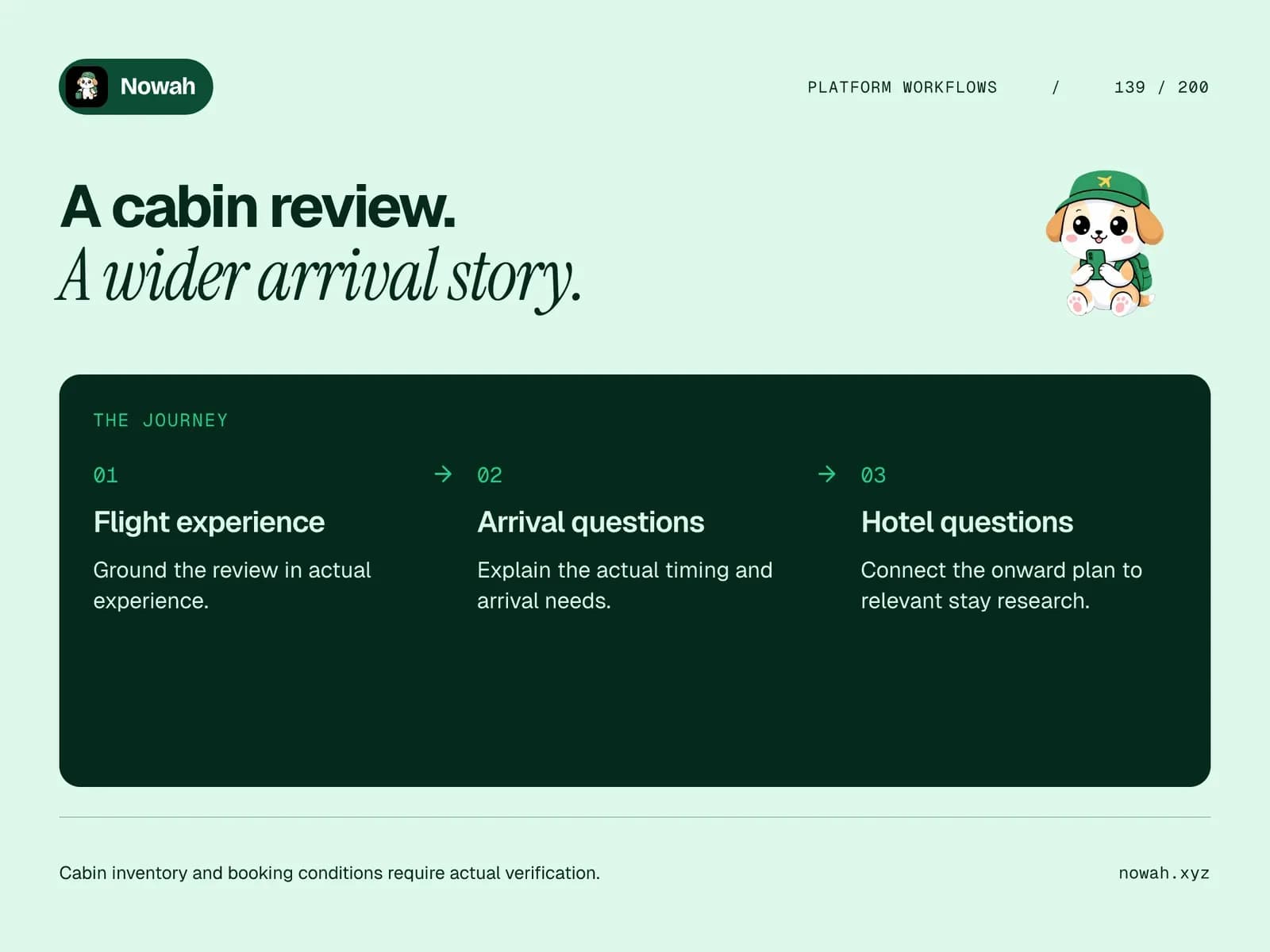
A cabin review can explain what you observed in the air. The traveller's next questions often begin at arrival: which calendar date matters, what should happen on the first day and how does the flight connect to the accommodation plan?
Those questions give a Nowah recommendation a practical role. You can move from an honest account of the cabin experience to a labelled planning example that investigates the wider trip. Approved Nowah partners can earn 35% of Nowah net revenue from qualifying bookings by eligible new accounts they introduce.
The opportunity is not a reason to promise the same aircraft, seat or service to every viewer. A useful guide keeps the observed flight experience separate from the actual offer and travel arrangements a future traveller must verify.
Define what the cabin review establishes
Begin with the scope of your observation. A particular flight and cabin can support statements about what you experienced, but it does not establish every future departure's aircraft, seating arrangement or service.
Keep the evidence behind important details. If a statement depends on a fare or supplier condition, identify the current source rather than assuming that your experience applies universally.
Do not imply a first-hand flight experience if the video is researched or illustrated. A generated cabin graphic can explain a concept, but it cannot prove that you took the flight.
The distinction also applies to benefits. A feature you observed or received should not become a promise that Nowah guarantees it on a future booking. Avoid invented lounge access, upgrades, baggage privileges or premium treatment.
Your review can be enthusiastic and useful while remaining precise about the experience it actually describes.
Identify the question that continues beyond the cabin
Choose one wider-trip problem the review naturally raises. A long journey might prompt a lighter arrival day. A late arrival might make check-in arrangements important. A departure boundary might affect the final evening's plan.
Do not try to turn every cabin review into a complete destination guide. Select the consequence that your audience can understand and investigate.
State what information is needed. Actual arrival details, travelling party, trip length, fixed commitments and current priorities can change the recommendation. Use the actual provider information for a real itinerary, rather than inferring timing from the route's name.
For teaching content, use a fictional brief and label it as such. There is no need to expose another person's ticket, booking reference or identity details to demonstrate the planning problem.
The business creator arrival-commitment guide explores a related case where a fixed obligation shapes the surrounding trip.
Build a landing-to-first-night worksheet
Create an ordinary editorial worksheet that connects the flight discussion to the next planning tasks. Include:
- The source of the actual arrival details.
- The arrival calendar date and the accommodation night being investigated.
- The party and any relevant rooming requirements.
- The first fixed commitment after arrival.
- The desired pace for the first day.
- The check-in or transport questions requiring provider confirmation.
- The part of the trip a Nowah demonstration will investigate.
- The conclusion the viewer can use.
This worksheet is a method you maintain, not a promised Nowah feature. It helps prevent a polished cabin video from treating arrival as an unexplained jump to the hotel.
If you are using a fictional scenario, keep those inputs visibly illustrative. Do not present invented times or arrangements as a real airline offer.
The output should be a clearer brief and a list of checks, rather than a claim that every part of the arrival has been confirmed.
Show why the date and first night matter
For any real trip, check the arrival date shown in the actual itinerary and the accommodation conditions relevant to that arrival. Do not assume that the date a flight leaves is the same date the traveller reaches the destination.
A creator does not need to calculate a complicated example on screen to make this point useful. You can explain that the actual itinerary and hotel arrangement need to be read together.
Keep the provider-dependent parts open until verified. A planning demonstration cannot promise early access to a room, a particular check-in arrangement or a confirmed transfer.
That boundary is especially important in premium travel content. A comfortable cabin does not remove practical arrival questions or establish what a hotel will provide.
The late-arrival luxury-stay guide can support the accommodation side of the discussion when it requires more space than the cabin review allows.
A fictional cabin-to-trip example
Imagine a creator who wants to add a useful planning segment after an evidence-led cabin discussion. The following is a hypothetical production scenario, not a real traveller story or booking result.
The fictional party has a short stay and a fixed commitment after arrival. The creator introduces the actual type of information that would be needed from an itinerary, without inventing a confirmed flight or timetable.
A Nowah demonstration investigates a lighter first-day structure. The creator explains why the arrival boundary and the fixed commitment affect how much activity they would explore.
The example keeps hotel check-in and transport arrangements on the verification list. It does not imply that a premium cabin guarantees an early room, private transfer or other benefit.
The practical takeaway is the completed landing-to-first-night worksheet. Interested viewers are invited to investigate their own requirements through an appropriate active partner route, with the commercial relationship explained clearly.
The segment is useful because it connects the flight discussion to the trip's next decision. It does not rely on a fictional commission or a promise that the same cabin experience is available to everyone.
Demonstrate a specific Nowah planning task
Give the product a role that follows from the brief. You might examine a day structure, revise a plan around an arrival constraint or consider how an accommodation area fits the wider itinerary.
Only show behaviour you can verify in the current product. Do not invent an airline privilege checker, automatic upgrade tool or creator earnings notification.
Explain what changed and why. If the fictional party prioritises a slower start, show how that priority affects the investigation. If a fixed commitment limits the first day, identify the consequence.
Separate the planning output from current supplier evidence. A suggested sequence does not establish availability, fare inclusions or a confirmed hotel arrangement.
Nowah's article about how it ranks flight options provides background for viewers interested in the decision process. Your own video still needs evidence for any specific fare or flight claim.
Keep the travel and creator destinations distinct
A viewer researching a trip may need an appropriate active partner route supplied after your approval and onboarding. Another creator interested in the program needs an explanation of the offer and application.
Label those purposes clearly. Do not imply that a general application address attributes travellers to you, or that watching a cabin review automatically enrols someone as a partner.
Check the current channel linking tools and the actual destination reached. The YouTube description-link guide provides a practical inventory method for keeping these routes understandable.
Tell viewers that you are a Nowah partner and may earn commission from qualifying referrals. Use applicable current platform disclosure tools, and make the relationship clear with the recommendation.
If a separate arrangement affected your flight experience or review, explain that connection accurately as well. It should not be confused with the Nowah partner relationship.
Explain the earning model with the right base
The Nowah program terms calculate the 35% share from Nowah net revenue, not the traveller's full fare or holiday budget. Premium-cabin content does not establish the amount of net revenue from a future booking.
An eligible traveller must follow an active partner link and create a new account within 30 days of introduction, with successful tracking. Existing accounts and self-referrals are excluded.
Valid account attribution can support earnings from later qualifying hotel, flight and paid eSIM bookings throughout the account's lifetime. It does not guarantee future bookings or income.
Completion, supplier settlement and the applicable hold and payout conditions still matter. A video view, a question about a seat or a pending plan is not proof of an earning event.
Finish with a useful research handoff
Before publishing, check the cabin claims against their evidence and the planning segment against its fictional brief. Remove any implied privilege or availability promise you cannot support.
Review the landing-to-first-night worksheet and the actual destination. The viewer should know what the example teaches, what still needs confirmation and which next step fits their purpose.
For the next piece, choose another genuine consequence of the trip rather than repeating the same premium-travel pitch. Arrival timing, rooming and departure constraints can each deserve a different useful explanation.
If that approach fits your audience, apply to Nowah Partners. Show how your cabin content can help people investigate the wider travel decisions around it. A clear, evidence-led handoff makes the Nowah recommendation more useful than a booking link detached from the trip.




