How Festival Creators Can Earn With Fixed-Date Travel Planning in Nowah
Turn fixed festival dates into a clear Nowah flight-and-stay brief while keeping admission and earning scope separate.
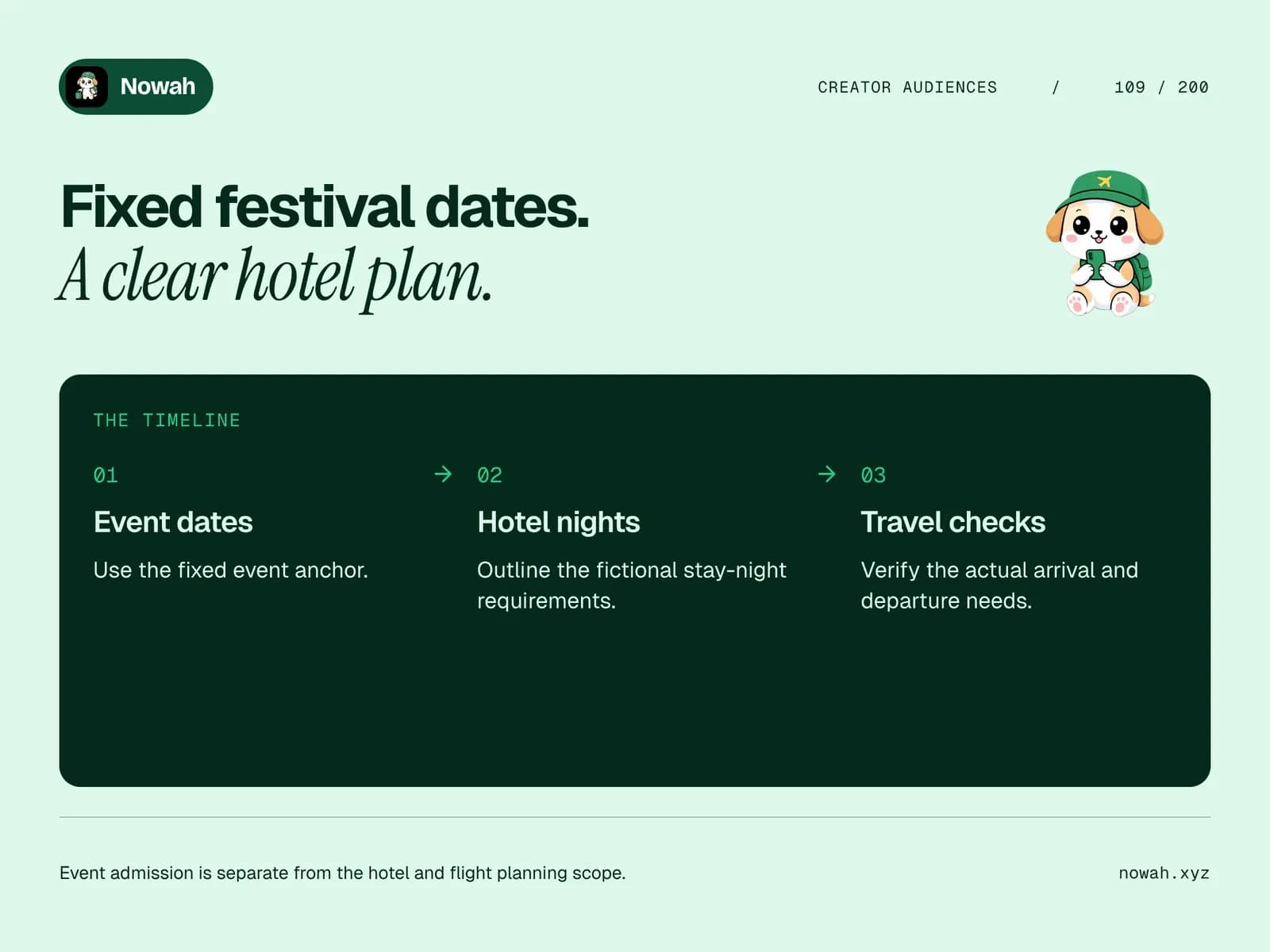
A festival can give an audience a clear reason to travel, while the flight and hotel questions remain unresolved. A useful creator turns the actual event dates into a readable travel brief and identifies the facts that still need checking. Approved Nowah partners can connect that explanation to disclosed referrals and potential earnings from qualifying bookings by newly attributed travellers.
Nowah is a strong fit for the travel research around the event. Show the fixed boundary, explain the accommodation-night question and demonstrate how a changed arrival assumption affects the outline. The audience sees a practical continuation of the festival interest instead of being asked to treat a lively montage as a complete travel arrangement.
Keep the earning scope explicit. Qualifying hotels, flights and paid eSIMs are the listed Nowah partner categories. Festival admission, event passes and other purchases are not automatically commissionable because they appear in the same story.
Establish the actual event facts
Use the relevant organiser's current information for a real event. Do not rely on an old poster, remembered schedule or social clip to establish the dates, location or admission conditions the traveller needs.
For a general demonstration, label the festival details as fictional teaching inputs. You can explain the relationship between an event and travel without inventing a real current schedule or implying that a particular ticket is available.
Keep an actual commitment separate from an idea. A person interested in a festival does not necessarily have admission arranged, and a saved post does not establish the whole trip. The travel brief should preserve that status rather than quietly turn every attractive event into a confirmed anchor.
Translate event dates into accommodation questions
The event date, the period away and the accommodation nights are different inputs. Show how the actual travel window relates to the dates being investigated instead of assuming they all match.
A creator should not prescribe one universal arrival pattern for every festival trip. The relevant flight information, provider conditions and traveller priorities determine what needs investigation. If the arrival crosses dates or creates a hotel-access question, make that dependence visible.
The late-arrival accommodation guide offers a verification sheet for that narrower situation. Its useful principle is to keep the actual local date and arrangement status clear rather than infer a benefit from the property's style.
Build an event-date-to-hotel-night outline
Give readers a record they can adapt. Useful fields include:
- The event and the source of its current relevant information.
- Whether admission is an idea or an actual separate commitment.
- The travel window and flight-arrival direction being investigated.
- The accommodation nights and rooming requirements.
- Movement or provider questions still unresolved.
- The next fact needed before relying on the travel direction.
Do not fill the outline with invented journey times or a guaranteed room arrangement. A visibly unresolved field helps the audience see what the recommendation depends on.
Keep the event and travel evidence separate. The record can show how they relate without implying that one admission decision establishes hotel availability or that a hotel search confirms the festival arrangements.
Demonstrate the fixed-date brief in Nowah
Use Nowah to explore the fictional travel requirements with the event boundary and admission status clearly labelled. Explain which question you are testing: an accommodation direction, the night outline or the effect of revising an arrival assumption.
Review the proposed plan against the brief. If it treats an unresolved arrangement as confirmed or schedules a movement across a fixed commitment without evidence, identify that issue and revise the question. Show the change so the audience understands the reasoning.
The practical Nowah recommendation concerns the clearer planning conversation and relevant flight, stay and paid-connectivity research. It does not imply that the service guarantees admission, event conditions, current availability or every provider arrangement in the story.
The culture-creator activity guide addresses a related task inside the trip: distinguishing fixed anchors from optional interests. Link when the audience needs to decide how much else belongs around the festival commitment.
Compare two fictional travel windows
Imagine a fictional traveller investigating two travel-window directions around the same event boundary. The directions create different accommodation-night and arrival questions. They are teaching scenarios, not current fares or verified packages.
Keep the party, rooming needs and relevant event inputs consistent. Do not make one direction look easier by giving it an assumed transfer, an extra usable morning or a confirmed inclusion that the other direction lacks.
Use Nowah to refine the preferred brief after the traveller identifies the priority. Return to the outline and update the unresolved facts. A useful conclusion may be the next research action rather than a claim that one travel window is universally best for festival visitors.
The premium short-break guide provides a usable-time ledger that can be adapted across budgets. It helps when the trip's whole arrival-to-departure window is narrow, rather than only the event itself being fixed.
Keep the hotel offer tied to the actual traveller
When research reaches specific properties or rates, identify occupancy, relevant inclusions and actual conditions. Do not infer a transfer, special access or flexible arrangement from a property appearing in festival content.
Your own stay can provide useful observations when described honestly, but it does not establish what every future traveller receives. Current supplier information and fictional planning should remain distinguishable from personal footage. A generated diagram can explain the outline without proving an actual visit or current route conditions.
If an important event or travel input changes, revisit the affected night and accommodation assumptions. A new date on a graphic should not imply that the whole itinerary has been rechecked when only one label was updated.
Give the audience a useful disclosed action
When recommending an active Nowah partner link, say that you may receive commission from qualifying referred bookings. Put the relationship beside the relevant research step so the audience understands the destination and your commercial connection.
A traveller needs the appropriate disclosed referral route. Another creator interested in participating needs the program explanation and application. Do not combine those journeys into a vague invitation that leaves the viewer unsure whether they are beginning travel research or partner onboarding.
For a shorter video or shareable image, preserve the fictional label and the unresolved condition that affects the recommendation. The companion article can hold the full outline, but the short version should not imply a confirmed event-and-hotel package if the detailed explanation remains provisional.
Keep admission status visible when the fictional brief changes. If the event remains only an idea, the travel outline should not imply that a confirmed commitment already exists. If the traveller has actual admission arranged, the relevant dates and conditions belong with the evidence for that arrangement rather than with an older saved post.
The creator can still demonstrate useful flight and stay research while those statuses differ. Show which input the Nowah brief is using and why the next provider question matters. If the short video and the companion outline describe different assumptions, revise them together. A useful event-led resource should help the audience understand the dependencies instead of making a polished travel sequence appear to settle admission, accommodation and movement at once.
Explain attribution without counting every festival viewer
Under the Nowah terms, an eligible traveller must follow an active partner link and create a new account within 30 days of the introduction. Existing accounts, self-referrals and artificial accounts do not qualify. Tracking must reach Nowah successfully; a festival post's reach, a saved guide or a link click is not proof of attribution.
Once valid attribution is established, it can remain for that traveller account's lifetime, including qualifying later bookings. That offers a potential continuing relationship while future travel and income remain unguaranteed. It does not automatically attribute an entire group attending the event.
The partner receives 35% of Nowah net revenue after the direct deductions defined in the terms, not the traveller's total festival budget. A labelled hypothetical $60 of Nowah net revenue produces $21 in partner earnings. That does not predict the return from either fictional travel window or establish a commission on admission.
Completion, supplier settlement, the applicable hold and payout conditions matter before earnings become eligible. Keep useful research, valid attribution, qualifying bookings and completed payouts distinct when discussing results.
The older Nowah article on how events relate to flight prices provides background for event-led travel questions. Do not treat it as a current quote or a forecast for the fictional example.
To participate, apply to Nowah Partners. Applying is free, applications are reviewed and there is no minimum follower count. Begin with accurate event inputs, demonstrate a useful Nowah travel brief and give followers a transparent way to investigate the journey around their interest.




