How Premium Short-Break Creators Can Earn With Useful Nowah Planning Guides
Help short-break audiences compare usable travel windows and continue practical flight and hotel research through Nowah.
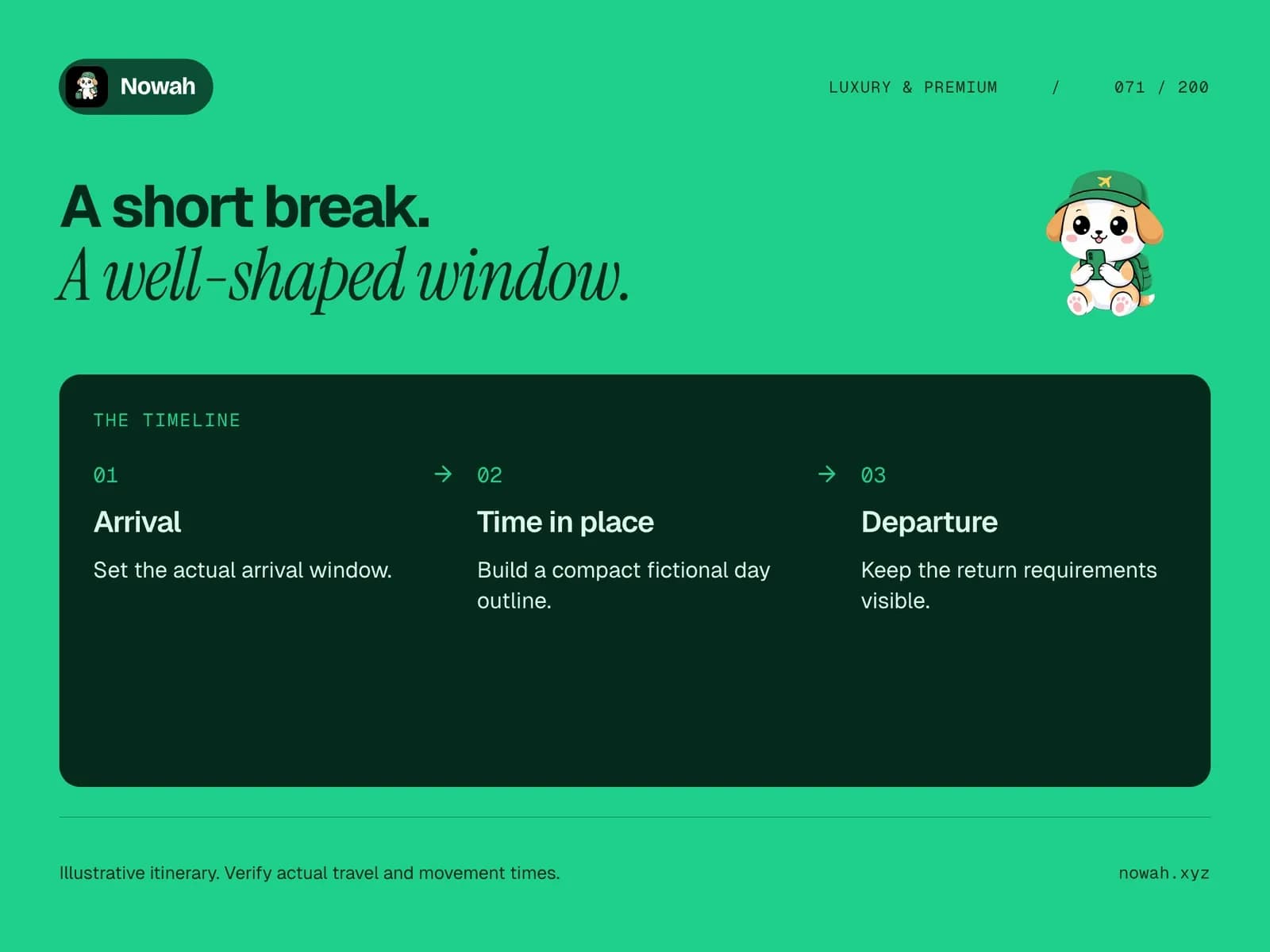
A premium short break is a compact travel decision, not simply a longer holiday squeezed into fewer days. Arrival and departure boundaries determine how much time a traveller can actually use, while the accommodation and day plan need to justify their place inside that window. An approved Nowah partner can turn that explanation into a useful demonstration, a disclosed referral and potential earnings from qualifying bookings by newly attributed travellers.
Nowah is a strong fit when your content shows how to compare a brief rather than simply advertise an escape. Give the audience a current travel window, one clear priority and a realistic planning question. Demonstrate how those inputs affect flight and hotel research, then explain what still requires verification.
The earning opportunity follows a valid traveller introduction and qualifying travel. A premium label, a high room price or an appealing weekend video does not establish a commission amount. The partner share is 35% of Nowah net revenue, not the traveller's total booking expenditure.
Define the window before describing the destination
Start with the earliest workable departure and the latest acceptable return. Distinguish the traveller's whole time away from the destination nights and the periods available for activities. A two-night stay does not necessarily mean two full destination days.
For a public demonstration, use a fictional brief and label it. Imagine a traveller comparing a two-night break with an evening arrival, a fixed return boundary and one priority experience. Explain which parts are assumptions and which details would need actual flight or accommodation evidence.
Avoid inventing universal airport, transfer or check-in allowances. The point is to identify the timing questions, not to give a precise-looking answer without a route or provider. Your content becomes useful when a follower can see what must be established before the short break can be evaluated fairly.
Build a usable-time ledger
A usable-time ledger gives each part of the trip a clear role. Suggested entries include:
- Outbound travel and the actual arrival boundary.
- Accommodation arrival questions that need confirmation.
- The first period genuinely available for the traveller's priority.
- Deliberately open time or optional activities.
- The actual departure requirements still to investigate.
- The point at which the traveller must stop treating the final day as free time.
Keep uncertain entries marked as uncertain. Do not subtract an assumed transfer duration and then present the remaining hours as a verified itinerary. If an important timing question is unresolved, show how the recommendation depends on that answer.
The ledger is a practical resource for a carousel, newsletter or companion article. It helps the audience compare short-break structures without relying on an attractive montage to imply that everything fits.
Demonstrate the constrained brief in Nowah
Use Nowah to explore the fictional trip's actual planning question. You might ask for a compact day structure that preserves one priority and leaves the arrival period light. State the departure boundary as clearly as the desired activities.
Review the proposed direction against the ledger. If a suggestion fills the final morning with a distant activity, explain why that sequence needs checking. If it treats an evening arrival as a full sightseeing day, revise the outline. Show the audience how a better brief changes the planning conversation.
Nowah belongs in the main teaching sequence: brief, proposed direction, review and revision. Do not imply that an itinerary draft confirms flight availability, accommodation arrangements or actual journey times. Those remain questions for current booking and supplier evidence.
The late-arrival guide is a useful next resource when the short break begins near an accommodation's relevant arrival boundary. Link at that decision point rather than repeating a full check-in discussion in every short-break article.
Compare the accommodation's role in the break
Ask how the traveller expects to use the stay. A short break centred on time at the accommodation creates different questions from a trip centred on exploring elsewhere. Neither direction becomes suitable merely because the property looks premium.
Investigate the actual location, room and rate conditions relevant to the brief. Do not assume that a particular label includes meals, a late checkout, an early check-in or a service that changes the usable window. If one of those arrangements matters, keep it provisional until supported by the appropriate evidence.
A useful comparison uses matched dates, party and relevant inclusions. If the available offers differ, identify the difference instead of treating their totals as directly equivalent. The traveller's desired rhythm and the actual conditions should explain the recommendation.
For readers thinking about adding a second accommodation base, link to multi-city premium itineraries. It addresses the extra movements and overnight sequence that a very short break may not have room to absorb.
A fictional two-night content example
Imagine the traveller wants one full, unhurried experience during the break and has a fixed return commitment. Direction A keeps the day plan compact around a single base. Direction B adds another location that introduces a movement question and reduces the time left open.
Show the common brief beside both directions. The comparison should not give Direction B an extra morning or assume an unusually convenient transfer. Ask what the extra movement achieves and whether that benefit matches the traveller's priority.
Use Nowah to explore the preferred direction after making the tradeoff explicit. Explain which information remains unresolved and how it could change the plan. A creator can give a clear recommendation to investigate one direction without declaring the entire trip confirmed.
The early-departure hotel-choice guide helps when the return boundary, rather than the outbound journey, determines the accommodation question. That is a distinct next task that can materially change a short-break decision.
Make the recommendation transparent
Put your partner disclosure beside the recommendation to continue in Nowah through an active partner link. Explain that you may earn commission from qualifying referred bookings. The viewer should understand the relationship and the travel task before deciding whether to follow the link.
Under the Nowah terms, an eligible traveller must follow an active partner link and create a new account within 30 days of the introduction. Existing accounts, self-referrals and artificial accounts do not qualify. Tracking must successfully reach Nowah; an interested comment or a link click is not proof of an established attribution.
Once valid attribution exists, it can remain for the lifetime of that traveller account, including qualifying later bookings. A genuinely useful short-break introduction can therefore be relevant beyond one weekend. Future travel and earnings are still not guaranteed.
If a viewer wants to become a partner, provide the application destination. If the viewer is planning the short break, use the relevant disclosed traveller referral route. Those are different journeys even when both begin with the same article.
Explain the earning calculation without promising a weekend result
Nowah's qualifying categories include hotels, flights and paid eSIMs. The creator share is 35% of Nowah's defined net revenue from qualifying attributed bookings. It does not use the traveller's full booking price, and premium positioning does not establish a particular net revenue amount.
For a labelled illustration, $60 of Nowah net revenue produces $21 of partner earnings at a 35% share. That is arithmetic, not an observed return from a two-night campaign or an estimate of what a particular follower will generate.
Completion, supplier settlement, the applicable hold and payout requirements also matter. A saved post, a new account, a pending booking and eligible earnings are different outcomes. Keep the short-break guide focused on the useful travel decision while explaining the commercial conditions accurately.
When you turn the ledger into a graphic, preserve the arrival and departure boundaries in the same view as the proposed day plan. A short-break image can otherwise suggest more usable time than the article actually describes. If the route still has an unresolved timing question, keep that label in the shareable version. The audience should be able to understand why the compact direction is worth researching without having to reconstruct hidden assumptions from several posts or remember a qualification from an earlier video.
Edit the guide around the constraint
If the article becomes a list of every possible activity, return to the fictional traveller's single priority. Remove suggestions that do not advance the decision. A compact guide can still be thorough when it explains the assumptions, tradeoffs and checks that determine whether the trip works.
The older Nowah article on how AI ranks flight options provides additional context for exploring travel choices. Your short-break resource should explain which timing and accommodation questions matter for this brief rather than assuming that one appealing option is universally best.
To participate commercially, apply to Nowah Partners. Applying is free, applications are reviewed and there is no minimum follower count. Start with a well-defined window, demonstrate a useful Nowah planning task and give followers a clear, disclosed next step that respects the time they actually have.




