Follower count vs travel intent: build a focused Nowah creator recommendation
Build a focused Nowah recommendation by separating follower count from travel intent, with an audience grid and a useful planning demonstration.
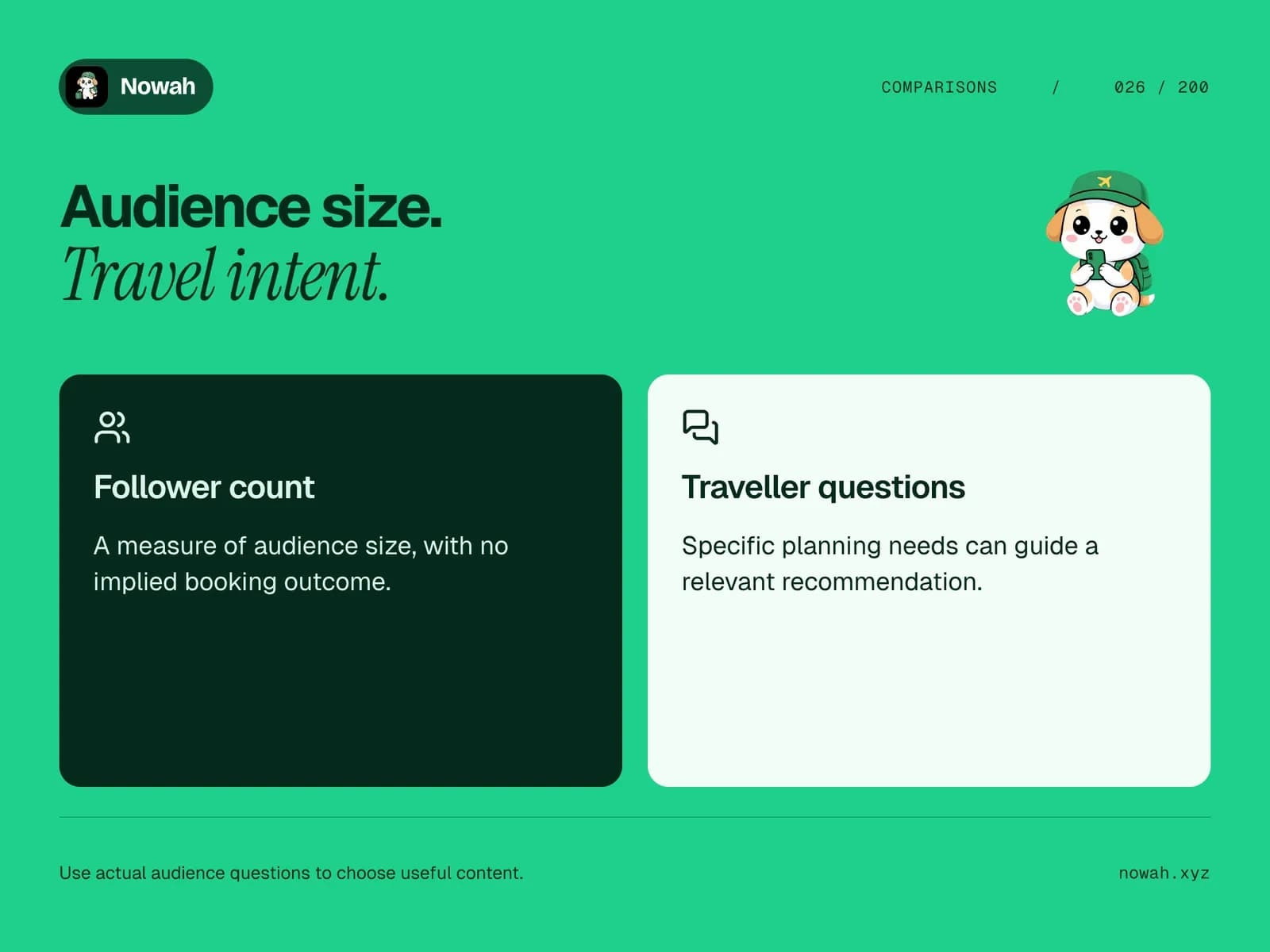
A large audience and a specific travel question are different assets. Follower count describes reach on a platform; it does not establish whether someone is planning a trip, needs the task you demonstrate or will complete a qualifying booking. For creators considering Nowah, the useful starting point is the audience decision your content can help with.
The Nowah Partner Program advertises no minimum follower count, with applications reviewed and eligibility requirements still applying. Approved partners can earn 35% of Nowah net revenue from qualifying bookings by eligible attributed accounts, including later qualifying bookings under the continuing account relationship.
That gives a focused creator a meaningful opportunity to investigate without inventing an income forecast. This guide shows how to build an audience-intent grid, select one useful demonstration and keep the commercial explanation separate from unmeasured assumptions about audience size.
Separate attention from a travel decision
Someone may follow a travel account for beautiful footage, humour or inspiration. Another follower may be actively choosing where to stay for an upcoming visit. Both are legitimate audience relationships, but they do not call for the same recommendation.
A useful Nowah content idea starts with a concrete question: how to compare hotel areas, organize a short-trip brief or prepare current information before investigating bookings. The relevance of that question matters more than an assumed percentage of followers who will buy.
Do not infer private travel plans from likes, appearance or a broad demographic label. Use actual questions, appropriate feedback and clearly stated editorial hypotheses. If you have not measured demand for a topic, describe the idea as something to test rather than a proven commercial opportunity.
The audience-fit worksheet is a useful companion for defining who a piece of content is intended to help.
Work through two fictional creator situations
Imagine one creator publishes broad destination inspiration and another answers detailed questions about short city breaks. These are fictional situations with no measured conversion or earnings results.
The first account may attract considerable attention without knowing which viewers are currently planning a trip. The second may have a smaller, more focused discussion about hotel areas and arrival constraints. Neither situation proves that one creator will earn more.
The practical difference is the question available for the next piece of content. The broad account may need to identify a specific travel task before adding a partner recommendation. The focused account may already have a useful question to demonstrate in Nowah.
A large audience can contain relevant travellers, and a small audience can contain none. Avoid replacing one simplistic promise with another. The point is to make the recommendation useful to a defined reader, not to claim that follower count is irrelevant to every business decision.
Build an audience-intent grid
Create three columns for observations, interpretation and next useful content. Keep them separate so that a signal does not silently turn into a certainty.
An observation might be an actual question about choosing a hotel area. The interpretation could be that the reader needs help comparing location priorities. The next content idea might be a labelled Nowah planning demonstration for a fictional short trip.
A saved scenic reel is a different observation. It may indicate interest, but it does not prove an upcoming booking. Your next useful content could ask a relevant question or explain a specific planning tradeoff rather than jump straight to an earnings pitch.
Add a fourth column for what you do not know. The viewer's account eligibility, actual travel date or purchase intentions may remain unknown. A good grid helps you choose useful content without pretending to establish private facts.
Turn one question into a Nowah demonstration
Choose a task you can explain well. For a hypothetical example, use two adults visiting a city for three nights with an evening arrival and a preference for a compact daily pace. Label the details fictional rather than presenting them as a real follower's private itinerary.
Show how you would organize the brief in Nowah, explain the location or timing question and identify the next detail to investigate. Keep current availability, supplier conditions and transport arrangements subject to verification. A planning output helps structure the decision; it does not certify every travel fact.
Nowah belongs naturally in this content because it helps the viewer continue a recognisable planning task. The recommendation is then more than a link placed after unrelated footage.
The one-question demonstration guide can help you keep the example focused enough to be understood in a short video or concise article section.
Explain the program's actual entry requirements
Nowah advertises no minimum follower count and free applications, but applications are reviewed. The terms require adult eligibility, accurate information and approval before promoting an active partner link. Payout eligibility also depends on supported-country capabilities and Stripe verification.
Do not present the lack of a follower minimum as automatic acceptance, unrestricted country availability or guaranteed income. The useful message is that a creator can consider the opportunity based on relevant work and the actual eligibility requirements, rather than assuming a public follower threshold excludes them.
The no-minimum-follower-count guide provides a focused explanation. Link to it when a reader's question concerns program access rather than the audience-content strategy developed here.
Your application and your audience recommendation are also separate journeys. Another creator needs the program information and application; a traveller needs the appropriate active partner route once you are approved.
Understand what creates an eligible account relationship
An eligible new traveller must follow your active Nowah partner link and create a new account within 30 days of the valid introduction, with tracking successfully recorded. Existing accounts, self-referrals and artificial accounts do not qualify.
Once established, attribution remains for the traveller account's lifetime and can apply to later qualifying hotel, flight and paid eSIM bookings. That continuity can suit useful evergreen content which helps a new traveller begin planning before they choose every purchase.
The model remains conditional. A follower may watch without clicking, click without an eligible signup or register without ever completing a qualifying booking. Do not convert the audience-intent grid into a forecast of account value or income.
The clicks-versus-attribution guide helps you keep those events distinct when interpreting actual evidence later.
Keep the earning example attached to the correct base
Approved Nowah partners receive 35% of Nowah net revenue from qualifying bookings by eligible attributed accounts. Under the current terms, the base is revenue actually received for the booking, less specified direct deductions. General overhead, salaries and general marketing are excluded from that deduction list.
As hypothetical arithmetic, a qualifying booking producing $60 of Nowah net revenue would generate a $21 partner share. That example does not establish the value of a follower, a view or a new account. The traveller's retail booking price is not the commission base.
Actual earnings also require completion and supplier settlement, followed by the hold and relevant payout conditions. A pending amount is not a bank receipt. These distinctions make the Nowah opportunity easier to understand without weakening its appeal.
Review the recommendation before distribution
Read the content as someone who does not know your account. Can they identify the travel question, understand the fictional example and see what the link helps them do next? If not, improve the explanation before trying to reach more people.
Disclose the partner relationship alongside the recommendation and test the actual link surface on the platform. A blog link, profile destination and video description may have different behaviour and conditions. Do not assume every audience member can follow the same route.
The existing 20-tab planning discussion provides useful background for simplifying the reader's next decision. A useful handoff should reduce confusion rather than ask the viewer to reconstruct why the recommendation matters.
Measure evidence instead of validating a follower-count theory
After publication, record the actual questions and available program events with their definitions. A comment can reveal confusion without proving purchase intent. A click can show interest without establishing an attributed account. Do not invent conversion improvements to justify the idea.
Use the audience-intent grid to choose the next useful explanation. If a viewer asks about rooming, create a rooming question resource. If the destination is unclear, improve the handoff. Avoid responding to every uncertain result by publishing a larger volume of the same generic recommendation.
Nowah gives creators a strong opportunity to connect useful travel advice with eligible new-account relationships and qualifying bookings. Choose one real audience question, prepare the grid and apply to Nowah Partners if the model fits your work. Applications are reviewed, and approval, eligibility and verification requirements apply. Let the practical reader need shape the content, then assess the commercial result through actual qualifying events rather than follower-count assumptions.




