How Honeymoon Creators Can Turn Route Comparisons Into Nowah Referrals
Use honeymoon route comparisons to help followers plan through Nowah and understand qualifying partner earnings.
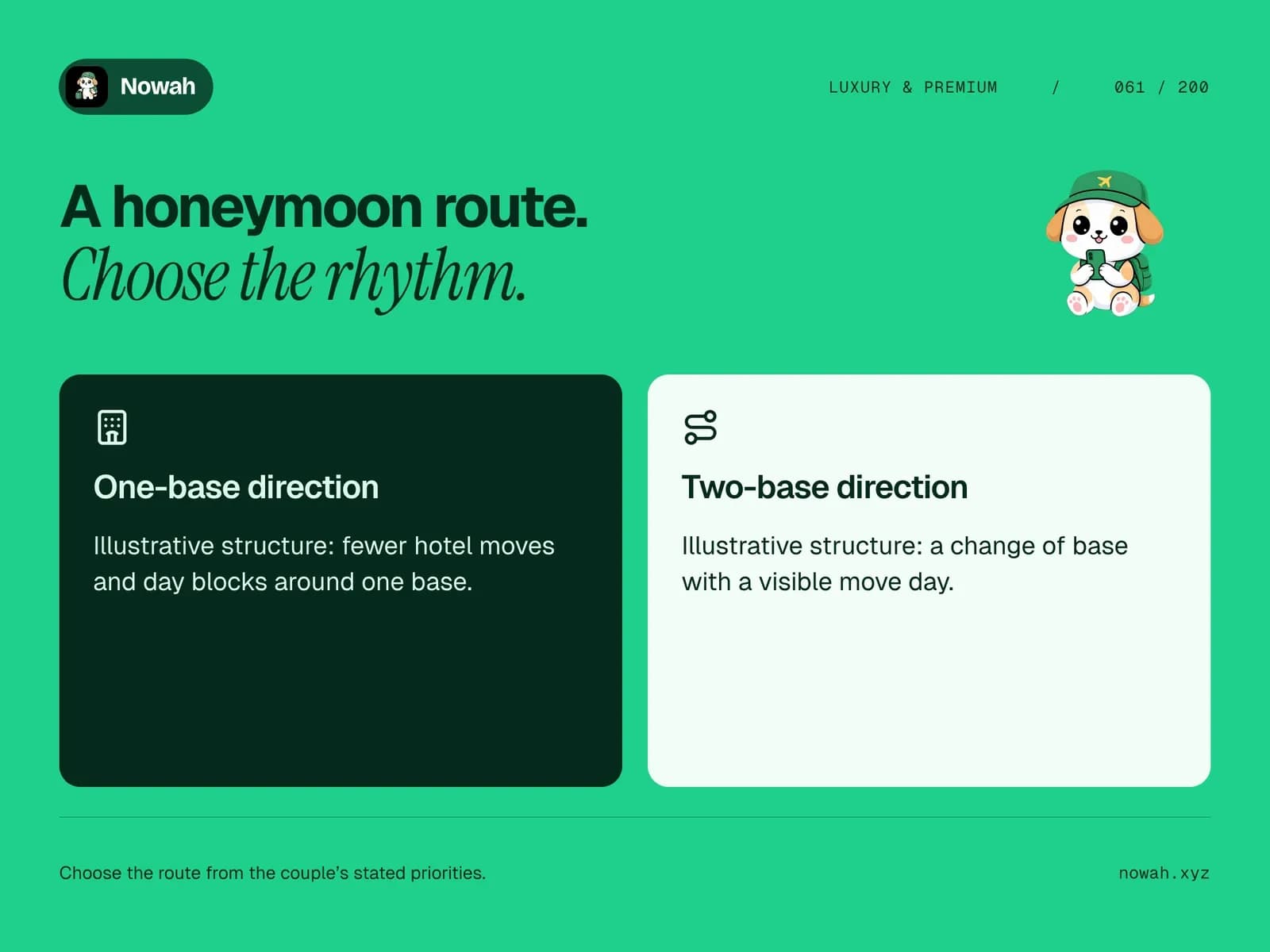
A honeymoon creator earns attention with beautiful places, but a couple often needs help with a less photogenic decision: how much moving should this trip involve? A comparison between one relaxed base and a two-stop honeymoon can turn saved inspiration into a usable travel brief. With Nowah Partners, an approved creator can connect that useful recommendation to a disclosed referral and potentially earn from qualifying bookings by a newly attributed traveller.
Nowah is especially useful when your content explains a decision rather than presenting a destination as universally romantic. You can show how the same couple's dates, departure point and preferred pace lead to different trip structures. Your recommendation then has a practical next step: explore the relevant flights and accommodation through Nowah, using your active partner link where appropriate.
The commercial opportunity comes from a valid new traveller relationship, not from the price tag attached to a honeymoon. The partner share is 35% of Nowah net revenue on qualifying bookings. It is not 35% of what the couple spends.
Make the comparison about one real decision
Choose a question that changes the route. “Where should we honeymoon?” is broad enough to produce an attractive but inconclusive list. “Should we spend seven nights in one place or divide them between two bases?” gives the reader something specific to evaluate.
State the common assumptions before introducing either direction. These might include seven nights away, an international arrival, a desire for relaxed mornings and one memorable food experience. Explain whether travel days sit inside those seven nights. A two-base plan can look generous until a transfer consumes an afternoon that the couple expected to spend together.
Keep the inputs consistent across the comparison. Do not give one option convenient flight timings and the other a difficult overnight connection unless that difference is the point you have verified. Your audience should be able to see which advantage comes from the route and which comes from an assumption.
For a broader method of discussing two people's priorities, use the guide to different interests on a couples' trip. It helps prevent a route comparison from assuming both partners want the same holiday.
Demonstrate the brief in Nowah
Prepare a fictional brief for the article or video, and label it clearly. For example: “We are comparing two honeymoon structures for a couple with seven nights, a late afternoon arrival and a preference for three unhurried mornings.” This is a teaching example, not a claim about an actual customer's booking.
Use Nowah to explore the itinerary question with those constraints. Explain what you want to learn: how the proposed bases fit the travel dates, which days involve movement, and what hotel-area questions remain. Show the reasoning and any revisions you make rather than implying that an initial AI response certifies every detail.
A useful demonstration might reveal that a two-base route has a hotel move immediately after a long arrival day. Revise the plan, or explain why a single base better respects the stated pace. The value is in making the tradeoff visible. You do not need to invent a “perfect” itinerary to make Nowah's planning workflow compelling.
Check current flight and accommodation details through the appropriate booking information before presenting an option as available. Do not turn a planning suggestion into a promise of a room, connection or supplier arrangement.
Use a route decision worksheet
Give the couple a worksheet they can complete after watching. Keep the categories concrete enough to change the recommendation:
- Nights available: distinguish nights at the destination from the full leave period.
- Fixed anchors: record a ceremony date, celebration meal or prepaid event only if it exists.
- Movement preference: ask how much packing, checking out and transferring feels worthwhile.
- Daily pace: identify mornings or days that should remain deliberately light.
- Accommodation priorities: separate room requirements from attractive property imagery.
- Open questions: list actual timings, inclusions and arrangements still needing confirmation.
Use the completed worksheet to explain the route, not to assign a compatibility score to a relationship. A traveller choosing fewer stops is making a legitimate preference decision, not failing to maximise the trip.
If the accommodation discussion becomes detailed, link to premium rate inclusions so readers understand which offer conditions deserve a separate check. A route comparison should not quietly assume that breakfast, transfers or a particular cancellation option comes with every hotel rate.
A hypothetical comparison with a clear conclusion
Imagine the fictional couple wants a city experience and a quieter final stretch. Direction A keeps all seven nights at one base and treats outings as optional. Direction B divides the stay between two bases, with one hotel-change day in the middle.
Your comparison could explain that Direction A creates more continuity: the couple unpacks once, develops a familiar daily rhythm and has greater freedom to abandon an outing. Direction B provides a more pronounced change of setting but introduces packing and movement that need to earn their place in the schedule.
Neither direction requires invented journey times. Put “transfer duration to verify” beside the movement day. If the exact route is not yet selected, that is an honest planning question rather than a weakness to conceal.
Your recommendation might be: “For the preferences in this example, start by researching the single-base direction. If a second setting is essential to your honeymoon, compare the actual movement and hotel conditions before committing.” Then demonstrate how to refine that brief in Nowah. You have connected a useful conclusion to a relevant product action without pressuring every viewer into the same booking.
Place the partner action at the decision point
Introduce the commercial relationship where you recommend using Nowah. A plain explanation might say that you are a Nowah partner and may receive a commission from qualifying referred bookings. Do not hide that information behind a generic “links below” message or a separate profile page.
The Nowah program terms require an eligible traveller to follow an active partner link and create a new account within 30 days of the introduction. Existing accounts and your own bookings do not create eligible new referrals. Tracking must work; publishing a link does not establish attribution by itself.
Once a valid account attribution is established, it can continue for that account's lifetime, including qualifying later bookings. That gives a creator a reason to make a genuinely useful first recommendation rather than chasing a single expensive honeymoon purchase. It does not guarantee future bookings or recurring income.
Keep a creator application link separate from the traveller action. Someone watching because they also create travel content should reach the program explanation and application. Someone planning a honeymoon needs the appropriate disclosed traveller referral route.
Explain earnings without turning romance into a forecast
Use a labelled arithmetic example if readers ask how the program works. If a qualifying booking produces an illustrative $60 in Nowah net revenue, a 35% share is $21. That example describes the calculation, not an average honeymoon commission or an earnings prediction.
A larger booking total does not tell you Nowah's net revenue. Qualifying hotels, flights and paid eSIMs fall within the listed program categories; a restaurant meal, celebration package or other service should not be presented as commissionable without supporting program evidence.
Earnings also pass through completion, supplier settlement and the applicable hold and payout conditions. The luxury creator earnings guide explains why content should distinguish the travel decision from the later commission calculation.
Film the comparison so the decision stays visible
Use the same visual structure for both route directions. Show the nights, the movement day and the open questions together, so a viewer can compare the plans without remembering details from an earlier clip. If you use separate posts, repeat the common brief rather than changing the fictional couple between episodes.
A helpful closing question is whether the viewer would exchange an extra hotel move for a different setting. It invites a relevant preference, not private honeymoon information. Use the answers to choose your next demonstration topic; do not describe them as confirmed bookings or proof of earnings.
Keep the resource useful after publication
Review the assumptions whenever you refresh the article. Check that the linked program destination remains appropriate, that any supplier facts are current, and that your example is still visibly hypothetical. If followers repeatedly misunderstand whether movement days count as holiday days, improve the worksheet rather than simply adding another destination to the list.
The older Nowah article on multi-city trip intelligence provides additional context for explaining why route relationships matter. Use that background to strengthen the planning discussion, while keeping the honeymoon guide focused on this couple's pace and priorities.
For creators, the next commercial step is to apply to Nowah Partners. Applying is free, there is no minimum follower count, and applications are reviewed. Build your first demonstration around one clear route decision, explain the recommendation honestly, and give your audience a useful way to continue planning through Nowah.