Luxury Creator Earnings: How to Calculate the Nowah Partner Share
Understand luxury creator earnings through Nowah net revenue, the 35% partner share and clearly labelled arithmetic examples.
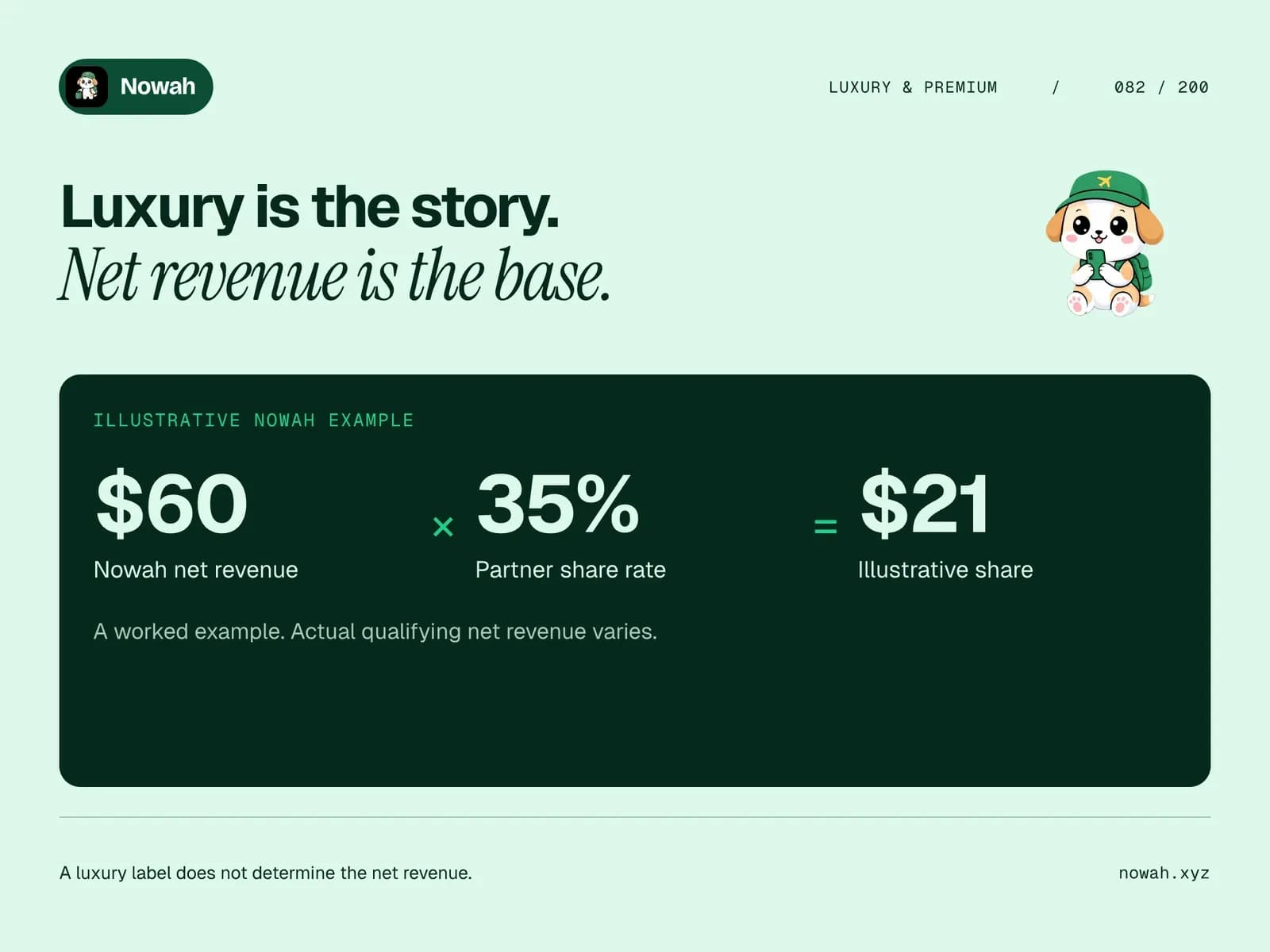
Luxury travel content can inspire substantial bookings, but the traveller's booking price does not tell a creator what they earn. The useful number is Nowah's defined net revenue from qualifying attributed travel. Approved Nowah partners receive 35% of that base, with eligibility, completion and payout conditions still applying.
This is a strong earning story when explained accurately. A creator can introduce a new traveller through a useful recommendation and potentially earn from that account's later qualifying bookings as well. The calculation becomes credible when the audience can see the base, the rate and the conditions, rather than being asked to equate an expensive-looking holiday with a large commission.
Use the examples below to teach the arithmetic. Every invented input is expressly hypothetical. None is an average, a forecast or evidence that a particular luxury review, follower or booking has generated earnings.
Begin with the public $60 example
Nowah's published illustration uses $60 in qualifying Nowah net revenue. The partner calculation is:
Illustrative partner earnings = $60 × 35% = $21.
The $60 is already the net revenue base. Do not subtract unspecified expenses from it again, and do not relabel it as the traveller's hotel price. The example explains the formula, not the price of a room or the expected value of a luxury trip.
A useful image or on-screen calculation should keep those labels visible together: illustrative net revenue, partner percentage and illustrative earnings. A large 35% graphic without its base can give the audience the wrong impression even when the full article explains the terms elsewhere.
Understand which revenue the terms describe
The Nowah program terms define net revenue as revenue actually received by Nowah for the booking, less the permitted direct deductions. These include direct payment fees, refunded Nowah revenue, Nowah-funded discounts and applicable transaction taxes. General overhead, salaries and general marketing are excluded from those deductions.
The traveller's total booking price is a different amount. Do not apply the 35% rate to that price, or infer Nowah's revenue from the room category, cabin description or luxury positioning of the content.
This distinction matters when discussing different creator niches. A premium travel audience may investigate different products and priorities, but it does not establish the net revenue of a particular transaction. Explain the actual earning base rather than using “luxury” as a mathematical multiplier.
Work through a fictional net-revenue ledger
For an expressly hypothetical example, imagine that a qualifying booking produces $80 in revenue actually received by Nowah before the permitted direct deductions used in this illustration. Suppose the fictional ledger contains $4 in direct payment fees, $10 in a Nowah-funded discount and $6 in applicable transaction taxes. Assume no refunded Nowah revenue in this example.
The arithmetic would be:
Illustrative Nowah net revenue = $80 − $4 − $10 − $6 = $60.
Illustrative partner share = $60 × 35% = $21.
These inputs were chosen to demonstrate the calculation. They are not typical fees, tax rates, discount levels or a description of an actual booking. Do not use them to estimate future deductions for a viewer's trip.
Notice that the hypothetical ledger did not deduct a salary or a general advertising expense. The example follows the categories in the program definition rather than inventing additional company costs that the creator must absorb.
Show why booking price cannot fill the missing field
Imagine a separate fictional travel plan whose visible booking expenditure is $1,800. That number alone is insufficient to calculate a partner earning. The missing field is the qualifying Nowah net revenue, not the ability to multiply a large number by 35%.
Do not present $630 as the commission on that fictional trip. That would apply the percentage to the traveller's booking expenditure and use the wrong base. Nor should you invent a margin to bridge the gap unless it is clearly an arbitrary teaching assumption with no predictive meaning.
For creator content, the better explanation is simple: the programme calculation uses the qualifying net revenue reported under its terms. A premium rate, an attractive suite or several travellers in the party does not establish that amount.
The premium rate-inclusions guide helps readers examine the travel offer itself. Keep those traveller-facing inclusions separate from the program's revenue definition.
Use a creator arithmetic worksheet
A small worksheet can prevent most errors before they become a published graphic. Suggested fields include:
- Whether the inputs are actual statement evidence or an expressly hypothetical example.
- The qualifying booking and relevant currency.
- Nowah revenue and permitted direct deductions, when those inputs are being illustrated.
- The resulting Nowah net revenue base.
- The 35% partner rate and calculated amount.
- The eligibility and settlement status, kept separate from the arithmetic.
Keep the source or assumption beside each input. An unlabeled number in a polished chart can appear more authoritative than the evidence behind it. If a field is unknown, leave it unknown rather than substituting a traveller budget or a guessed margin.
The terms specify calculation in the settlement currency and rounding once to the nearest minor unit. Avoid adding unnecessary intermediate rounding in a teaching example that would change the final result.
Explain attribution before calling the amount earned
A correct multiplication does not establish that a booking qualifies. Under the terms, an eligible traveller must follow an active partner link and create a new account within 30 days of the introduction. Existing accounts, self-referrals and artificial accounts do not qualify. Tracking must reach Nowah successfully.
Once valid attribution exists, it can persist for the lifetime of the traveller account, including qualifying later bookings. That opportunity is commercially meaningful, but future purchases and income are not guaranteed. A link click is not the same event as a valid new-account attribution.
Nowah's listed qualifying categories are hotels, flights and paid eSIMs. A meal, excursion or other purchase shown in luxury content is not automatically commissionable because it appears in the same itinerary.
The independent-judgement guide explains why the recommendation should follow the traveller's priorities and evidence even when the creator has a financial incentive.
Separate calculated, pending and eligible amounts
Earnings require completed bookings and verified supplier settlement. The 30-day hold begins after the later of completion and settlement. A mathematically correct illustrative share is therefore not a promise that money is immediately available for payout.
The completion-and-settlement guide addresses those events in more detail. Use it when readers need to understand why a booking event and an eligible earning appear at different stages of the workflow.
Refunds, chargebacks and corrected supplier statements can affect earnings under the terms, including after a previous payout. Do not use an early figure as a permanent result without the appropriate status and evidence. The statement history is relevant when explaining an actual correction; a creator should not invent a correction reason to reconcile an unknown amount.
Monthly eligible processing also has a US$50-equivalent minimum separately per settlement currency, alongside verification and other conditions. Do not silently merge currencies or describe a transfer to a Stripe account as the same event as arrival in a bank account.
A second hypothetical base can help demonstrate why the rate and result must remain separate. If qualifying Nowah net revenue were $45 instead of $60, multiplying by 35% would produce $15.75. The partner percentage has not changed; the hypothetical base has. Neither number establishes an average or a minimum earning for luxury content.
Keep the two examples labelled as separate fictional calculations. Do not describe them as two observed creators, two verified hotel offers or evidence that one kind of luxury trip earns more. The comparison teaches a mathematical relationship using invented inputs, while an actual earning still requires qualifying account, booking and settlement evidence.
This also gives a creator a useful final graphic check: can a viewer identify which number is the base, which is the percentage and which is the result? If the answer depends on an explanation hidden in another post, revise the labels before publishing the image.
Make the arithmetic support a useful Nowah demonstration
Build the earning explanation around a real creator task. Show how a luxury review creates a travel question, demonstrate a fictional brief in Nowah and explain the disclosed partner route. Then use the labelled $60 example to teach how a qualifying earning is calculated, without claiming the demonstration itself generated it.
The older article on the anatomy of a hotel recommendation provides background for keeping the traveller's requirements at the centre of the content. A sound earning calculation does not replace a useful recommendation; it explains the commercial relationship that accompanies one.
To participate, apply to Nowah Partners. Applying is free, applications are reviewed and there is no minimum follower count. The practical first step is an honest, relevant demonstration and a clearly disclosed link. Keep the base visible, show the arithmetic accurately and let actual qualifying evidence establish results rather than forecasting income from luxury imagery.




