Instagram Stories vs YouTube Shorts links: plan a clear Nowah recommendation
Compare Instagram Stories and YouTube Shorts handoffs for Nowah recommendations, with account checks and a practical two-channel route card.
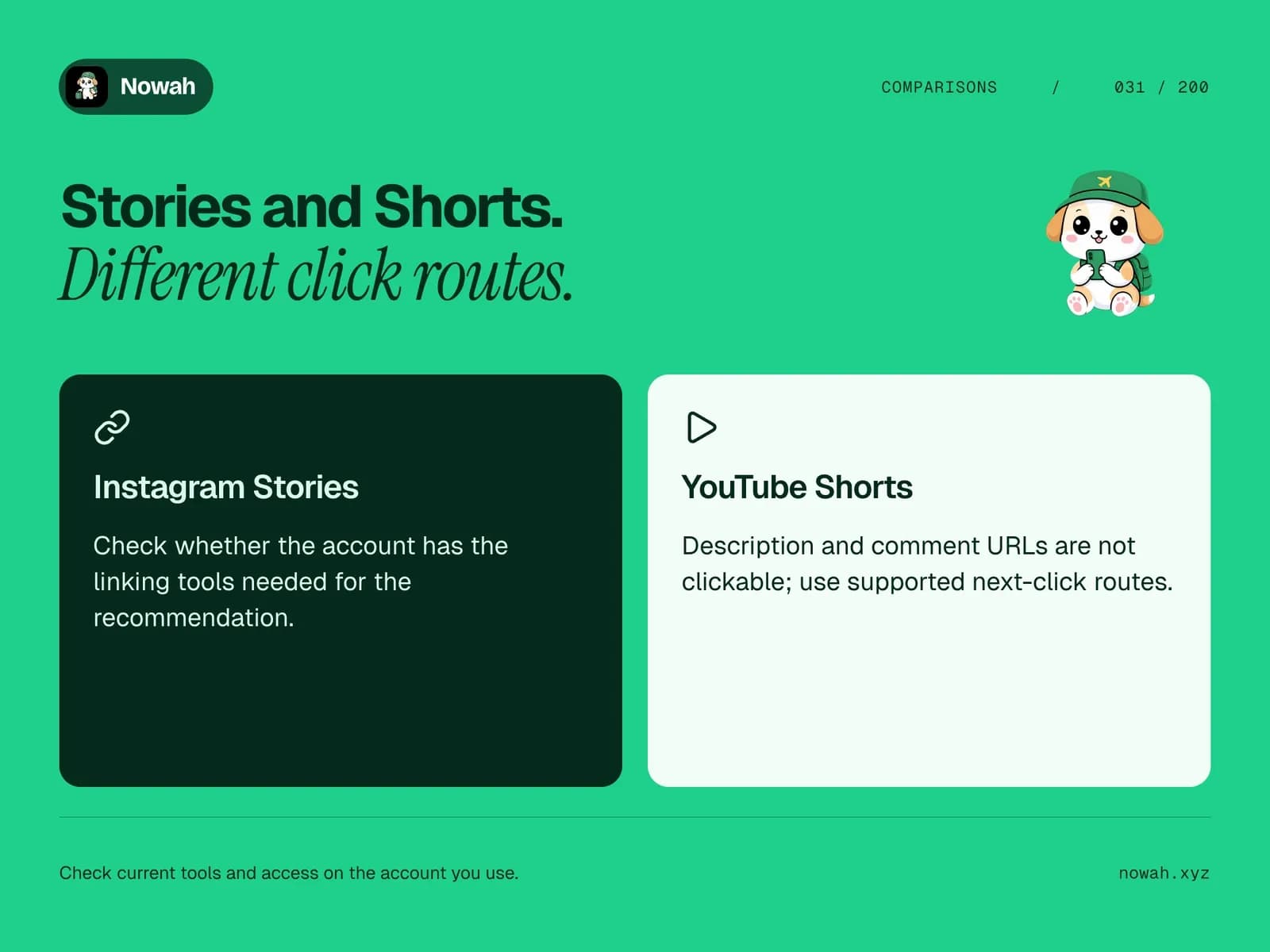
The same travel explanation can work in an Instagram Story and a YouTube Short, but the next-click route should not be copied blindly. A link surface, a spoken instruction and a viewer's actual destination need to agree. For creators recommending Nowah, a useful demonstration is only part of the handoff.
The Nowah Partner Program offers approved partners 35% of Nowah net revenue from qualifying bookings by eligible attributed accounts. Its continuing account attribution gives creators a meaningful opportunity when useful travel content introduces a new traveller. It does not make an unavailable or unclickable link surface work.
This guide compares the handoff you should prepare for Stories and Shorts. It provides a two-channel route card, rather than an unverified universal interface walkthrough. Check the current tools actually available to your account before recording instructions or publishing a recommendation.
Keep the travel task consistent across channels
Choose one question the content helps a traveller understand. A hotel-area tradeoff, a compact trip brief or an arrival-planning question can provide a clear reason to demonstrate Nowah.
The explanation should remain useful when adapted to another format. Do not change the promise from practical planning help to a guaranteed booking outcome merely because the second platform has a different call-to-action convention.
Use the same labelled fictional inputs in both versions if you want to compare the communication clearly. Keep current supplier availability, room conditions and actual transport arrangements subject to verification. A plan or map can organize the question without certifying the trip.
The one-question demonstration guide helps you choose a task narrow enough to teach in either short format.
Verify the actual Instagram Story route
Inspect the current Story tools available on your account and confirm the destination you can actually provide. Do not rely on an old screenshot or assume every account has the same features and restrictions.
Meta announced its Story link-sticker format in 2021, with account exclusions described in its official announcement. That historical announcement is not a substitute for checking your present account or a complete current walkthrough. This guide therefore does not promise a universal sequence of buttons.
If an appropriate link surface is available, give the viewer a specific reason to use it. The surrounding frame should explain what the Nowah destination helps them continue, rather than simply displaying an unexplained arrow or generic “tap here” message.
Test the actual destination in the format a viewer will encounter. A visible link label should describe the real next task, including the difference between a creator application and an approved traveller recommendation.
Understand the YouTube Shorts limitation
YouTube's official link guidance states that URLs in Shorts descriptions and comments are not clickable. Pasting an external address there is not the same handoff as a clickable blog link.
The same guidance describes channel-profile links and related-video routes, with separate conditions for external linking from long-form content. Check the tools and access available to your actual channel before selecting a route.
Your spoken call to action should match that route. If the next step is another video, explain what it adds. If the relevant destination is on the channel profile, identify the useful reason to visit it. Do not tell viewers to click a Shorts-description URL as though it supports that behaviour.
The YouTube long-form versus Shorts comparison provides a deeper look at choosing between those content surfaces.
Work through a fictional two-format example
Imagine a creator preparing a labelled demonstration for two adults taking a three-night city break with an evening arrival. The content explains one hotel-area priority and shows how the trip question can be organized in Nowah. No actual creator results are being reported.
For the Story version, the creator plans a sequence with the question, useful demonstration and disclosed next action. The destination depends on the current appropriate tools available to the account. Each frame should retain enough context that the commercial recommendation remains understandable.
For the Short, the creator preserves the same travel question but changes the next-step explanation to match the channel's actual route. A related longer explanation, where appropriate and available, should answer the promised follow-up rather than merely repeat the Short.
The example does not forecast which format will perform better. Its purpose is to prevent a useful Nowah recommendation from being undermined by a confusing or unsupported click instruction.
Build a two-channel route card
Create one row for Stories and another for Shorts. Give each row six fields: travel question, useful demonstration, available link surface, actual destination, next action and disclosure placement.
Add the date you checked the account tools. If a surface is not available, change the instruction before publishing instead of leaving a call to action that cannot be followed. A missing tool is an editorial constraint, not evidence that the audience lacks interest.
Then read each row as a viewer. The question and demonstration should align with the destination. If the content promises help with a traveller's own trip, the reader should not unexpectedly arrive at a form intended for influencers applying to a program.
The one-link versus clear-next-step guide helps review the wording around the handoff itself.
Distinguish the two Nowah audiences
A creator-facing article can invite another influencer to learn about the program and apply to Nowah Partners. Applications are reviewed, applying is free and the program advertises no minimum follower count. Approval, eligibility and verification requirements still apply.
A traveller-facing recommendation needs the appropriate active partner route once you are approved. The viewer's practical task is to continue planning, not to become a partner merely to investigate a holiday.
Keep those destinations separate in the route card and in your actual content. Both can be useful, but they create different journeys. Confusing them makes it harder for the viewer to understand why Nowah appears in the explanation.
The creator acquisition versus traveller-referral guide is a useful next resource for planning content that serves both audiences without mixing their actions.
Review the route without your preparation notes
Ask someone unfamiliar with the demonstration to describe what each version promises and where they expect to go next. Keep the exercise focused on comprehension rather than asking them to create a test traveller account or make a booking. Their answer can reveal whether the Story label, the Short narration or the destination description is unclear.
If the two formats require different routes, say so directly. A viewer should not need to infer that a reference to a profile belongs to one channel while a link label belongs to another. Update the script and the route card together so the published instructions remain consistent.
Explain attribution without promising every click qualifies
Under the current Nowah terms, an eligible new traveller must follow an active partner link and create a new account within 30 days of the valid introduction. Tracking must successfully reach Nowah. Existing accounts, self-referrals and artificial accounts do not qualify.
Once established, attribution remains for the traveller account's lifetime and can include later qualifying hotel, flight and paid eSIM bookings. This continuity is a meaningful reason to build useful evergreen recommendations across channels.
It does not establish that every profile visit, link interaction or shared Story creates an attributed account. A navigation check also does not prove future booking eligibility or native-install tracking in every situation. Use actual program evidence for a specific attribution question.
The clicks-versus-attribution guide helps keep those events distinct when you review outcomes later.
Keep the commercial explanation clear
Approved Nowah partners earn 35% of Nowah net revenue from qualifying bookings by eligible attributed accounts. The traveller's retail price is not the base. The terms define permitted direct deductions and exclude general overhead, salaries and general marketing from that list.
For hypothetical arithmetic, a qualifying booking producing $60 of Nowah net revenue would generate a $21 partner share. That is not the value of a Story view or a Short interaction. Actual earnings also require completion, supplier settlement, the hold and the relevant payout conditions.
Disclose the partner relationship alongside the recommendation in the actual format people encounter. Do not rely only on a distant profile statement or a caption that may not accompany a shared clip. Check applicable platform and advertising requirements for the content you publish.
Review usefulness before comparing performance
After distribution, record actual questions and available evidence. If viewers misunderstand the next step, improve the route card and content explanation. Do not invent a conversion increase or assume that a format is commercially superior from views alone.
The existing 20-tab planning discussion provides background for simplifying a traveller's next decision. Your recommendation should reduce uncertainty, including uncertainty about where a link goes.
Nowah gives creators a compelling way to connect useful travel advice with eligible new-account relationships and qualifying bookings. Choose one question, build the two route cards and verify the tools before publishing. If the model fits your work, apply to Nowah Partners. Keep approval and eligibility conditions clear, preserve the useful demonstration and make each channel's next step honest enough to follow.




