YouTube long-form vs Shorts: choose the right format for a Nowah demonstration
Choose YouTube long-form or Shorts for a Nowah demonstration using a practical storyboard, verified link routes and clear earning conditions.
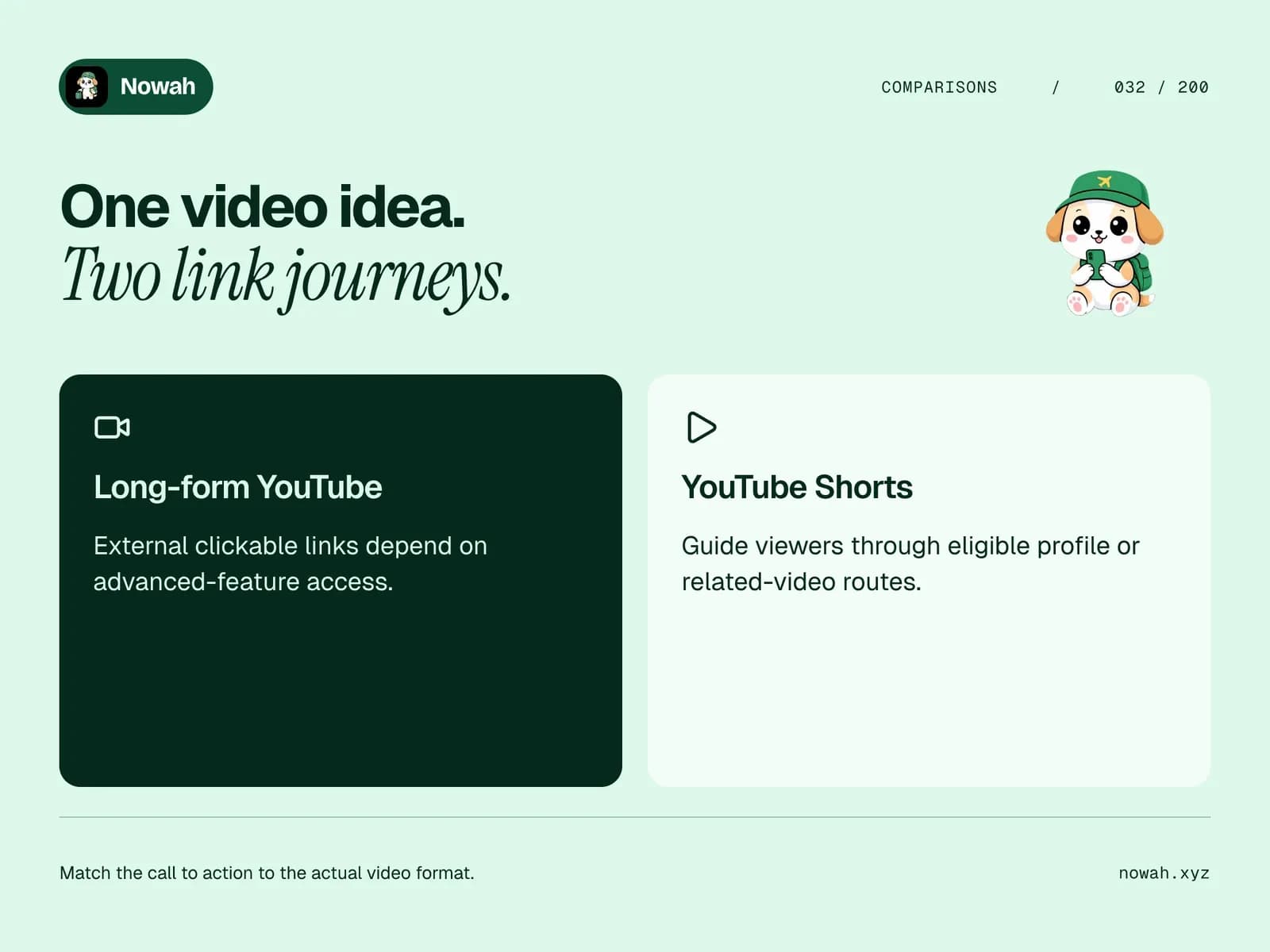
A Short and a long-form video can teach different parts of the same travel question. The best choice for a Nowah recommendation depends on how much context the viewer needs and which next-click route your channel can actually support. It should not be based on an unsupported assumption that one format always produces more earnings.
The Nowah Partner Program gives approved creators a defined share of net revenue from qualifying bookings by eligible attributed accounts. Its continuing account attribution can make useful evergreen travel explanations commercially relevant beyond the first piece of content.
This guide provides a format-selection storyboard for creators who want to demonstrate a practical Nowah workflow. It separates the teaching task from the link conditions and earning rules, so your viewer can understand both the travel benefit and the commercial relationship.
Choose the decision before the format
Start with the question a traveller needs help understanding. A simple location tradeoff may fit a focused Short. A full explanation of how to organize a trip brief, review assumptions and revise a day plan may need more context.
Do not force every detail into the shorter format or stretch a simple answer into a long video merely to add more promotional space. The practical output should determine the amount of explanation.
Nowah should appear where it helps that task. A useful demonstration explains the inputs, shows what you are investigating and identifies the next detail requiring verification. The recommendation then has a reason to exist beyond a logo at the end.
The one-question demonstration guide helps you decide which part of a broader travel problem belongs in the next video.
Use a Short for one clear teaching point
A focused Short can introduce a recognisable traveller situation and explain a single decision. For example, a fictional city break with an evening arrival may raise a question about the first night's priorities or a manageable first morning.
Keep the fictional status visible. A brief or diagram is a teaching device, not proof that a particular hotel is available or that a journey takes a guaranteed amount of time. Identify the supplier or official information the traveller would need to check.
The Nowah segment should make the reasoning understandable. If the viewer needs a longer explanation to interpret the output, plan an appropriate next resource rather than leaving an unexplained screen recording.
A Short can therefore be valuable as a complete small answer or an introduction to a more detailed lesson. Neither role establishes that it will achieve a particular reach or commercial result.
Use long-form when the reasoning needs room
A longer demonstration can show the brief, the tradeoff, the evidence boundaries and the revision. That is useful when several traveller constraints interact or when the viewer needs to understand why one change affects the itinerary.
For a labelled fictional example, use two adults taking a three-night break with one fixed commitment. Explain the initial question, show how you would organize it in Nowah and discuss what you would investigate or revise next. Current availability, room conditions and actual transport arrangements remain subject to verification.
You can also give the earning explanation enough space to be accurate. The practical demonstration should remain the centre of the video, while the commercial relationship is disclosed and the relevant conditions are explained proportionately.
The YouTube Nowah demonstration outline provides a focused follow-up for planning that longer teaching sequence.
Verify the actual link route for each format
YouTube's official guidance on sharing links identifies different clickable surfaces. External URLs in Shorts descriptions and comments are not clickable. Long-form external linking requires the channel's access to advanced features.
Check your actual channel tools before publishing a call to action. Profile destinations and related-video routes have different roles from a direct external link. A spoken instruction should describe the route you can actually provide, rather than borrow the wording from a different format.
If a Short points to a related longer explanation, that video should answer the promised follow-up. Do not add an unnecessary intermediate step that simply repeats the Short without helping the traveller understand the task.
The Instagram Stories versus Shorts link comparison is useful if you are adapting the same idea to another channel with a different handoff.
Build a two-format storyboard
Create one row for the Short and one for the long-form version. Give each row the same fields: audience question, fictional inputs, useful output, evidence needing verification, commercial disclosure and actual next route.
For the Short, choose one point from the wider brief and make it understandable on its own. For the longer version, explain how that point fits the trip and what changes when an input is revised. The two pieces should add different value rather than duplicate the same pitch at different lengths.
Then compare the ending of each script with its available link surface. A long-form description and a Shorts description cannot be treated as interchangeable. Update the script if the account tools do not support the route you initially planned.
This storyboard is a preparation tool, not a claim that a multi-video sequence produces a better conversion rate. Review its usefulness first and measure actual outcomes only when you have evidence.
Give the Nowah recommendation a specific purpose
A good call to action tells the viewer what they can reasonably continue. For a traveller-facing lesson, that may be organizing their own brief or investigating the tradeoff demonstrated. A creator-facing lesson may instead lead to the program information and application.
Keep those audiences distinct. Another influencer can apply to Nowah Partners, while an approved traveller recommendation needs the appropriate active partner route for the introduction. An application destination should not be labelled as if it were a traveller booking page.
Applications are reviewed, applying is free and Nowah advertises no minimum follower count. Approval, eligibility and verification requirements still apply. Your channel's linking permissions and Nowah's program eligibility are separate conditions, not substitutes for one another.
The one-link versus clear-next-step guide helps review the actual invitation surrounding the link.
Explain the account relationship accurately
Neither a Short nor a long-form video changes the Nowah introduction requirements. The traveller needs to follow the active partner route and create an eligible new account within 30 days of that valid introduction. Successful tracking is necessary, while existing accounts, self-referrals and artificial accounts remain excluded.
Once established, attribution continues for the traveller account's lifetime and can apply to later qualifying hotel, flight and paid eSIM bookings. That continuity is a substantial reason for creators to build useful travel explanations that remain relevant over time.
It does not guarantee repeat income or mean every viewer becomes an attributed account. A Short view, a long-form watch or a profile visit is not equivalent to the qualifying introduction. Use actual program evidence for a specific attribution question.
The clicks-versus-attributed-accounts guide can support a separate explanation when your audience needs to understand those event boundaries.
Keep the earning example tied to a booking
Approved Nowah partners earn 35% of Nowah net revenue from qualifying bookings by eligible attributed accounts. The traveller's retail booking price is not the base. The terms define the permitted direct deductions and exclude general overhead, salaries and general marketing from that list.
For hypothetical arithmetic, a qualifying booking producing $60 of Nowah net revenue would generate a $21 partner share. This does not estimate the income of either video format or value a view at a fixed amount.
Actual earnings require completion, verified supplier settlement and a 30-day hold after the later event. Monthly payout eligibility also depends on the separate currency threshold, verification and other conditions. A pending amount is not a bank receipt.
These conditions can be explained clearly without turning the demonstration into a promise of automatic income from YouTube attention.
Review the viewer experience before comparing results
Watch each version without its preparation notes. Can someone identify the travel decision, distinguish hypothetical material from actual evidence and understand the next route? If the answer is unclear, revise the script before adding more promotion.
Read the disclosure in the actual format and check the rules applicable to your content. A viewer encountering a shared extract should not receive a misleading impression about personal experience or the commercial recommendation.
The existing 20-tab planning article provides context for simplifying a traveller's next decision. Your two-format structure should help reduce confusion, not multiply unexplained steps.
Nowah gives creators a compelling opportunity when useful demonstrations introduce eligible new travellers and qualifying travel follows. Choose the task, complete the storyboard and verify your channel's link conditions. If the model fits your work, apply to Nowah Partners. Keep approval and eligibility requirements clear, make each format useful in its own right and assess actual results through the events and evidence that belong to them.




