How Wellness Travel Creators Can Earn With Practical Nowah Planning Content
Help wellness travel audiences turn pace and accommodation preferences into useful Nowah research without medical promises.
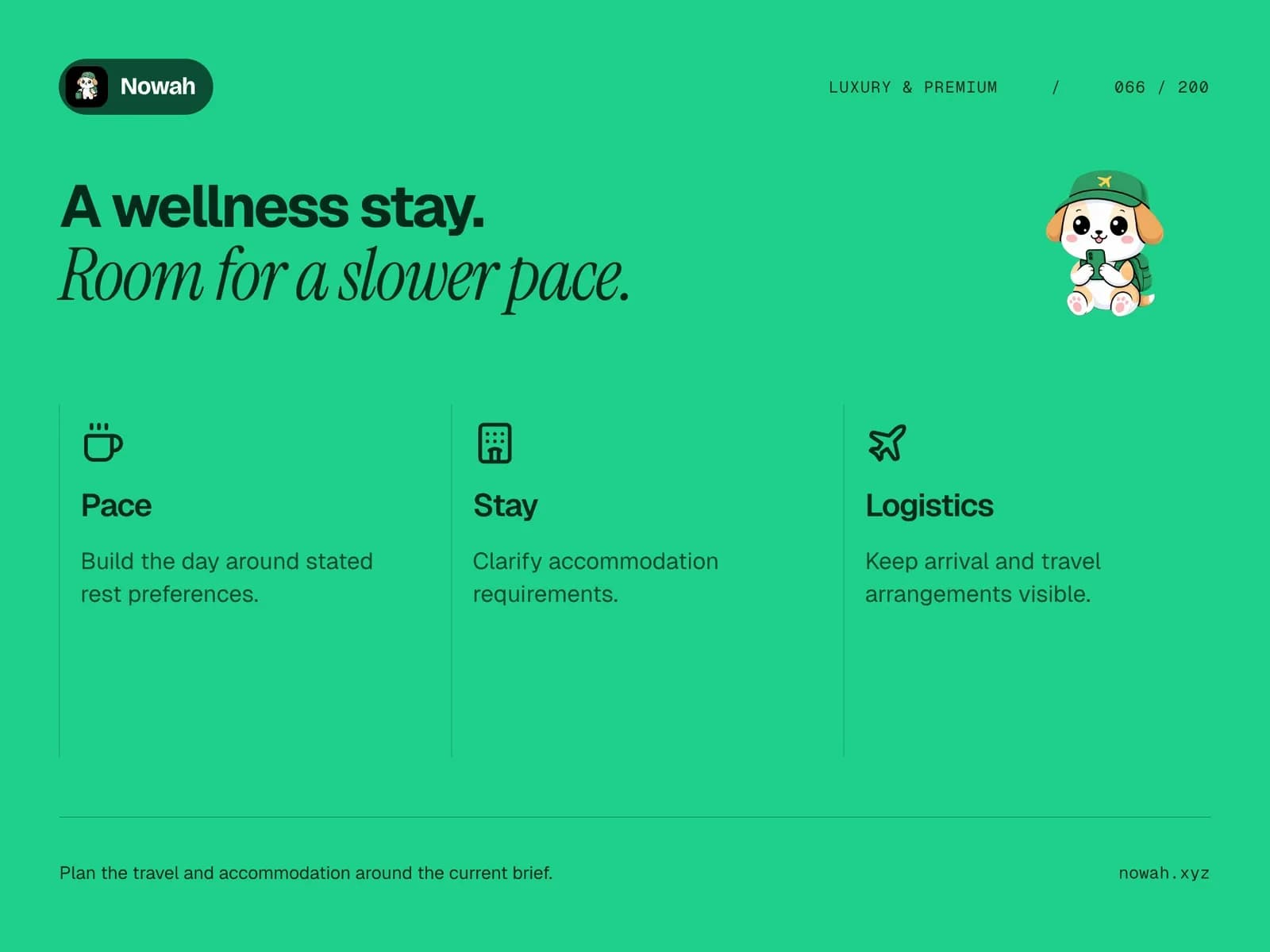
Wellness travel content can help an audience imagine a slower, more restorative-feeling break. To make that inspiration useful, a creator needs to explain the travel decisions behind it: the pace, accommodation questions and arrival logistics. An approved Nowah partner can connect those practical recommendations with a disclosed referral and potentially earn from qualifying bookings by newly attributed travellers.
Nowah works well in this content when you demonstrate a clear travel brief. Show how a traveller's preference for fewer movements or a lighter first day changes the itinerary. Explain what the accommodation needs to support and which details still require evidence. That is a credible reason to recommend Nowah without claiming that a trip, hotel or AI planning conversation produces a medical outcome.
The commercial story should be equally clear. The partner share is 35% of Nowah net revenue from qualifying bookings, not 35% of the traveller's trip budget. Useful content creates a relevant introduction; it does not establish an earnings forecast.
Define the travel preference before the wellness label
Begin with the actual travel task. A viewer may want a shorter daily schedule, more time at one base, fewer hotel changes or room conditions they need to investigate. Those preferences are concrete enough to affect a planning demonstration.
Do not assume that the word wellness tells you a traveller's health, fitness, budget or preferred activities. Avoid collecting private health information for a public example. A fictional brief can simply say that the traveller wants two deliberately light days and does not want to change accommodation during a short break.
Separate a preference from an outcome. You can demonstrate a less crowded itinerary without promising that it will improve sleep, relieve a condition or deliver a particular psychological benefit. The content remains travel planning, and the traveller can decide whether the suggested structure fits their current preferences.
Demonstrate a pace-first Nowah brief
Use a fictional four-night trip to show the method. Give the brief a clear arrival boundary, one accommodation base and a preference for leaving a substantial part of each day open. Explain what you are asking Nowah to explore rather than calling the result a personalised wellness prescription.
Review the proposed itinerary against those inputs. If it introduces several separate movements on a day meant to remain light, revise it. If a suggestion assumes a facility or service that you have not verified, mark that point as a question instead of building the whole demonstration around it.
A useful Nowah demonstration shows the edit as well as the initial direction. The audience learns how to protect a preference when planning, rather than learning that a busy list of activities can be renamed a wellness holiday.
For a broader audience example, link to slower travel for wellness creators. Keep this guide focused on evaluating a particular stay and the logistics that support it, while the supporting article addresses the wider daily rhythm.
Create a stay-requirements sheet
A stay-requirements sheet translates a general preference into questions a traveller can investigate. Use these fields:
- Trip boundary: dates, duration and actual arrival or departure constraints.
- Preferred rhythm: which parts of a day the traveller wants to leave open.
- Accommodation requirement: the specific room or property question that matters.
- Evidence source: current provider information or a clearly labelled personal observation.
- Unconfirmed point: anything that still needs a direct answer.
- Planning implication: what changes if the answer is different from the assumption.
The final field is particularly useful. A facility may look attractive without being essential to the brief. Conversely, an ordinary room detail can determine whether a particular option merits further research. Help readers separate those two cases rather than equating a premium image with suitability.
Use fictional information in the example sheet. There is no need to display private correspondence, identity details or sensitive traveller information to teach the process.
Check the offer behind the accommodation imagery
If you discuss a facility or inclusion, use evidence for the actual offer. A property photograph does not establish that a service is included in every rate, available on every date or appropriate for every traveller. Do not imply that booking through Nowah guarantees a particular accommodation arrangement.
Explain the difference between a provider describing a feature and a traveller confirming the details relevant to their booking. Where an arrangement is important, the audience should know what remains to be checked and with whom.
Link to premium rate inclusions when the question involves meals, fees, room conditions or cancellation terms. That is a separate useful resource, not an invitation to make the wellness article a long inventory of unsupported property claims.
If you have personal stay evidence, state the circumstances honestly. A generated illustration can explain the workflow, but it should not be presented as footage or photography from a real visit.
Give arrival day a realistic job
A lighter itinerary can fail its own brief if the creator ignores arrival logistics. Explain whether the fictional example begins before travel, on arrival or after the first night. Do not count a travel day as a full destination day without making the assumption visible.
Show how the actual arrival boundary affects the first day's planning. A late arrival may change the accommodation questions and justify leaving the next morning open. That is a travel-structure decision, not evidence of a guaranteed benefit from the stay.
The late-arrival and luxury-stay guide gives readers a deeper checklist for that situation. Link where the question arises so the next resource feels like a continuation of the brief.
In the fictional four-night example, you could compare a first full day with one optional outing against a day with several fixed movements. Ask which structure better respects the stated preference. Avoid inventing journey durations or exact opening arrangements simply to make one direction look easier.
Put a disclosed partner link beside a useful next action
Once you have shown what the traveller can investigate in Nowah, explain your partner relationship alongside the recommendation. Say that you may earn commission from qualifying referred bookings. Do not leave the commercial connection to a generic profile description that the viewer may never see.
The Nowah terms require an eligible traveller to follow an active partner link and create a new account within 30 days of the introduction. Existing accounts and self-referrals do not qualify. Tracking must successfully reach Nowah; a click is not itself evidence of an attributed account.
A valid account attribution can continue for that traveller account's lifetime, including qualifying later bookings. This is a reason to create a genuinely useful first recommendation. It does not promise that a viewer will book again or generate a regular income for the creator.
Someone interested in becoming a Nowah partner needs the application journey. Someone planning a stay needs the appropriate disclosed traveller referral. Keep those actions distinct so neither audience is sent to a destination that does not answer its question.
Explain what can generate partner earnings
Qualifying hotels, flights and paid eSIMs are the listed travel categories. A wellness activity, treatment, class or other service discussed in your content is not automatically commissionable under those categories. Be specific about the relevant travel booking instead of implying a share of every purchase associated with the trip.
Use a labelled illustration to explain the formula: $60 of Nowah net revenue multiplied by a 35% partner share produces $21. Those are hypothetical arithmetic inputs, not a result achieved by a wellness creator or an expected commission on a particular stay.
Completion, supplier settlement, the applicable hold and payout conditions also matter. Avoid presenting an interested viewer, a pending booking and eligible earnings as interchangeable outcomes. Accurate economics let you explain the opportunity confidently without suggesting that a soothing visual style guarantees commercial results.
A useful companion caption can identify the one accommodation question the example leaves open. Keep it visible when sharing a still from the demonstration. If the article says a facility needs confirmation, the image should not imply it is included. This small consistency check helps followers carry the planning method into their own research without remembering every qualification from the longer piece.
Make the resource easier to maintain
The older Nowah article on the twenty-tab problem provides useful background for explaining fragmented travel research. Your own guide should show how the requirements sheet and Nowah demonstration keep the specific stay question understandable.
When you refresh the resource, review supplier facts and the example's labels. Check whether followers are confusing an optional activity with an included service, or a planning preference with a promised health outcome. Improve the explanation where that confusion arises.
To participate, apply to Nowah Partners. Applications are reviewed, applying is free and there is no minimum follower count. Build the first campaign around one clearly defined travel preference, demonstrate the relevant Nowah task and help the audience take a transparent, useful next step.




