How Luxury Family Creators Can Earn With Better Rooming Advice
Help luxury family audiences verify rooming needs and continue their travel research through Nowah Partners.
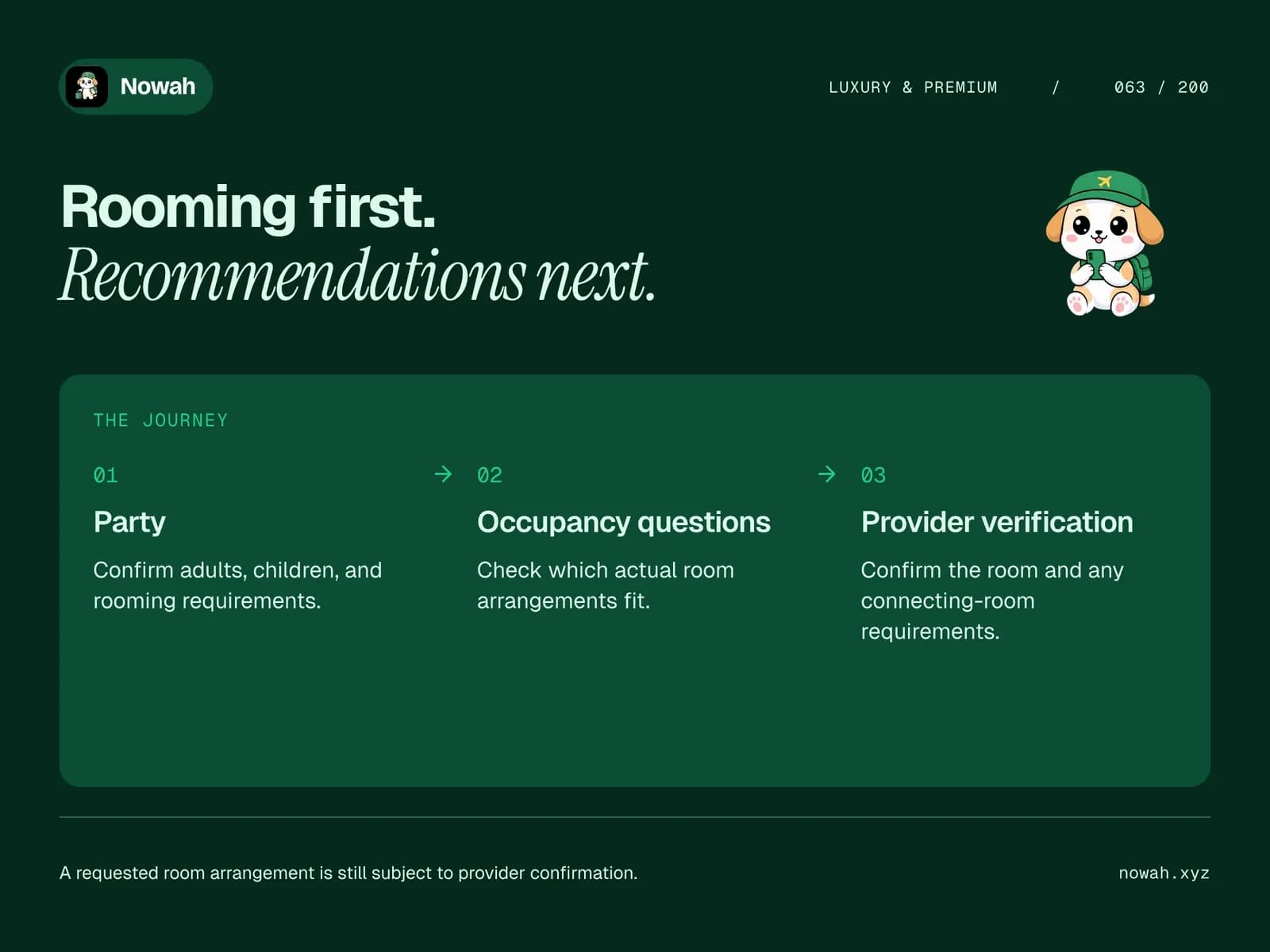
A luxury family hotel can look ideal in a room tour and still leave a parent with the question that matters most: where would everyone actually sleep? Creators who answer rooming questions carefully provide something more useful than an attractive property montage. Through Nowah Partners, approved creators can connect that guidance to a disclosed referral and potentially earn from qualifying travel bookings by newly attributed accounts.
Nowah is a strong fit for turning a rooming question into a broader planning brief. Your content can explain who is travelling, what accommodation arrangement the family needs and what must be checked with the provider. You can then demonstrate the relevant hotel and flight research in Nowah, rather than asking viewers to infer family suitability from décor or room size alone.
The earning story should follow that useful decision. A premium booking price does not establish the creator's commission. The partner share is 35% of Nowah net revenue on qualifying bookings, subject to the program conditions.
Begin with the travelling party
Ask how many adults and children are travelling and which rooming constraints affect their choices. Use fictional details in a public demonstration. Avoid collecting children's names, personal documents or unnecessary private information to create a travel example.
Rooming requirements vary between families. Some may need everyone in one accommodation unit. Others may consider separate rooms only if a particular arrangement is confirmed. A family might prioritise a separate sleeping area, space for an infant's sleeping arrangement or access requirements that need direct provider clarification.
These are research inputs, not features you can assume a property offers. “Family-friendly,” “suite” and “luxury” do not establish an occupancy limit or guarantee a particular bed configuration. The point of your content is to make the missing questions visible before a family commits to an unsuitable offer.
Distinguish room category from room arrangement
A room-category label is only the beginning of the evidence. Explain that a family needs to investigate the actual occupancy, included sleeping arrangements and conditions attached to the offer they are considering. Avoid translating a room name into a promise that every traveller can stay there.
If a property photograph shows two beds, it still does not answer every occupancy question. The selected rate may have conditions that depend on the party, and a photographed configuration may not represent every unit in the category. Tell readers which information comes from current supplier material and which remains unconfirmed.
Connecting or adjoining rooms deserve especially careful wording. Do not promise that a request will be fulfilled, that separate rooms will connect or that a relationship between rooms meets a family's needs. The guide to evidence-based VIP wording helps distinguish a request from an actual confirmation.
Demonstrate a rooming-first Nowah brief
For a fictional demonstration, imagine two adults and two children comparing one larger accommodation unit with two rooms. State that this is an illustrative planning problem, not an actual customer booking or a claim about a specific hotel.
Use Nowah to explore a hotel-research brief that preserves the relevant constraints. Explain why the number of travellers and the required arrangement need to remain visible as the trip develops. If the proposed itinerary changes hotels midway, the rooming questions must be checked again for the second stay.
Show how you revise the research direction when an assumption is unsupported. If the provider evidence does not confirm the required arrangement, describe the alternative question to investigate. That is a credible demonstration of Nowah helping structure a complicated travel decision, not a claim that AI can certify every supplier detail.
For a related question about the overall family day, link to rest-day planning for family creators. Good accommodation advice and a realistic daily pace solve different parts of the same trip.
Give parents a rooming verification sheet
A practical sheet should capture the evidence the family needs, with space to record its source and status:
- Travelling adults and children, using only relevant information.
- Required number of rooms or accommodation units.
- Occupancy and sleeping arrangements for the exact option being investigated.
- Any arrangement that requires a provider's explicit confirmation.
- Room and rate inclusions that affect the comparison.
- Open questions, evidence date and next verification action.
Use statuses such as “shown in current supplier information,” “question sent” and “confirmed by provider.” Do not mark a question resolved simply because someone acknowledged receiving it. The worksheet should distinguish an answer about one option from an assumption about the entire property.
You can show the sheet beside the Nowah demonstration so viewers understand the reasoning. It is especially useful when explaining why a visually appealing hotel has been set aside while another accommodation direction deserves further research.
Compare two arrangements without inventing prices
In the fictional example, Arrangement A keeps the family together in one unit. Arrangement B uses two rooms, subject to the required room relationship being confirmed. Compare privacy, sleeping routines and the practical implications of moving between spaces as questions for this particular family.
Do not declare Arrangement B cheaper or Arrangement A better value without actual matched offers. A fair comparison uses the same travel dates, party and relevant inclusions. If one offer remains unverified, keep it visibly provisional rather than presenting an incomplete comparison as a booking recommendation.
Explain how the family can continue researching their current requirements through Nowah. Your demonstrated value is a clearer decision process and a relevant next action. A creator does not need an invented discount or a guaranteed room upgrade to make the recommendation persuasive.
The premium rate-inclusions guide provides a useful next read when parents need to separate the room arrangement from meals, fees and cancellation conditions.
Make the partner relationship clear
When you recommend using Nowah, disclose that you are a partner and may receive commission from qualifying referred bookings. Keep that explanation close to the recommendation and the active link, including in the content itself where the format calls for it.
The Nowah terms require an eligible traveller to follow an active partner link and create a new account within 30 days of the introduction. Existing accounts, self-referrals and artificial accounts do not qualify. Tracking must work successfully; a follower clicking a link is not the same as an established attribution.
Once a valid account attribution exists, it can persist for that account's lifetime, including qualifying future bookings. This is meaningful for family creators whose audiences may return to useful planning resources over time. It remains a conditional earning opportunity, not a promise of repeat purchases or income.
An audience member who wants to become a creator partner should receive the application destination. A parent researching a family trip needs the appropriate traveller referral route. Do not confuse those two journeys.
Explain the earning base accurately
Suppose an illustrative qualifying booking generates $60 in Nowah net revenue. A 35% share produces $21 in partner earnings. Label that arithmetic as hypothetical. It does not establish the commission on a suite, two rooms or any particular family holiday.
Nowah's defined net revenue differs from the traveller's booking total. Eligible categories are qualifying hotels, flights and paid eSIMs. A restaurant visit, childcare arrangement or activity discussed in family content should not be described as commissionable merely because it appears in an itinerary.
Completed bookings, supplier settlement, the applicable hold and payout conditions matter before eligible earnings are processed. If you discuss the economics in detail, point readers to the terms rather than presenting a pending booking as an immediate payout.
Keep the comparison readable on a small screen
Give each arrangement the same labels and display the unresolved questions beside it. A parent should not need to pause several different clips to discover that one option depends on a room request. If you shorten the demonstration for social media, preserve that condition in the shorter version. A companion article can hold the complete verification sheet, while the video explains the single rooming decision. This keeps your most important qualification connected to the appealing imagery rather than separated from it.
Build a resource families can return to
Rooming advice has lasting value when it teaches a method. Review the sheet when supplier information changes, and retain a clear distinction between your own observations, current provider evidence and a fictional example. If you did not experience a room arrangement yourself, do not write as though you did.
The older Nowah article on the anatomy of a hotel recommendation helps explain why the traveller's requirements belong before the shortlist. Your family-specific contribution is making occupancy and room relationships part of that decision from the beginning.
To put this workflow into practice, apply to Nowah Partners. Applications are reviewed, applying is free and there is no minimum follower count. Start with one useful rooming comparison, demonstrate how Nowah helps organise the research, and make the follower's next step clear without promising an arrangement that still needs confirmation.




