How Family Creators Can Earn With Useful Rest-Day Planning in Nowah
Create useful family day plans with core, optional and open blocks, a Nowah demonstration and transparent partner links.
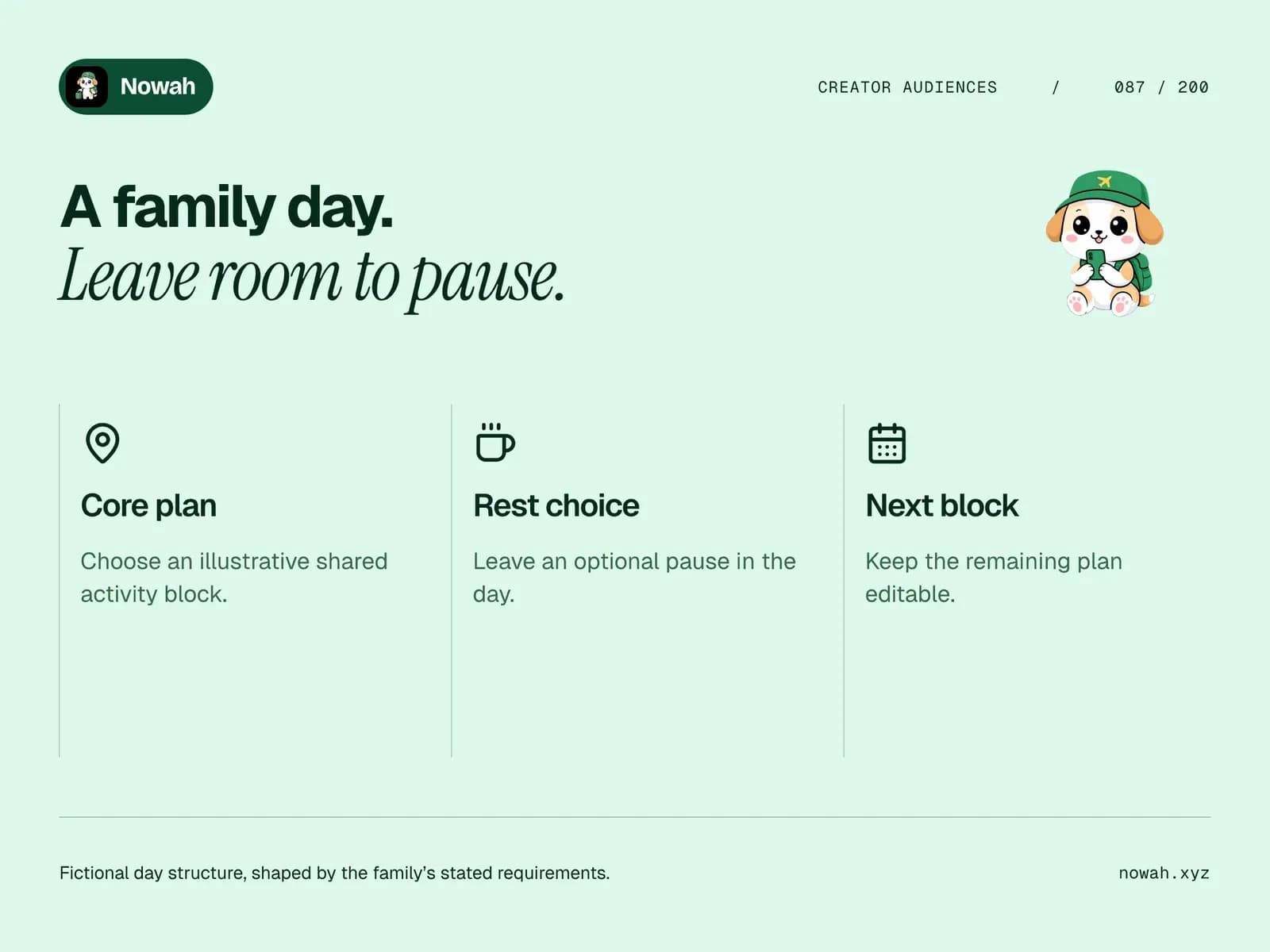
A family itinerary does not become more useful simply by fitting more activities into a day. Many audiences need help deciding what to keep, what can remain optional and where the plan depends on movement or accommodation questions. Approved Nowah partners can connect that practical guidance to a disclosed referral and potential earnings from qualifying bookings by newly attributed travellers.
Nowah is well suited to demonstrating this planning task. Start with a fictional family brief, explain the core priority and show how you revise an outline that has become too crowded for the stated preferences. The recommendation is useful because the audience sees how to investigate a trip that reflects its own rhythm.
Treat rest as a planning preference rather than a promised health outcome. Families differ, and an illustrative day plan does not establish what every child or adult should do. The creator's earning opportunity comes from valid introductions and qualifying travel, not from claiming that a particular itinerary produces guaranteed comfort or income.
Decide what the day must protect
Begin with the family's stated priority. That might be one core activity, a shared commitment or simply keeping part of the day open. Do not infer the answer from children's ages or a general family-travel label.
Use fictional inputs in a public demonstration. Imagine a family investigating a day with one main interest and a preference for avoiding several separate movements. State that the example teaches a planning method; it is not a real customer's schedule or a universal recommendation.
Keep the actual travel boundaries visible. An arrival day, a full destination day and a departure day create different questions. If the brief has an unresolved timing assumption, identify it rather than treating every day as equally available for activities.
Separate core, optional and open blocks
A simple day structure can distinguish three kinds of content. A core block serves the family's main priority. An optional block is something they can investigate without treating it as essential. An open block deliberately remains unscheduled.
Do not fill an open period merely to make the visual look complete. Explain its role in the fictional brief and let the family decide whether that kind of structure fits its current preferences.
Equally, do not label an activity optional while building the rest of the itinerary around its assumed location or timing. The planning implications should match the label. If removing an activity changes several later movements, show that dependence rather than presenting the plan as effortlessly flexible.
Demonstrate the day structure in Nowah
Use Nowah to explore the fictional brief with the core priority and movement preference explicit. Review the proposed direction against those inputs and explain any revision.
If an outline includes several separate locations on a day intended to remain light, show how you refine the question. If it relies on a facility or arrangement that has not been verified, mark that point as a supplier question instead of making it central to the plan.
The useful demonstration is the reasoning. Nowah helps organise the travel question and explore a revised outline, while actual availability, provider conditions and relevant routes still need appropriate current evidence.
The multigenerational planning guide offers a related method when different travellers want genuinely different day directions. It can support families whose needs involve optional parallel interests rather than one shared schedule.
Create a day-block planning sheet
Give readers a sheet with one row for each meaningful part of the illustrative day. Useful fields include:
- The purpose of the block.
- Whether it is core, optional or deliberately open.
- The location or accommodation question it creates.
- Any movement or timing evidence still needed.
- What changes if the optional block is removed.
- The next fact to investigate before relying on the plan.
Avoid invented journey durations or fixed rest prescriptions. The sheet should expose assumptions, not hide them behind exact-looking times. If an important route is unknown, keep that status visible.
A creator can show one completed fictional row in the article and explain how it affects the rest of the day. That practical output gives the audience something to adapt instead of a schedule it must copy exactly.
Work through two versions of the same fictional day
Imagine the fictional family wants to investigate one core interest while avoiding several additional movements. Version A keeps the surrounding periods open or nearby in the plan's research direction. Version B adds several optional ideas that create more route questions.
Keep the common inputs consistent. Do not give Version A a different accommodation location or extra time without explaining the change. The comparison should teach the cost of additional dependencies, not manufacture a winner by changing the brief.
Use Nowah to revise Version B after identifying which extra idea matters most. Show how removing or moving one block changes the outline. A useful conclusion can be a clearer research direction rather than a claim that every detail is confirmed.
The premium short-break guide helps when the family's usable destination window is narrow. Its arrival-to-departure ledger addresses a different planning boundary from this article's day-block choices.
Connect the day plan to accommodation research
Accommodation location and rooming can affect the questions a family asks about its daily rhythm. Do not assume a property feature or arrangement from a family-friendly description or an attractive photograph.
If the plan depends on spending a particular part of the day at the accommodation, explain what the family needs to verify about the actual offer. A planning preference does not establish a facility, room access arrangement or inclusion.
The rooming-first family workflow gives readers the earlier questions to resolve before a hotel recommendation becomes useful. Link where the day-plan discussion reveals that an accommodation assumption still needs evidence.
Keep the planning demonstration and the offer information distinct. A generated day graphic can explain the structure, but it does not document an actual property experience or confirm supplier arrangements.
Make the Nowah next step transparent
Disclose that you are a Nowah partner and may receive commission from qualifying referred bookings when recommending an active link. Put the relationship beside the useful action so the audience understands why the destination is relevant and how you could benefit.
The Nowah terms require an eligible traveller to follow an active partner link and create a new account within 30 days of the introduction. Existing accounts, self-referrals and artificial accounts do not qualify. Tracking must reach Nowah successfully; a saved day plan or link click does not establish attribution by itself.
Valid attribution can remain for the lifetime of that traveller account, including qualifying later bookings. It does not automatically attribute the whole family or guarantee future purchases and income. Someone who wants to become a creator partner needs the separate program explanation and application journey.
Explain earnings without treating activity count as revenue
Nowah's listed qualifying categories are hotels, flights and paid eSIMs. A family activity, meal or other service appearing in the day plan is not automatically commissionable. Adding more items to an itinerary does not establish additional partner earnings.
The partner receives 35% of Nowah net revenue from qualifying attributed bookings, not the family's booking total. A clearly hypothetical $60 of Nowah net revenue produces $21 in partner earnings. That calculation is not an observed result from the illustrative family day or an estimate of what a follower will generate.
Completion, supplier settlement, the applicable hold and payout conditions matter before earnings become eligible. Keep audience interest, a valid new account, a qualifying booking and a paid amount separate when discussing the content's commercial results.
Show what happens when the fictional family removes an optional block. Which movement questions disappear, and which fixed commitment remains? That small revision can be more instructive than adding another activity to fill the space. It demonstrates how the day’s structure responds to the family’s current choice.
Keep the resulting open period open in the published example. Do not describe it as a guaranteed benefit or quietly replace it with a new obligation in the short-form edit. The audience should be able to follow the same preference-led plan across the sheet, the Nowah demonstration and the final graphic.
Keep the resource useful across formats
If you turn the plan into a short video or carousel, preserve the fictional label and the main unresolved question. The shorter version should not make a flexible research outline look like a confirmed daily schedule.
The older Nowah article on the twenty-tab problem provides context for reducing fragmented travel research. Your day-block sheet gives that idea a concrete family-planning application.
To participate, apply to Nowah Partners. Applying is free, applications are reviewed and there is no minimum follower count. Start with one meaningful family priority, demonstrate a useful Nowah revision and give followers a transparent way to continue planning at a pace they choose.




