How Luxury Food Creators Can Turn Itinerary Content Into Nowah Referrals
Turn luxury food inspiration into a practical itinerary, hotel research and a transparent Nowah partner recommendation.
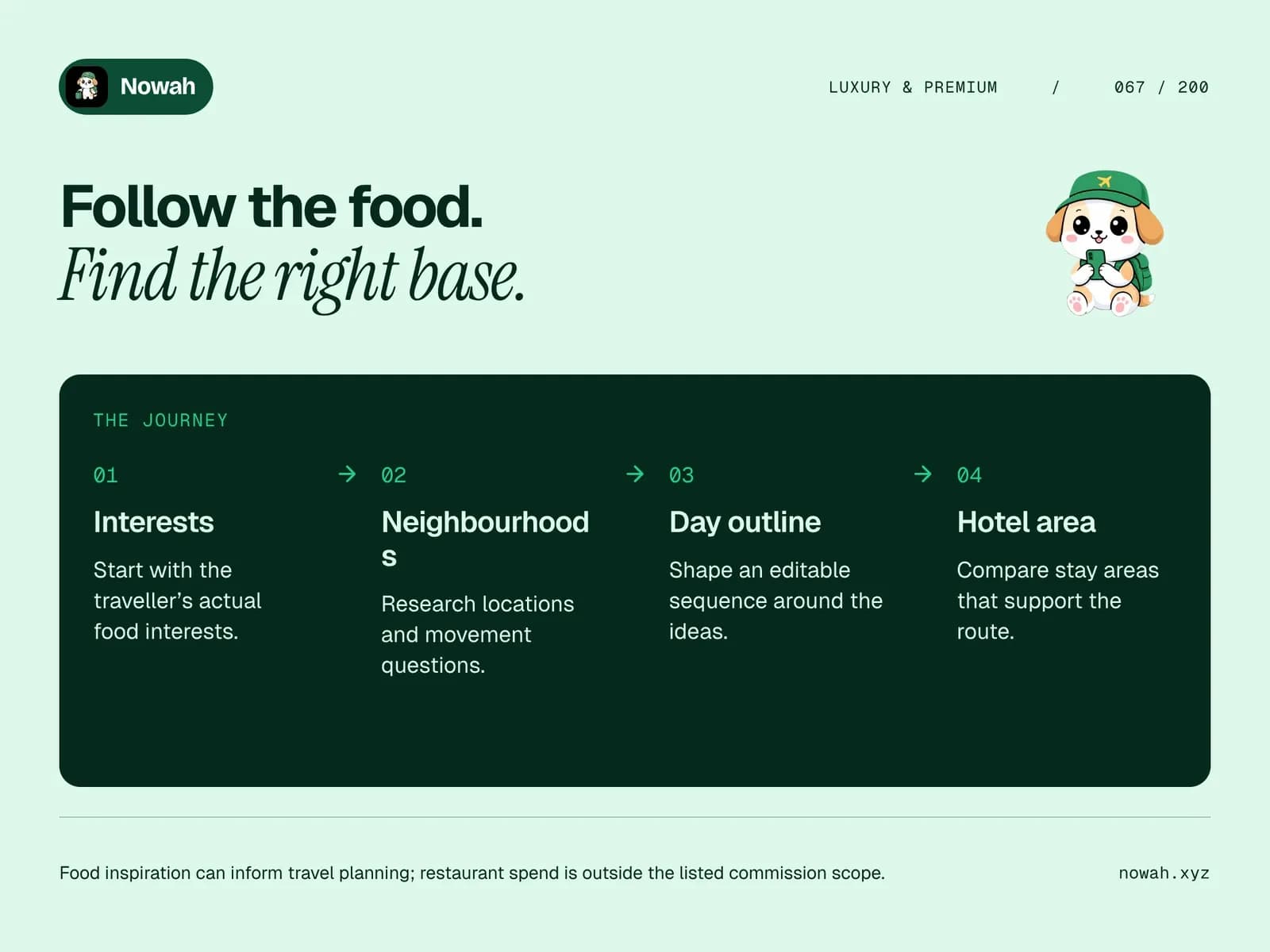
A memorable food recommendation can start a trip, but it does not answer where a follower should stay or how the wider journey fits together. Luxury food creators can make their content more useful by connecting dining inspiration to hotel-area questions, arrival logistics and a realistic day plan. Through Nowah Partners, approved creators can link that travel-planning value to disclosed referrals and potential earnings from qualifying bookings by newly attributed accounts.
Nowah is a good fit when you demonstrate the travel context around the food interest. A viewer may need a suitable accommodation base, a flight option that respects a fixed commitment or paid connectivity for the trip. Those are relevant research tasks. The restaurant spending itself is not a listed Nowah partner commission category.
That boundary does not weaken the commercial idea. It helps you explain exactly why the next step is useful: the food recommendation provides the reason to travel, and Nowah helps the follower explore the travel arrangements around it.
Choose a food question that changes the itinerary
Start with the audience's practical decision. A broad list of exceptional restaurants can inspire saves without helping anyone build a trip. A more focused question might ask how to choose a hotel area when the traveller has several food interests, or how to keep an arrival day light before a fixed dining commitment.
Use a fictional example when you do not have a real, appropriately sourced itinerary to discuss. For instance, imagine a traveller with three nights, one fixed evening commitment and several neighbourhoods to investigate. State that the example illustrates a planning method, not an actual booking or a review of a particular restaurant.
Keep food preferences separate from assumptions about budget and travel style. A person interested in one premium meal may still prioritise accommodation flexibility or a simpler daily schedule. Your content should help the viewer choose which tradeoffs matter, not assign an entire luxury identity to them.
Separate food evidence from travel assumptions
A first-hand dining review, a current restaurant statement and a fictional itinerary are different kinds of information. Label them accordingly. Do not write as though you visited a restaurant or stayed nearby if you have not.
The same care applies to travel relationships. A location appearing close on a map does not establish a reliable journey time, a convenient late-night route or a particular transport arrangement. Explain what has actually been checked and what the traveller still needs to verify.
If a restaurant or event is a genuine fixed anchor, preserve its actual date and location in the brief. If it is only an idea, keep it labelled as an idea. A useful creator itinerary distinguishes inspiration from commitments so a follower does not build an entire holiday around an unconfirmed assumption.
The food-creator guide to choosing the stay area explores the accommodation decision in more depth. This article focuses on how to turn several food interests into a coherent trip outline.
Demonstrate the wider trip in Nowah
Use Nowah to explore a brief that includes the travel dates, accommodation priorities, fixed anchors and preferred pace. Explain which question you are asking: how to organise the days, which hotel-area direction deserves research or how an arrival boundary affects the itinerary.
Show the planning choices rather than implying that every proposed place, time or arrangement has been verified. If the initial direction tries to fit too many neighbourhoods into one day, revise it. If it treats an unconfirmed meal idea as a fixed booking, correct that assumption in the demonstration.
Nowah's role becomes clear when your audience sees the connection between the brief and the revision. A food creator can teach followers how to investigate a travel plan without claiming that the tool guarantees restaurant availability or handles every service mentioned in the itinerary.
For readers starting from a short social post rather than a full itinerary, link to turning a food reel into a travel brief. That supporting guide addresses the earlier step of extracting useful planning inputs from saved inspiration.
Build a food-anchor itinerary sheet
Give the audience a simple sheet with one row per day or meaningful day block. Include these fields:
- The food interest or fixed commitment that gives the block its purpose.
- The status of that anchor: observed recommendation, idea or confirmed commitment.
- The relevant location information and its source.
- The hotel-area or movement question it creates.
- The space intentionally left open in the plan.
- The next verification action.
Do not fill the sheet with invented timings to make it look complete. “Journey to verify” is a useful entry when the exact route has not been checked. Likewise, an open meal period can be a deliberate part of the travel rhythm rather than a gap that must be filled with another recommendation.
The sheet turns your expertise into a resource the follower can adapt. It also gives the Nowah demonstration a clear structure: show the brief, review the outline and explain the remaining checks.
A hypothetical luxury-food trip comparison
Imagine the fictional three-night traveller has one fixed evening commitment and wants to investigate two different food areas. Direction A keeps the accommodation in one base and builds the remaining days around flexible interests. Direction B adds a hotel change to spend a night in a different setting.
Explain what the move must justify. Does it advance a specific travel priority, or does it simply make the itinerary appear more elaborate? Do not assume the second base saves time without actual route evidence. Make the packing, check-out and movement day visible in the comparison.
Use Nowah to explore the chosen direction, then identify what must be checked in the current offers. That includes actual flight timings, accommodation location, occupancy, rate inclusions and cancellation conditions. The food theme does not make those ordinary booking facts less important.
The premium rate-inclusions guide is a useful next read when a follower begins comparing accommodation offers. A hotel rate that includes a meal arrangement still needs to be assessed on its actual terms; do not infer a particular dining benefit from premium imagery.
Make the referral action match the content
Place a clear partner disclosure beside the recommendation to use Nowah. Explain that you may earn commission from qualifying referred bookings. A viewer should understand both your relationship and the travel task they can continue through the link.
The Nowah program terms require an eligible traveller to follow an active partner link and create a new account within 30 days of the introduction. Existing accounts and self-referrals do not qualify. Tracking has to work successfully; a saved reel or link click does not establish an attributed account by itself.
Once a valid account attribution is established, it can remain for the lifetime of that traveller account, including qualifying later bookings. This makes a helpful food-led introduction potentially relevant beyond one itinerary. It does not mean you earn commission on every future purchase or that the traveller will keep booking.
A fellow creator who wants to join the program needs the application journey. A follower planning this trip needs the appropriate disclosed traveller referral route. Keep the two next steps visibly separate.
Explain the eligible earning opportunity
Nowah's listed qualifying categories are hotels, flights and paid eSIMs. Restaurant bills, tasting-menu purchases, market shopping and other food spending should not be described as partner commission events merely because they inspired the trip.
The creator share is 35% of Nowah's defined net revenue from qualifying bookings. The traveller's total booking spend is not the base. If an illustrative qualifying booking produces $60 of Nowah net revenue, a 35% share is $21. Label the arithmetic as hypothetical, not as an observed result from a luxury-food campaign.
Completion, supplier settlement, the applicable hold and payout conditions also affect when earnings become eligible. A premium itinerary, a new account and a completed qualifying booking are different events. Keeping those distinctions clear lets you discuss the opportunity confidently without making the food content carry an invented earnings promise.
Maintain the itinerary as a useful travel resource
Refresh the distinction between fixed commitments and ideas whenever you update the article. Check current source information before repeating a specific supplier fact. If a follower asks whether an itinerary diagram proves availability, make that limitation clearer in the diagram and its caption.
The older Nowah article on the anatomy of a hotel recommendation supplies background for choosing accommodation around actual requirements. Your food-creator contribution is showing which requirements come from the traveller's interests and how they affect the wider trip.
To participate commercially, apply to Nowah Partners. Applying is free, applications are reviewed and there is no minimum follower count. Start with one useful food-led itinerary question, demonstrate the relevant Nowah workflow and give followers an honest way to continue planning the travel around their inspiration.




