How Food Creators Can Turn a Saved Reel Into a Nowah Travel Brief
Turn saved food inspiration into verified inputs, an editable Nowah travel brief and a transparent partner recommendation.
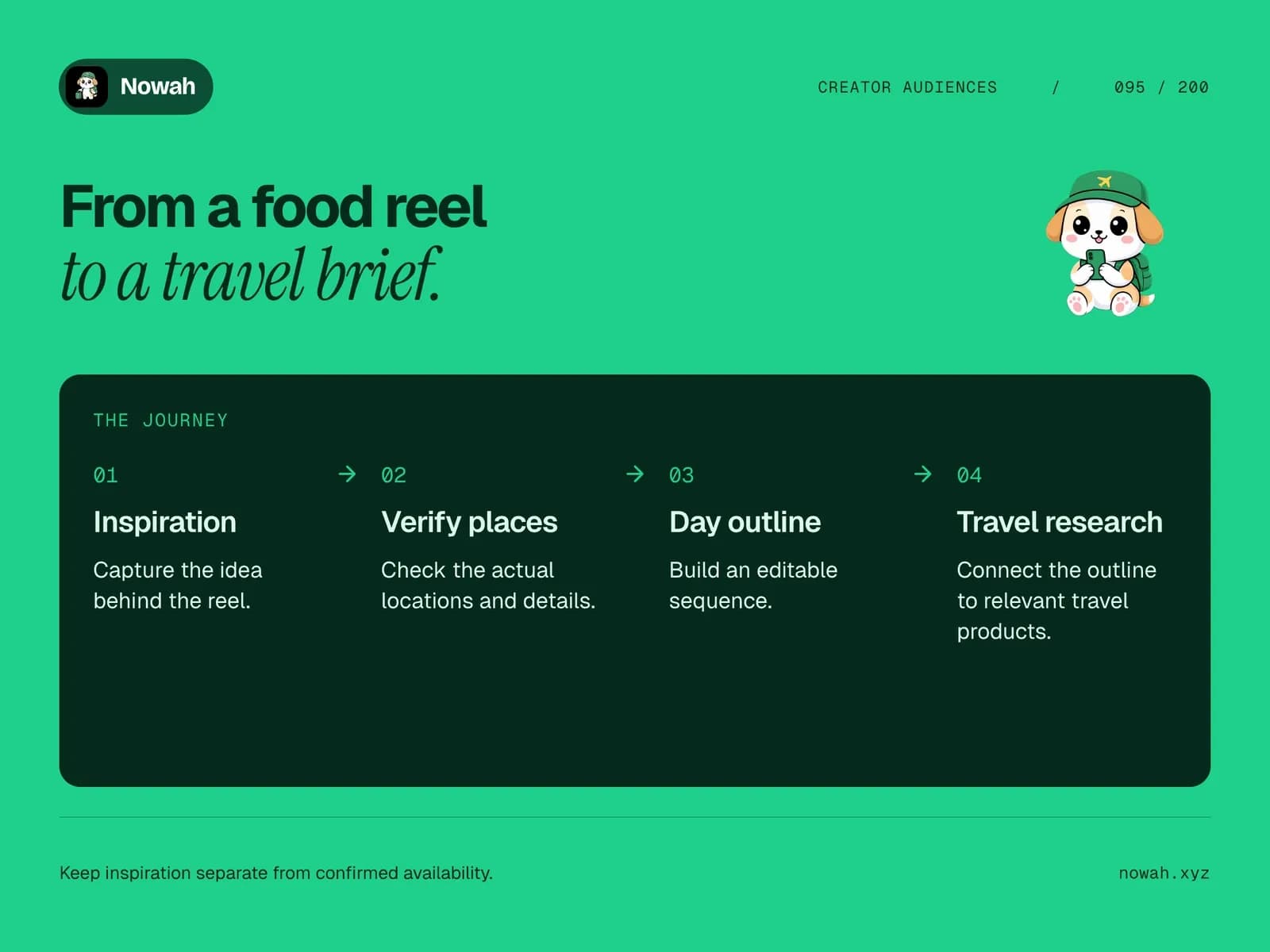
A saved food reel is a signal of interest, not a complete travel plan. It may suggest a place, a type of experience or a reason to investigate a destination, while leaving dates, accommodation and current information unresolved. Approved Nowah partners can show audiences how to turn that inspiration into a useful brief, a disclosed referral and potential earnings from qualifying travel bookings by newly attributed accounts.
Nowah is a strong fit after the creator has clarified the inputs. Explain what the saved content actually establishes, identify the questions to verify and use the current brief to explore an itinerary direction. The audience then sees a practical next step rather than being asked to treat a short video as proof of availability or suitability.
Keep the commercial boundary visible. Qualifying hotels, flights and paid eSIMs are the listed Nowah partner categories. Restaurant spending and other food purchases are not automatically commissionable because they inspired the trip.
Identify what the reel has actually contributed
Ask whether the saved post supplies a place to investigate, a general interest or a specific claim that needs verification. Do not assume that every detail the viewer infers is established by the video.
If you are discussing someone else's material, attribute it appropriately and do not imply that you personally experienced the place. Your own footage, current supplier information and a fictional planning example play different roles. A generated graphic can explain the process without becoming evidence of an actual visit.
For a public demonstration, use a fictional set of saved ideas or your own appropriately sourced example. Say which parts are teaching assumptions. The useful task is to show how an interest becomes a research question, not to manufacture a personal travel story.
Create an inspiration-extraction sheet
Give each saved idea its own row. Useful fields include:
- The source and the interest that attracted attention.
- The place information actually supplied by the content.
- Any factual point that needs a current check.
- Whether the idea matters to this trip or belongs in future inspiration.
- The location or itinerary question it creates.
- The next verification action.
Keep the sheet honest about missing information. A location-looking background does not establish the place, and an old post does not establish current operating arrangements. Do not invent a route relationship simply because two ideas appear in the same collection of saves.
The sheet is a practical creator asset. It teaches followers how to use inspiration without asking them to copy an itinerary whose assumptions they cannot see.
Separate the current trip from the saved collection
A person may save many ideas without wanting all of them in one holiday. Ask which interests matter to the current departure point, travel window and preferred pace. Keep the traveller's priorities separate from the number of clips available.
Use a fictional example with two saved food interests and a limited trip window. Explain that the objective is to choose which idea deserves research now, not to prove that both can fit comfortably into the same route.
If one idea requires a location or timing assumption that has not been verified, keep that question open. The creator can demonstrate why the current brief needs more information rather than filling every gap with precise-looking details.
The food-area accommodation guide helps when the saved interest creates a hotel-location question. That is a distinct next decision after the inspiration has been translated into usable inputs.
Demonstrate the brief in Nowah
Use Nowah to explore the current fictional brief after identifying the relevant interests and open questions. Explain what you are asking: how to structure the days, which accommodation direction deserves research or what changes if one saved idea remains optional.
Review the proposed direction against the brief. If it treats an unverified idea as a fixed commitment or adds unnecessary movements, identify the assumption and revise the question. Show the audience the change rather than presenting the first outline as a confirmed trip.
The useful Nowah demonstration is the reasoning from inspiration to a clearer plan. It does not independently certify current venue information, actual routes, accommodation availability or supplier arrangements. Keep those facts attached to appropriate evidence.
Do not describe a planning workflow you have not shown as an automatic import or verification feature. The article should explain the actual creator task: organising relevant inputs, checking their status and exploring the brief through Nowah.
Work through a fictional saved-idea example
Imagine the fictional traveller has two food ideas from different pieces of content. The first is a strong current interest, while the second is attractive but not essential to this trip. Their location relationship and current details remain to be checked.
The creator can show two planning versions. Version A treats both ideas as fixed anchors. Version B preserves the main interest and leaves the second optional while investigating the wider itinerary. Explain the different assumptions each version introduces rather than declaring that the fuller version is better.
Use Nowah to revise the outline after the traveller identifies the current priority. Then return to the extraction sheet and update the status of the ideas. The useful output is a clearer research direction and a visible list of remaining checks, not an invented booking confirmation.
The luxury food-itinerary guide takes the process further when several verified interests need to fit a wider trip. Its route sheet solves a later task than extracting the relevant information from saved content.
Keep the editable route separate from evidence
An itinerary draft can be revised as the brief changes. It should not be presented as proof that every place is available, that particular movements are convenient or that the creator experienced the trip.
If a current source changes an important fact, revisit the direction rather than keeping the old plan because it makes a better story. If an idea remains unverified, preserve that status in the article and any shareable visual.
The TikTok saved-ideas planning guide provides a platform-specific continuation. Keep the actual linking tools and audience route relevant to the format rather than assuming every caption or profile has the same capabilities.
For a short video, show the interest, the unresolved question and the useful Nowah revision together. A companion article can hold the full extraction sheet, but the shorter version should retain the qualification that affects the recommendation.
Give the audience a disclosed next step
When recommending an active Nowah partner link, explain that you may receive commission from qualifying referred bookings. Put the relationship beside the travel-research action so the viewer understands both the purpose of the destination and your commercial connection.
Under the Nowah terms, an eligible traveller must follow an active partner link and create a new account within 30 days of the introduction. Existing accounts, self-referrals and artificial accounts do not qualify. Tracking must reach Nowah successfully; saving a reel or clicking a link is not proof of a valid attribution.
Once valid attribution is established, it can remain for the lifetime of that traveller account, including qualifying later bookings. That offers a potential continuing relationship, while future purchases and income remain unguaranteed. A viewer interested in becoming a partner needs the separate program explanation and application journey.
Before publishing, compare the extraction sheet with the final itinerary graphic. Every fixed-looking element should have the same status in both. If a place remains only an idea, the graphic should not imply it is an arranged commitment. If an input was removed from the current brief, do not leave it in the short video merely because the clip is visually attractive. That consistency helps followers understand the method without mistaking a coherent-looking route for verified current availability.
Explain the earning opportunity around the food idea
The partner receives 35% of Nowah net revenue from qualifying attributed bookings after the direct deductions defined in the terms. The traveller's full booking price is not the base, and restaurant spending cannot be substituted for that revenue.
A labelled hypothetical $60 of Nowah net revenue produces $21 in partner earnings. That arithmetic does not forecast a return from a reel, a saved collection or the fictional itinerary. Completion, supplier settlement, the applicable hold and payout conditions also matter before earnings become eligible.
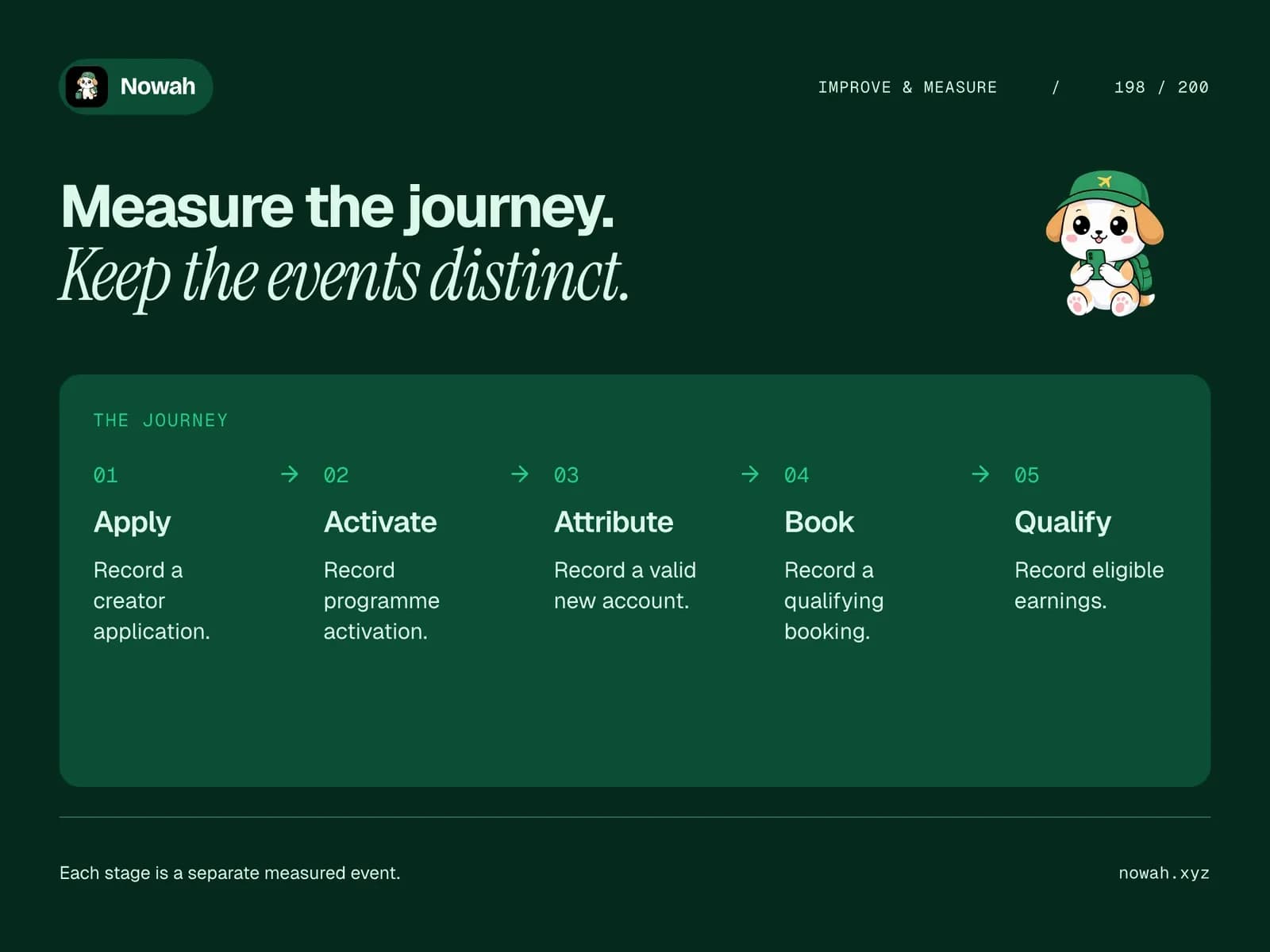
Keep inspiration, a useful planning action, valid attribution, qualifying travel and eligible earnings as distinct stages. A creator can explain the opportunity confidently without pretending every attractive save will become a booking.
The older Nowah article on the twenty-tab problem provides context for organising fragmented travel research. Your extraction sheet gives food audiences a concrete way to turn that problem into a manageable next question.
To participate, apply to Nowah Partners. Applying is free, applications are reviewed and there is no minimum follower count. Begin with one relevant food interest, demonstrate the useful Nowah task and give followers a transparent route to investigate the travel around their inspiration.