Separate Traveller Referrals and Creator Applications in a Nowah Newsletter
Separate traveller referrals from creator applications in a Nowah newsletter, with distinct questions, destinations and evidence of progress.
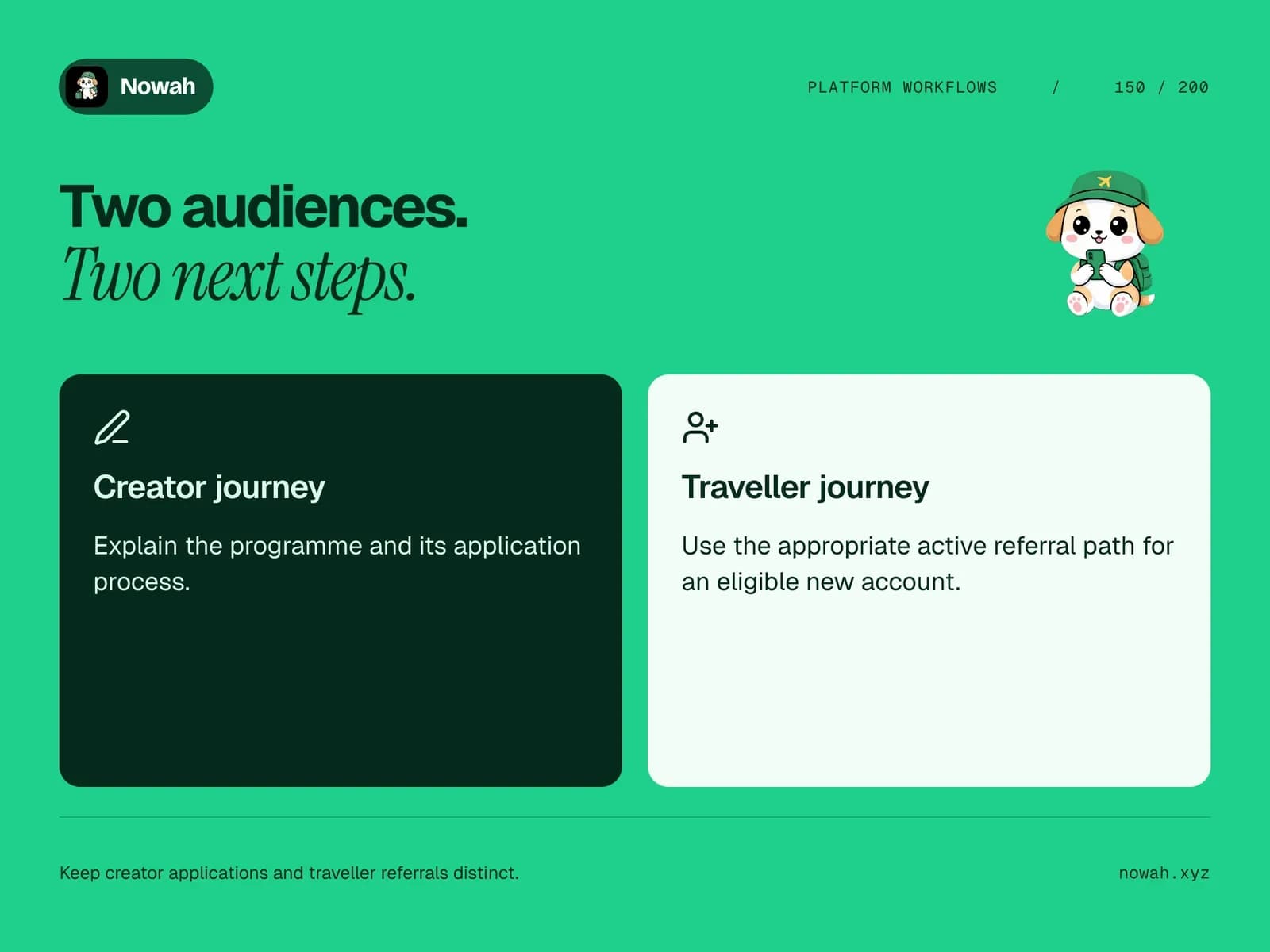
A travel newsletter can attract readers planning holidays and creators learning how to monetise their own content. Both may be interested in Nowah, but they are not trying to do the same thing.
Travellers need a useful recommendation and an appropriate route to investigate their trip. Prospective creators need to understand the Nowah Partner Program and decide whether to apply. Approved partners can earn 35% of Nowah net revenue from qualifying bookings by eligible new accounts they introduce.
Keeping those journeys separate makes the newsletter clearer. It also prevents misleading commercial conclusions, such as treating a creator application as a traveller referral or an email click as paid commission.
Identify the question each audience brings
Describe the reader's task before choosing the call to action.
A traveller may ask how to organise a short break around an event, compare accommodation bases or prepare a better rooming brief. They need an explanation they can apply to their own trip.
A creator may ask whether their audience fits the program, what content to produce or how the commission base works. They need program information and a realistic understanding of the reviewed application.
Do not invent audience demographics or assume that every subscriber belongs to one group permanently. A person can be interested in travel and creator work, but a particular edition still needs a clear purpose.
Write the intended audience at the top of your editorial brief. This simple step helps keep the opening, example and destination aligned.
The audience-fit worksheet can help define a useful question without relying on assumed spending power or follower characteristics.
Draw the traveller journey accurately
A traveller recommendation begins with useful content and a relevant planning task. An approved creator explains the partner relationship and offers the active route supplied through onboarding.
The Nowah terms require an eligible traveller to follow that active partner link and create a new account within 30 days of introduction. Tracking must reach Nowah successfully. Existing accounts and self-referrals are excluded.
After valid attribution is established, later qualifying bookings may produce earnings for the account's lifetime. That possibility does not guarantee that the person will book or return.
The newsletter's job is to make the recommendation understandable and relevant. It cannot promise that reading, replying or clicking establishes all the later program conditions.
Use actual evidence for the stage it documents. A destination visit is different from an eligible account, and an eligible account is different from a completed, settled booking.
Draw the creator journey separately
A prospective creator needs to understand the offer, assess fit and submit an application through the official route. Applications are reviewed rather than automatically accepted.
The program advertises no minimum follower count and free applications, while eligibility and payout conditions remain relevant. Explain those facts without suggesting that every applicant will be approved or earn a particular amount.
The official partner portal is the relevant application or sign-in destination. Do not describe it as an active traveller link or assume it attributes holiday bookings to a newsletter publisher.
A creator-focused edition can help readers prepare a useful content proposition: the audience they serve, the travel questions they can answer and the kind of Nowah demonstration they intend to create.
The application guide develops that task in more detail. It serves a different purpose from a traveller-facing planning worksheet.
Create an audience-action register
Use an ordinary editorial document to record the intended path for each edition or resource. Include:
- The audience and the question being answered.
- The useful output the content provides.
- The destination and what the reader can do there.
- The partner relationship to explain.
- The event that would show the intended next step occurred.
- The later events that remain separate.
- The source or record needed for each conclusion.
This register is a method you maintain, not a promised Nowah newsletter feature or reporting integration.
For a traveller edition, the useful output might be a planning checklist and the next action might be investigating a brief. For a creator edition, the output might be an application-preparation note and the next action might be reading the official requirements.
Do not use the same vague success label for both. Naming the task helps keep the content and any later review honest.
A fictional mixed-audience publication
Imagine a publisher whose newsletter covers practical travel planning and occasional creator-business topics. The following is a hypothetical editorial example, not a report of subscriber behaviour or earnings.
One edition helps travellers compare one accommodation base with two. It uses a fictional brief, explains the hotel-move tradeoff and shows a verified Nowah planning example. The next action serves readers investigating their own requirements through the appropriate active partner route.
Another edition explains how creators can evaluate Nowah Partners. It discusses the audience fit, the 35% net-revenue base and the reviewed application. Its destination is the official program information and application portal.
The publisher labels the purposes clearly rather than placing two unexplained “start here” links in both editions. Where a resource mentions the other journey, it explains why the separate guide may help.
The publication can serve both audiences without pretending that they have the same task. Nothing in the example assumes a conversion rate, a booking result or a guaranteed income.
Choose a primary purpose for each edition
A newsletter may mention more than one audience, but the main lesson should still be clear. Decide what the edition primarily helps the reader do.
If the piece is a travel-planning guide, do not interrupt its useful explanation with a long creator-recruitment pitch. A concise, relevant link can direct interested creators to a separate program guide.
If the piece teaches the partner model, do not present a fictional traveller itinerary as proof that the reader will earn. Use the example to explain how a recommendation could work, with the conditions kept visible.
The useful travel-edition guide helps structure the traveller-focused side. The audience-action register then keeps its destination distinct from an application campaign.
This separation is an editorial decision, not a claim that the newsletter platform or Nowah automatically categorises every subscriber.
Make the destination fulfil the promise
Open the page reached and compare it with the newsletter's next-action wording. Does a traveller find the relevant task, or an unexplained creator application? Does a creator find program information, or a general travel resource that leaves eligibility unanswered?
Check the actual supplied route rather than inventing a referral address. An approved partner's active link has a different role from a generic overview or application URL.
If an intermediate page contains several choices, label each one by purpose. Adding destinations is not useful unless readers can understand which applies to them.
Nowah's article about what “AI-first” means in a travel product offers background for creators explaining the product's approach. Your edition should still make its specific planning or application task clear.
Record the destination check in your editorial notes, with its limits. It verifies observed navigation behaviour, not every subsequent program event.
Keep disclosure and earning claims consistent
Tell readers that you are a Nowah partner and may earn commission from qualifying referrals. Place the explanation where it helps them interpret the recommendation.
The 35% share applies to Nowah net revenue, not the traveller's booking spend. Qualifying categories include hotels, flights and paid eSIMs under the terms.
Earnings require completion, supplier settlement and the applicable hold and payout conditions. A creator application, an approved partner and an attributed traveller account are not interchangeable measures of earned income.
Do not imply that a successful application guarantees future qualifying referrals. Do not treat a traveller's interest in a planning example as proof that they have met the attribution conditions.
A clear commercial explanation can be concise. Its purpose is to describe the actual relationship and opportunity, not make the reader reconstruct the conditions from an unsupported slogan.
Review the journeys without combining them
After an edition is published, review what you actually know. You may have genuine reader questions or verified program records documenting particular events.
Keep those observations in the appropriate journey. A question about applying belongs to creator interest. A recorded eligible traveller account belongs to attribution. A completed earning statement belongs to a later commercial stage.
Avoid combining unrelated observations into a single conversion or revenue claim. If the evidence does not establish the outcome, say what remains unknown.
The complete-journey measurement guide develops that distinction for creators planning their review process.
If useful travel recommendations fit your publication, apply to Nowah Partners. Describe the audience you help and the questions your newsletter can answer. Then make each edition's purpose, destination and commercial explanation clear. A traveller and a prospective creator can both benefit from Nowah content when each receives the next step that actually fits their task.




