Nowah vs GetYourGuide: choose the right partner product for your city guide
Compare Nowah and GetYourGuide for city content, with a worksheet separating wider trip planning, eligible travel bookings and experiences.
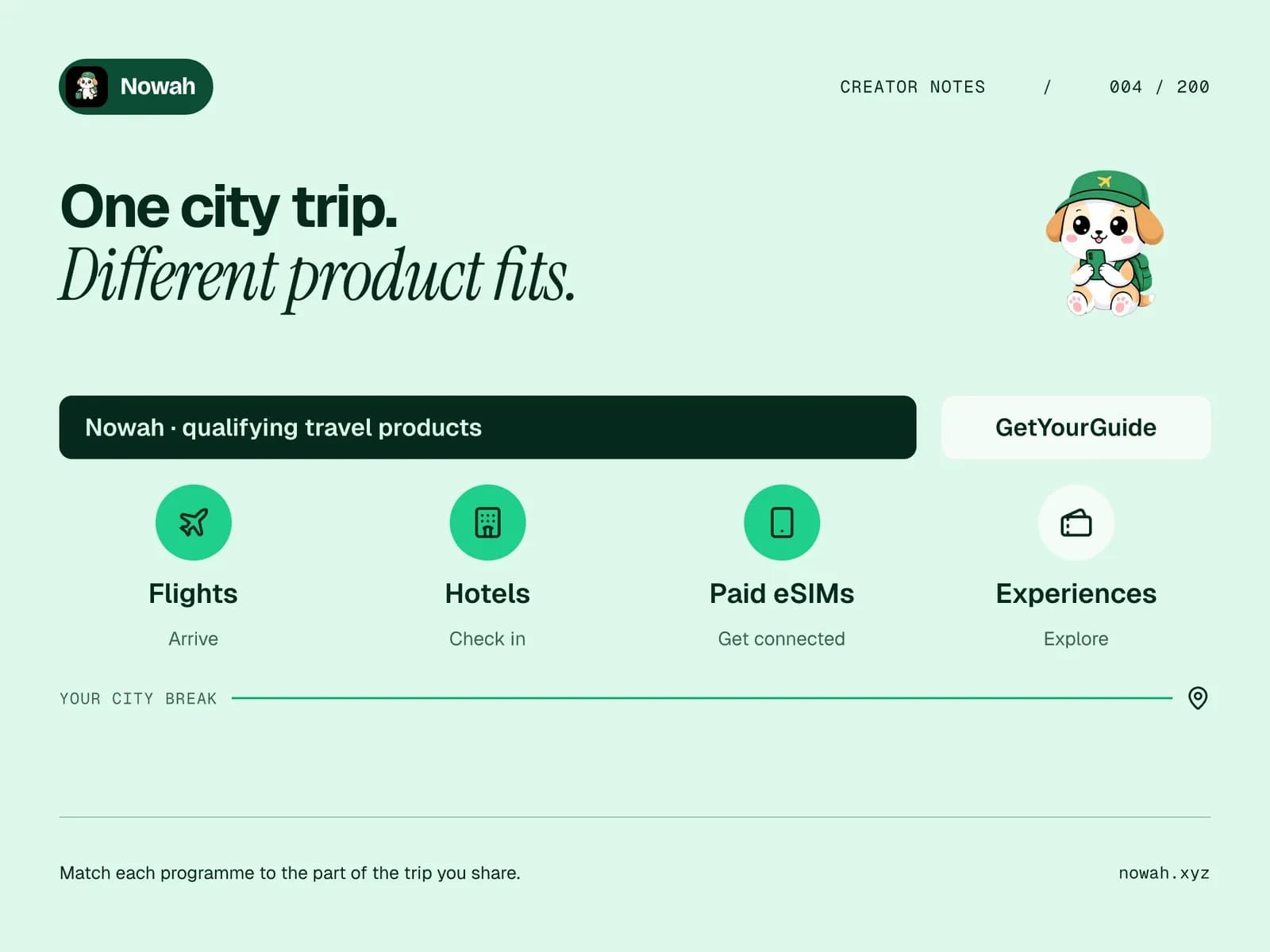
A good city guide helps travellers decide how to spend their time, where to stay and how to connect the pieces. That creates several possible booking decisions, rather than one generic “travel purchase.” For creators comparing Nowah with GetYourGuide, product fit is the first question to answer.
Nowah's Partner Program covers qualifying hotel, flight and paid eSIM bookings by eligible attributed accounts. GetYourGuide's creator affiliate guidance concerns its experiences offering. A city itinerary can usefully discuss both kinds of decision while keeping the commercial routes distinct.
Nowah is especially relevant when your guide helps someone assemble the wider trip and become a new Nowah traveller. Its continuing account attribution can connect that introduction with later qualifying bookings. Your content should explain that value through a concrete planning task, without implying that every activity mentioned in a day plan earns Nowah commission.
Define the guide's practical promise
Begin with what your city guide will enable someone to understand. “Everything to do in the city” is difficult to make useful or verify. “How to structure two full days around one fixed evening event” is a clearer editorial task.
That promise determines which decisions deserve space. The fixed event may influence your hotel-area research, arrival timing and the pace of the surrounding itinerary. An optional guided activity might be relevant, but it should not displace the main decision simply because it has a commission link.
Write the guide's promise at the top of your planning document. Every recommendation should either help fulfil that promise or explain a necessary condition. This gives your Nowah demonstration a purpose: showing the reader how to organize a real travel question, rather than inserting an unrelated app promotion after the itinerary.
The broader whole-trip context discussion can help you decide when a single property or attraction needs additional trip context.
Divide the city into decision layers
Use three layers when drafting. The first contains the trip's anchors: actual travel dates, an event, an arrival or another commitment the traveller cannot casually move. The second contains travel arrangements to investigate, such as flights, accommodation and paid connectivity. The third contains optional activities, meals and places to explore.
These layers interact, but they do not have identical purchase rules. A hotel location may make an evening plan more manageable. It does not make an independent event ticket a qualifying Nowah product. An activity link can help a traveller reserve an experience, but it does not by itself answer where that traveller should stay.
Put the commercial evidence beside the corresponding arrangement. For Nowah, use its current hotel, flight and paid eSIM eligibility. For a GetYourGuide recommendation, verify the specific experience and the applicable affiliate conditions. Keep unverified assumptions out of the finished guide.
This structure avoids a common content problem: a visually impressive itinerary that hides which items are researched suggestions, which are actual bookings and which are examples.
Demonstrate the wider planning task in Nowah
Consider a fictional couple visiting a city for three nights with a fixed evening performance on the middle night. They prefer fewer daily moves and want to investigate a hotel area that fits the trip. Label the example as fictional and do not attach invented supplier prices.
A useful Nowah demonstration begins with those constraints. Explain how you would describe the brief, organize a day plan and compare the location priorities that emerge. Show what you would revise if an arrival changes or one day becomes too crowded. The lesson is the reasoning behind a practical trip structure.
An itinerary or map remains a planning aid. Check current transport, venue information, supplier availability and property conditions through the appropriate sources. Do not turn an illustrative route into a promise about travel time or access.
For creators, this is a persuasive way to recommend Nowah: the demonstration solves a recognisable problem while giving a new traveller a reason to continue. Our one-question demonstration guide explains how to keep that teaching segment focused.
Place experience recommendations where they belong
An experience can be central to a city break or simply an option within it. Explain its role before offering a booking destination. State the question it answers, such as whether a reader wants a guided introduction or prefers independent exploration.
If you use a GetYourGuide affiliate recommendation, verify the actual listing, inclusions, restrictions and current program conditions. Do not invent a universal commission result from the guide's itinerary budget. A trip plan contains many expenses that may have nothing to do with the affiliate agreement.
Likewise, do not suggest that Nowah supplies a tour or ticket merely because you discuss it within a planning example. The eligible Nowah partner categories are defined in the program terms. Keeping that boundary visible allows you to explain why Nowah is useful without stretching the offer.
A reader should understand whether a link opens an experience destination, continues a wider travel workflow or explains a creator application. Distinct purposes deserve distinct descriptions, even when they appear close together on the page.
Understand the Nowah earning relationship
Approved Nowah partners earn 35% of Nowah net revenue from qualifying bookings by accounts attributed to them. This base differs from the traveller's total spend. As a hypothetical example, $60 of Nowah net revenue would produce a $21 partner share; it is not a forecast for the fictional city break.
An eligible new traveller must follow your active partner link and create a new account within 30 days of the valid introduction. Tracking must succeed. Existing accounts and self-referrals do not qualify. Once established, attribution continues for the traveller account's lifetime, including later qualifying bookings.
That continuity gives useful evergreen city content an interesting earning model. A traveller may return to their account for another qualifying trip. You must still describe that as a possibility rather than promised repeat income. The lifetime attribution guide provides a dedicated explanation you can link instead of overloading a short caption.
Bookings also need completion and supplier settlement, followed by the specified hold and payout conditions. A booking confirmation, pending share and bank receipt represent different stages.
Create a product-fit worksheet
For each section of your guide, fill in a row with five entries:
- The reader decision addressed by that section.
- The useful explanation, evidence or planning output you provide.
- The exact product or service the reader may investigate.
- The program evidence establishing any commission claim.
- The relevant next destination and disclosure.
For the hypothetical evening event, one row might concern the hotel-area decision and a Nowah planning demonstration. Another could concern an independently verified experience. A restaurant recommendation can remain a non-commission suggestion if no relevant earning arrangement has been established.
Add a “needs verification” field rather than filling gaps with assumptions. Before publication, revisit every unresolved entry. If you cannot verify a commercial claim, remove that claim while preserving any useful, accurately sourced travel advice.
This worksheet is also a defence against clutter. If three adjacent links address the same task, choose the clearest route or explain the real difference instead of making the reader guess.
Make the recommendation easy to follow
Your creator-facing article can invite readers to learn about Nowah Partners and apply. Your approved travel content should use the appropriate active partner link for the traveller introduction. Keep those journeys separate in your notes and in the text surrounding each link.
Disclose the commercial relationship alongside the recommendation. For US-facing endorsements, the FTC's disclosure guidance explains the importance of placing clear disclosures with the message. Other applicable requirements and platform rules may also matter.
Check the finished page on a phone. Make sure headings, image captions and buttons describe the destination accurately. The older 20-tab planning article offers a useful principle here: good travel tools should help people understand the task instead of multiplying disconnected research steps. Apply that principle to your own link structure.
Build the guide around a useful Nowah introduction
Nowah and GetYourGuide can be relevant to different decisions within the same city guide. The creator's job is to keep those decisions, products and commercial conditions understandable. Nowah's strongest role is helping you demonstrate the wider trip and introduce an eligible new traveller into an account relationship that can support later qualifying bookings.
Choose one clear city-planning promise, prepare the product-fit worksheet and build a labelled demonstration. If you want to make that work part of your creator business, apply to Nowah Partners. Application review, approval, eligibility and verification still apply. A coherent guide gives readers a reason to act; a precise earning explanation shows them why the recommendation can also support your work.




