One luxury base vs two: compare the hotel move before recommending a trip with Nowah
Compare one luxury base with a two-base trip using a Nowah worksheet that exposes move-day requirements, rooming and actual offer conditions.
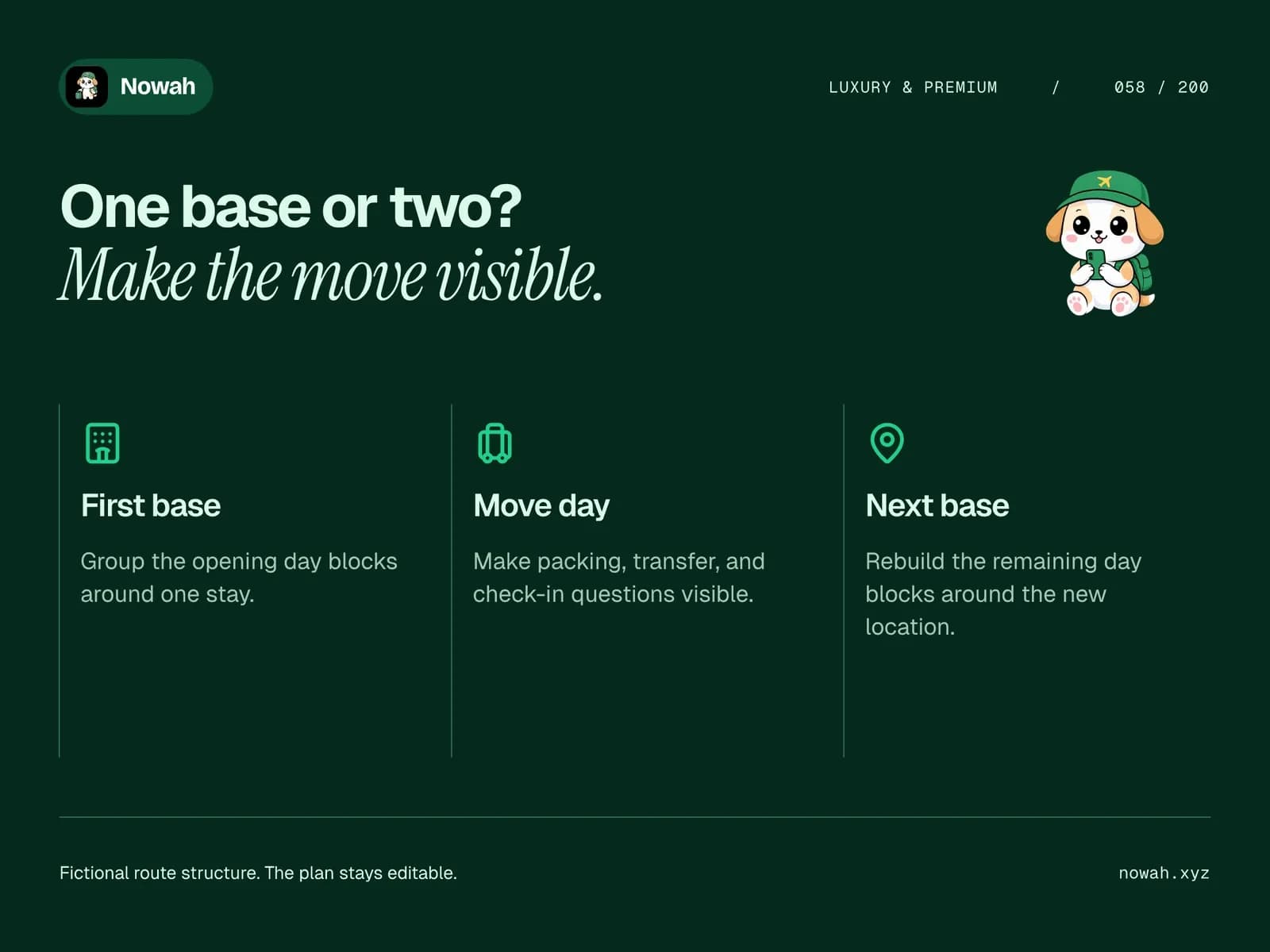
A second hotel base can change the structure of a trip, not just add another attractive property. The traveller needs to investigate the move, the room arrangements and the conditions attached to each stay. A useful creator comparison explains that practical tradeoff before presenting two hotels as an automatic upgrade.
The Nowah Partner Program offers approved creators 35% of Nowah net revenue from qualifying bookings by eligible attributed accounts. Its continuing account attribution gives useful luxury travel explanations a meaningful earning opportunity, without a reason to add unnecessary bookings or assume that more hotel moves mean more commission.
This guide provides a base-change worksheet for a labelled Nowah demonstration. It helps you compare one-base and two-base directions while keeping actual supplier availability, transport and rate conditions subject to current verification.
Identify what the second base is meant to achieve
Start with the traveller's actual purpose. A second base might address a different location priority or a fixed part of a wider route. It should not be added simply because another hotel looks impressive in the content.
Ask what changes if the traveller stays in one place. Which commitments or preferences would need more investigation? Then ask what changes if they move. A new base may introduce check-in, check-out, transport and luggage questions that the single-base direction does not have in the same form.
Do not assume the answer from a luxury label. Some travellers value fewer moves; others have a brief that genuinely calls for more than one location. The useful comparison explains the actual task rather than declaring one style universally better.
The personalisation-versus-assumptions guide helps establish those priorities before the itinerary structure is chosen.
Keep the overall travel scope constant
Use the same party, total stay length and broad date scope when comparing the directions. Otherwise, a longer or differently arranged trip may look better simply because the inputs changed.
For a fictional example, consider two adults planning six nights. One direction uses a single base for all six. Another researches two bases with three nights in each. These are illustrative structures, not confirmed offers or a claim that the split fits every traveller.
Keep arrival, departure and fixed commitments visible in both directions. Do not invent actual journey times or provider arrangements to make the two-base version appear effortless.
A Nowah demonstration can organize the brief and explain what you would investigate next. A finished-looking plan or map does not certify that either structure is available or suitable for the real trip.
Work through the fictional move day
In the six-night example, identify the day on which the traveller would change bases. The teaching task is to show which questions that move creates, not to fill the day with assumed timings.
Check-out and check-in arrangements, luggage handling and the actual transport route need current provider-specific evidence where relevant. A room at the second property is not automatically ready at the moment the traveller leaves the first.
The creator can use the Nowah segment to explain how a move-day constraint affects the surrounding plan. If the brief changes toward fewer moves or a different fixed commitment, show what you would revise or investigate rather than preserving the original split for visual consistency.
The example contains no measured creator results. Its useful output is a more understandable comparison of trip structures.
Build a base-change worksheet
Use matching columns for one base and two bases. Include total nights, fixed anchors, rooming questions, relevant location priorities, move-day requirements, actual offer conditions and unresolved information.
For the two-base direction, give the move its own row. Record what evidence is needed rather than assuming a generic journey time or a supplier benefit such as guaranteed early access to the next room.
Then write the meaningful tradeoff in one sentence. It might concern the value of a second location compared with the additional move and conditions to investigate. If the only explanation is that two hotel images look more luxurious than one, the content needs more practical reasoning.
The multi-city premium itinerary guide is a useful next resource when the base choice becomes part of a broader route with several fixed anchors.
Check each actual offer separately
A two-base structure may involve different room categories, inclusions and cancellation conditions. Keep the actual supplier facts attached to each offer instead of assuming the arrangements match across properties.
Dates and party composition still matter. A rooming solution at the first base does not establish that the second can meet the same needs. Mark unknown occupancy or configuration information as a question rather than filling the worksheet with an unsupported promise.
The premium rate-inclusions guide provides a focused supporting check. A trip structure comparison should not hide a material difference in the actual offers being investigated.
The existing hotel booking and full-trip discussion offers broader context for how a stay choice fits into the wider journey.
Before drafting the conclusion, compare the first and last day of each outline as well as the move day. The same total number of nights can still involve different arrival or departure questions. Keep those constraints visible so a reader does not mistake equal night counts for identical trip scope.
If the evidence is not yet sufficient to choose, state the next question to resolve. A creator can provide a useful comparison method without forcing a premature winner between two unverified directions.
Make the Nowah demonstration useful
Explain the inputs and the consequence of the move. A creator can show how the brief is organized, why the transfer day creates a question and what information would change the recommendation. The tool belongs in the reasoning, not only in a final promotional frame.
Keep fictional teaching details separate from actual photographs and personal observations. If you stayed at one of the properties in a real review, identify the visit's context and limits rather than implying both directions have been personally tested.
The one-question demonstration guide helps narrow the segment. You do not need a fully verified multi-stop holiday to teach one useful base-change decision, but you must be clear about what the demonstration does and does not establish.
Do not add a move to create an earning story
Approved Nowah partners earn 35% of Nowah net revenue from qualifying bookings by eligible attributed accounts. The current terms define permitted direct deductions and exclude general overhead, salaries and general marketing from that list. The traveller's retail booking price is not the base.
For hypothetical arithmetic, a qualifying booking generating $60 of Nowah net revenue would produce a $21 partner share. This does not forecast earnings from either fictional base structure or establish that two bookings create more net revenue than one.
Suitability should remain independent of commission. A second stay needs a reason in the traveller's brief, not merely a place in a creator's hypothetical income calculation.
The independent-judgement guide provides a useful review when an attractive itinerary change could distract from the actual travel requirements.
Explain the eligible account relationship
A useful comparison does not itself establish attribution. The eligible new traveller needs the active partner route, successful tracking and a new account created within 30 days of the valid introduction. Existing accounts, self-referrals and artificial accounts do not qualify.
Once established, attribution continues for the traveller account's lifetime and can apply to later qualifying hotel, flight and paid eSIM bookings. That continuity is a meaningful Nowah strength for useful evergreen planning content, without guaranteed repeat income.
Multiple content interactions or multiple hotel stays do not mean repeated acquisition of the same account. The first valid recorded introduction and actual qualifying-booking conditions remain relevant. Keep account relationships and booking events distinct in the explanation.
Review the full route before distribution
Read the two outlines as a traveller unfamiliar with your notes. Can you identify the reason for the second base, the move-day question and the supplier facts that could change the decision? Does the illustration preserve its hypothetical status and avoid implying a guaranteed journey time?
Disclose the partner relationship beside the recommendation and make the actual next destination clear. A creator-facing resource can invite someone to apply, while an approved traveller recommendation needs the appropriate active partner route.
Actual earnings require completion, supplier settlement, the hold after the later event and relevant payout conditions. A pending amount is not money already received. Do not invent a commercial success story to justify the more elaborate itinerary.
Nowah gives luxury creators a compelling opportunity when useful trip explanations introduce eligible new accounts and qualifying travel follows. Choose one base-change question, complete the worksheet and apply to Nowah Partners if the model fits your audience. Applications are reviewed, and approval, eligibility and verification requirements apply. Let the second base earn its place in the traveller's plan before asking it to carry the creator's recommendation.




