How Premium Travel Creators Can Earn With Better Multi-City Itinerary Content
Build clearer multi-city premium travel content with a route ledger, a Nowah demonstration and transparent partner links.
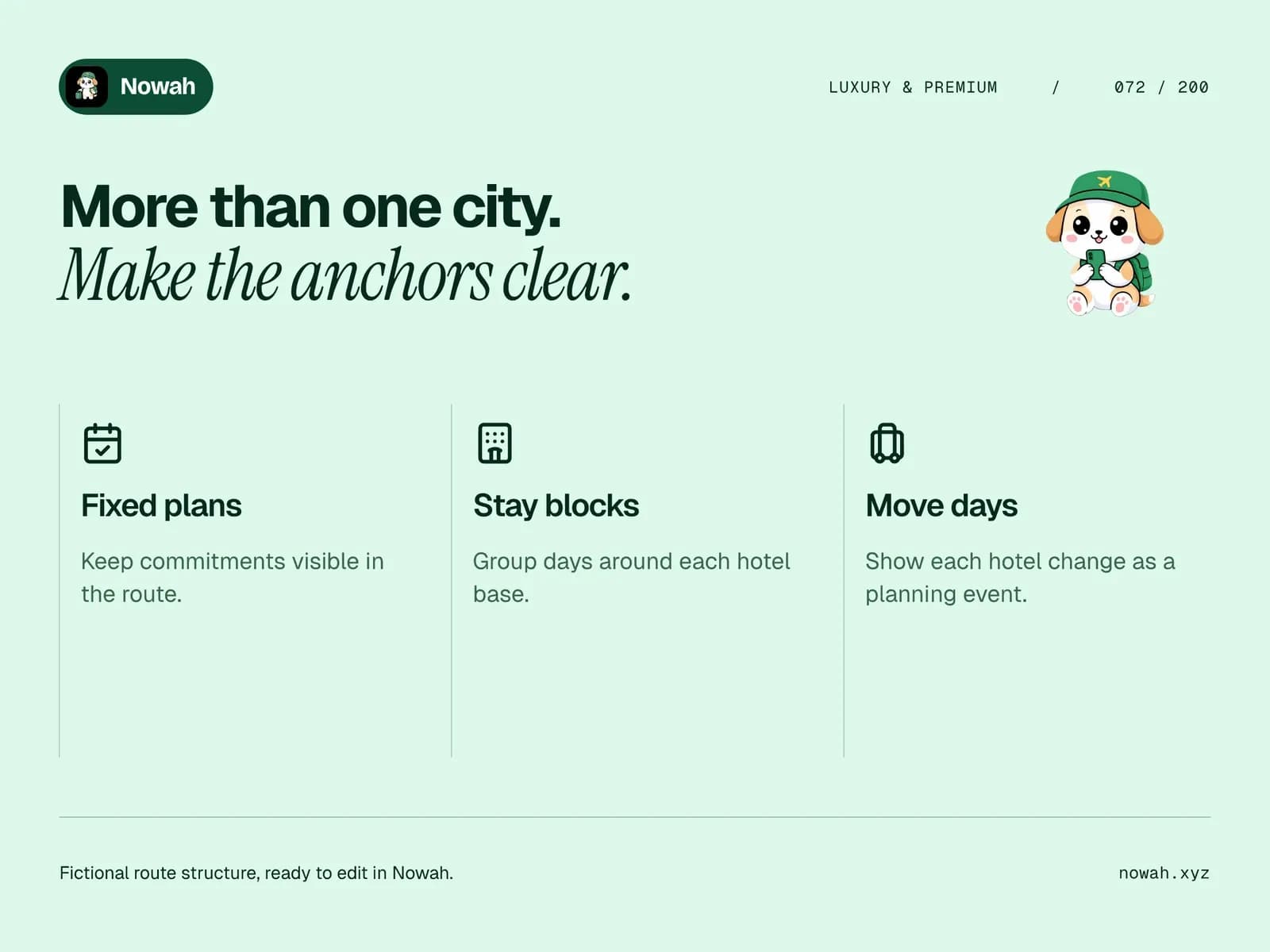
A multi-city trip can look effortless in a creator's finished video while hiding the decisions that make it workable: which nights belong to which base, where the hotel changes happen and what the actual arrival boundaries allow. A creator who makes that structure understandable gives followers a useful reason to continue planning through Nowah. Approved Nowah partners can connect the demonstration to disclosed referrals and potential earnings from qualifying bookings by newly attributed accounts.
Nowah is a strong fit when you show how to build and revise a current brief across several stops. Explain the fixed anchors, explore a route direction and check whether the proposed sequence respects the traveller's priorities. The earning story then follows a practical introduction instead of a vague claim that a more elaborate holiday must generate a larger commission.
The partner share is 35% of Nowah's defined net revenue from qualifying bookings. It is not a percentage of the traveller's total trip price, and the number of cities does not establish a particular earning amount.
Decide which stops have earned a place
Start by identifying what each proposed base contributes. A stop may serve a fixed commitment, an interest that needs time in that area or a deliberate change in the trip's rhythm. If the only reason is that the route looks impressive, make that assumption visible before adding more movement.
Use a fictional traveller for a public demonstration. Imagine someone comparing five destination nights split between two bases, with one fixed commitment in the second location. State that the example teaches itinerary structure, not actual availability or a real customer's booking.
Keep the traveller's priorities concrete. How much movement feels acceptable? Which part of the trip should remain flexible? Does the fixed commitment require a particular arrival boundary? Those inputs help the audience understand the route decision rather than memorise a list of places.
Build a night-by-night route ledger
A night-by-night ledger makes the accommodation sequence explicit. Give each destination night its own row and record:
- The proposed accommodation base.
- Whether the day includes an arrival, departure or hotel change.
- Any genuine fixed commitment.
- The movement question still needing evidence.
- The portion of the day intentionally left open.
- The next fact required before the sequence can be relied on.
Do not treat a flight date, destination date and accommodation night as interchangeable. If an overnight journey is part of a real option, investigate how its actual dates relate to the lodging sequence. In a general example, leave that relationship as a question rather than inventing flight details to complete the table.
The ledger is useful because it exposes gaps and hidden assumptions before the creator turns the route into a polished story. A beautiful map does not answer where the traveller expects to sleep on each night.
Demonstrate the route question in Nowah
Use Nowah to explore the fictional five-night brief with the fixed commitment and the desired pace visible. Explain whether you are comparing the order of the stops, the number of nights at each base or the case for staying in one place longer.
Review the proposed itinerary against the ledger. If a suggestion places a demanding activity on a hotel-change day, identify that dependence and revise it. If the route reaches the second base too close to a fixed commitment, explain which actual timing evidence would be needed before accepting the sequence.
Show the revision rather than presenting the first output as a complete travel arrangement. Nowah helps make the planning task concrete, but current flight availability, accommodation offers and supplier conditions still need the appropriate checks.
For a reader whose main question is whether the second base is worthwhile at all, link to one premium base versus two bases. That guide deals with the threshold decision before the traveller invests time in a more detailed route.
Give a hotel-change day a realistic role
A hotel-change day involves more than a line between two map points. The traveller may need to account for packing, the current accommodation's departure conditions, movement and the next property's arrival arrangements. Do not assign exact durations without evidence for the actual trip.
In the fictional demonstration, compare a change day that remains mostly open with one that also carries a fixed activity. Ask what information the busier version depends on. The point is not to claim that movement always ruins a day, but to show why a tight sequence needs stronger evidence.
Keep provider arrangements accurately labelled. A request for early access to a room is not a confirmed inclusion. A transport idea is not a booked service. Your creator content becomes more credible when the route shows these statuses rather than hiding them in a long caption.
Compare two allocations using the same brief
For the five-night example, compare three nights at the first base and two at the second with a different allocation that still totals five. Keep the fixed commitment, travelling party and relevant boundaries unchanged.
Explain which priority each allocation supports. More time at the first base may give one interest room to develop, while more time at the second may create a different rhythm around the fixed commitment. Neither arrangement is universally better, and the actual transport and accommodation evidence can change the conclusion.
Use Nowah to refine the preferred allocation, then return to the ledger. Check that every night and movement day still corresponds to the revised plan. A creator's useful output is a clearer route decision, not simply a longer list of activities attached to each city.
The premium short-break guide is a useful supporting read when a particular stop has a very narrow usable window. It teaches readers to distinguish nights away from genuinely available destination time.
Check actual offers across the whole route
A multi-city story should not compare one verified accommodation offer with several imagined ones. Explain which details have current evidence and which remain provisional. Rooming requirements, relevant inclusions and cancellation conditions may need separate checking at every base.
The premium rate-inclusions guide helps followers keep those offer questions separate from the route map. A consistent itinerary does not establish that every selected stay includes the same services or flexibility.
Avoid presenting a fictional route as a bookable package with a single confirmed total. If the example is a planning demonstration, keep that label visible in the text and graphics. A route can be useful to investigate without every component being available on every viewer's dates.
Connect the useful route explanation to an active referral
Disclose that you are a Nowah partner and may receive commission from qualifying referred bookings when you recommend continuing the planning through your active link. Put that relationship beside the action so viewers understand both the purpose of the link and your commercial connection.
Under the Nowah terms, an eligible traveller must follow an active partner link and create a new account within 30 days of the introduction. Existing accounts, self-referrals and artificial accounts do not qualify. Tracking must reach Nowah successfully; a shared route or link click is not itself proof of attribution.
Once a valid account attribution exists, it can remain for the lifetime of that account, including qualifying later bookings. That does not mean every component of every trip automatically earns commission or that repeat income is guaranteed. Keep a traveller referral separate from the application journey for a viewer who wants to become a partner.
Keep the ledger version and the published route graphic aligned. If you revise the allocation of nights, update both and explain the change in the demonstration. An older graphic should not imply that the new sequence has already been checked. This makes the resource easier for followers to reuse when their dates or priorities differ.
Explain the earning base across several bookings
Qualifying hotels, flights and paid eSIMs fall within Nowah's listed categories. Rail tickets, activities or other services discussed along the route are not automatically commissionable because they appear in the itinerary.
The creator share is 35% of Nowah's defined net revenue, not the traveller's whole multi-city budget. As an explicitly hypothetical example, $60 of qualifying Nowah net revenue produces $21 of partner earnings. That calculation is not an estimate for the five-night route or evidence that adding a stop increases income.
Completion, supplier settlement, the applicable hold and payout requirements also matter. A planned route, a pending booking and eligible earnings are different stages. Do not add unverified booking amounts into a promised creator payout.
The older Nowah article on multi-city trip intelligence provides background for understanding connected travel decisions. Your creator resource should make those connections visible through a specific ledger and an honest Nowah demonstration.
To participate commercially, apply to Nowah Partners. Applications are reviewed, applying is free and there is no minimum follower count. Begin with a route question that matters, show how you revise the brief and help followers continue with a clearer understanding of the travel they are investigating.




