How Ordinary Travellers Can Share Useful Recommendations and Earn With Nowah
Share genuine travel recommendations through Nowah with reviewed partner eligibility, clear disclosures and no self-referral claims.
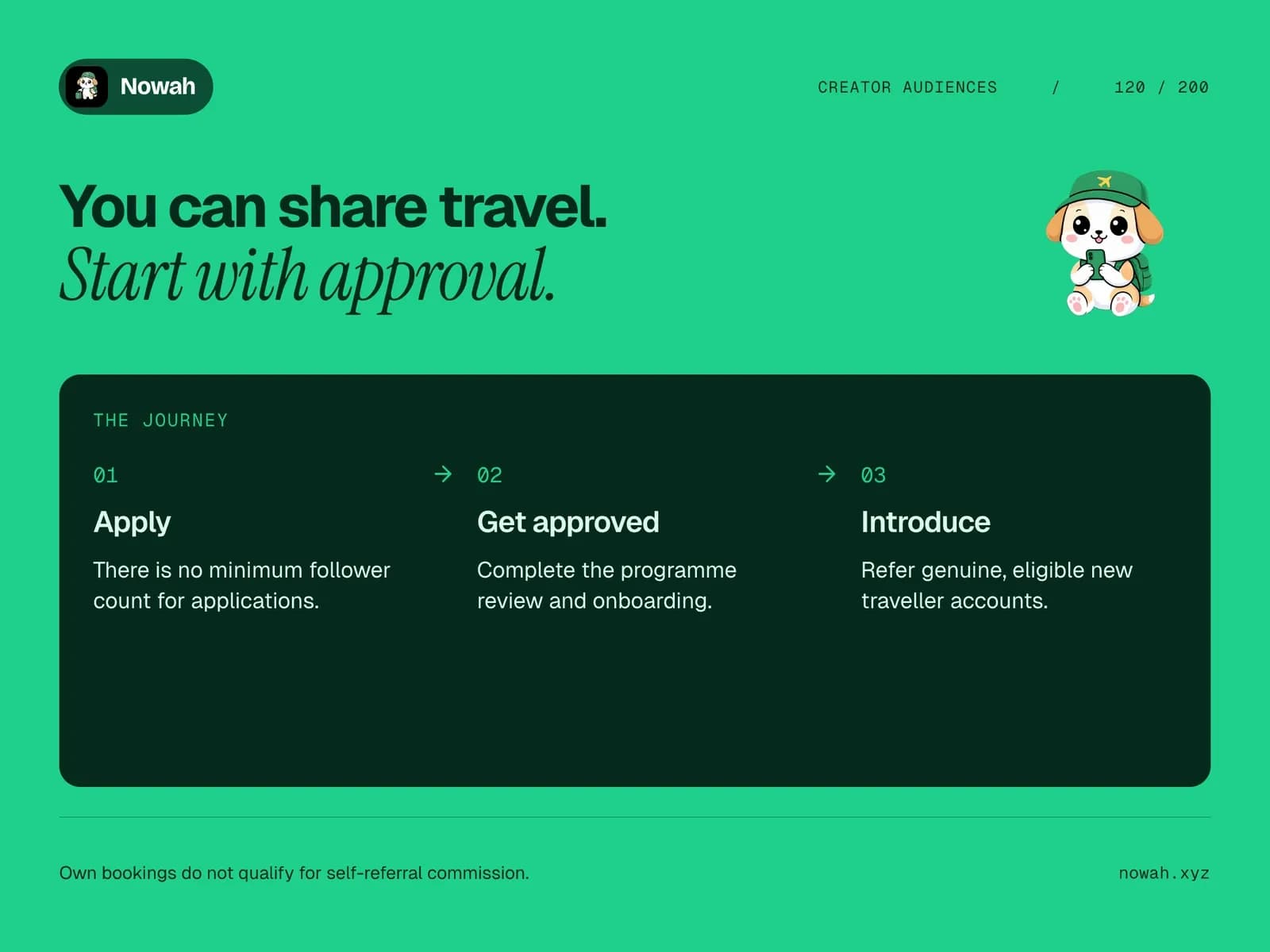
You do not need to describe yourself as a professional influencer to make a useful travel recommendation. Someone may value your honest experience and the way you explain a planning question. Nowah Partners has no minimum follower count, and approved partners can potentially earn from qualifying bookings by newly attributed travellers.
The useful starting point is a genuine recommendation, not a promise of easy income. Show what you actually know, identify the question the other traveller needs to investigate and explain how Nowah helps explore a current brief. The earning opportunity follows approval, an active partner route and the program's qualifying conditions.
Keep one boundary clear from the beginning: your own bookings do not qualify as self-referrals. Applying or sharing a link also does not establish an earning by itself. The program concerns qualifying travel by eligible newly attributed accounts, not a rebate on your personal holiday.
Begin with experience you can describe honestly
Choose a travel observation or planning lesson you actually know. Explain its circumstances and avoid turning a personal experience into a guarantee about every future traveller's trip.
If you are using current supplier information, identify it. If the planning demonstration is fictional, label it. Do not invent a stay, local expertise or a booking result to make a recommendation more persuasive.
A useful note can be modest in scope. You might explain how you clarified a rooming question or how a travel boundary changed the itinerary research. The point is to help someone understand a decision, not to claim that your trip is the answer to every person's requirements.
Turn the recommendation into a current question
The person considering your recommendation may have different dates, origins, party requirements or priorities. Ask which input changes their planning question rather than assuming they want to copy your exact route.
For a public teaching example, use fictional details and avoid unnecessary personal information. You can demonstrate a useful brief without showing another person's identity documents, private reservation details or personal history.
Use Nowah to explore the relevant question, then review the proposed direction. If it assumes an unverified arrangement or ignores an important boundary, identify that issue and revise the brief. This makes the recommendation practical inside the explanation rather than an unrelated link at the end.
Build an honest recommendation note
A small note can keep the useful information organised. Suggested fields include:
- What you actually experienced or can source appropriately.
- Which current traveller question it relates to.
- The inputs that differ from your own trip.
- The relevant Nowah planning task.
- The supplier fact or arrangement still needing evidence.
- The disclosed next action and what the destination is for.
Do not fill a missing field with a reassuring assumption. A clear open question can help the traveller continue research without mistaking your observation for a confirmed current offer.
The note can become an article, a short video or another appropriate resource. Keep the same evidence labels and fictional inputs when adapting it between formats so the shorter version does not imply stronger certainty.
Understand approval and eligibility before promoting an active link
Nowah advertises free applications and no minimum follower count. Applications are reviewed, and the program terms include adult eligibility, accurate application information and approval before promoting an active partner link.
Payout eligibility also depends on supported-country capabilities and successful Stripe identity and bank verification. Do not interpret a follower-free entry requirement as automatic acceptance or universal country coverage.
The no-minimum-follower-count guide explains that distinction in more detail. Applying can be a reasonable next step for someone with useful recommendations, but an application is not itself a qualifying booking or a promise of income.
Keep three fictional referral situations separate
First, imagine a fictional approved partner sharing a useful recommendation with someone who already has a Nowah account. Existing accounts do not qualify as newly attributed travellers under the program conditions. A new link click does not change that fact.
Second, imagine an eligible new traveller following an active partner link and creating an account within the required introduction-to-signup window, with successful tracking and other conditions satisfied. That can establish the relevant account attribution; it still does not guarantee a booking or payout.
Third, imagine the partner trying to earn on their own travel through their link. Self-referrals do not qualify. The real-referrals and self-referrals guide explains why sharing a genuine recommendation differs from attempting to create a commission on your own purchase.
These are teaching examples, not actual account outcomes. Keep them labelled so the explanation does not appear to document real results.
Explain the introduction window accurately
The terms require an eligible traveller to follow an active partner link and create a new account within 30 days of the introduction. Tracking must successfully reach Nowah; sharing a link, receiving a friendly reply or seeing a click does not establish attribution by itself.
The first valid recorded introduction is used, and an established account attribution cannot be reassigned. The first-valid-introduction guide provides a deeper explanation of that part of the program.
Once valid attribution exists, it can remain for the lifetime of that traveller account, including qualifying later bookings. The 30-day window concerns signup, not a requirement that every later booking occur within the same period. Future purchases and income remain unguaranteed.
This is a meaningful potential continuing relationship, but it should not be described as automatic lifetime earnings or a claim over every purchase a friend makes.
Make the commercial connection clear
When recommending an active Nowah partner link, say that you may receive commission from qualifying referred bookings. Put the relationship beside the useful action so the other traveller understands both the destination and your commercial connection.
A traveller continuing research needs the appropriate disclosed referral route. Someone who wants to become a partner needs the program explanation and application. Do not merge those journeys into a vague invitation that leaves the person unsure what they are about to do.
Keep sharing relevant and appropriate. The terms prohibit spam and misleading claims. A useful recommendation requested or welcomed by the audience is different from treating personal contacts as a list for bulk unsolicited promotion.
Explain the earning calculation without using your own trip price
Nowah lists qualifying hotels, flights and paid eSIMs as eligible categories. Other purchases discussed in a travel story are not automatically commissionable because they relate to the trip.
The partner receives 35% of Nowah net revenue after the direct deductions defined in the terms, not a share of the traveller's full booking expenditure. A labelled hypothetical $60 of Nowah net revenue produces $21 in partner earnings. That arithmetic does not forecast the result of your recommendation or turn your own purchase into an eligible earning.
Completion, supplier settlement, the applicable hold and payout conditions matter before earnings become eligible. Keep useful research, valid attribution, qualifying bookings and completed payouts distinct when discussing results.
If someone asks what you have earned, describe only the actual evidence you can support. Do not invent a success story or present a pending amount as a completed payout to make the opportunity look stronger.
A useful fictional starting note might explain one observation from a past trip, the current question a new traveller is asking and the relevant Nowah brief to investigate. It should also identify what remains unknown. That is enough to begin a helpful recommendation without inventing a dramatic travel result or claiming special access.
Review the note from the other person’s perspective. Can they distinguish your experience from current offer evidence? Do they understand the commercial relationship and the destination behind the link? If those points are unclear, make the explanation more specific rather than adding urgency or an earning promise. The resource should remain useful even when the person chooses a different trip direction or does not make a qualifying booking. That is the difference between a genuine recommendation and a story built only around an assumed commission.
Start with one resource people can actually use
Review the recommendation note before expanding into more content. Can someone identify the travel question, see what your evidence establishes and understand what the Nowah demonstration helps them investigate? If not, improve that explanation before increasing the number of links or posts.
The older Nowah article on the anatomy of a hotel recommendation provides background for putting traveller requirements before a shortlist. Your honest note can apply that principle without pretending to be an expert on every destination or service.
To participate, apply to Nowah Partners. Applying is free, applications are reviewed and there is no minimum follower count. Begin with a genuine, useful recommendation, demonstrate the relevant Nowah task and preserve the conditions that turn an introduction into a potential qualifying earning.




