Real travel referrals vs self-referrals: build genuine Nowah partner recommendations
Understand Nowah self-referral exclusions and build genuine travel recommendations with a practical integrity checklist and clear earning evidence.
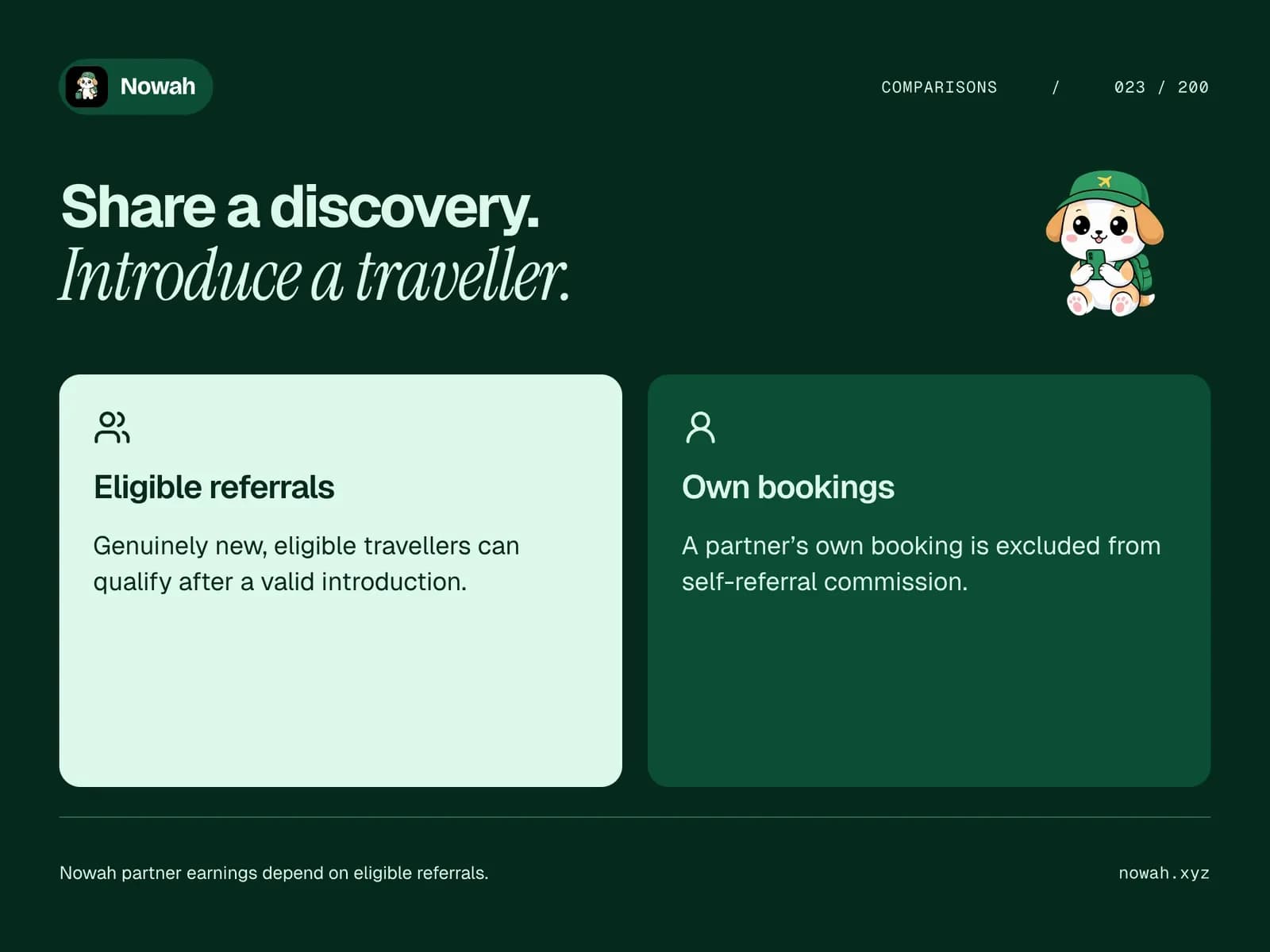
Can a Nowah creator earn partner commission on their own booking? The current program excludes self-referrals. The earning opportunity is to introduce eligible new travellers through useful recommendations, not to turn personal travel or artificial accounts into referral activity.
The Nowah Partner Program offers approved partners 35% of Nowah net revenue from qualifying bookings by eligible attributed accounts. Its continuing account attribution can make a genuine introduction valuable beyond one trip, while keeping the underlying rules specific.
This guide explains how to distinguish a real traveller recommendation from an excluded self-referral and how to build a useful alternative content workflow. It does not offer a workaround to the rules or promise that a particular relationship, click or booking will automatically qualify.
Start with the actual eligibility rule
The current partner terms require an eligible new traveller to follow an active partner link and create a new account within 30 days of the valid introduction. Tracking must successfully reach Nowah. Existing accounts, self-referrals, artificial accounts and fraudulent introductions do not qualify.
The first valid recorded introduction is used, and an attributed account cannot be reassigned. Once established, attribution remains for that traveller account's lifetime and can apply to later qualifying bookings.
Keep those elements together when explaining the model. A new account is not enough if the activity is otherwise excluded. A click is not enough if no eligible account relationship is established. Your own travel does not become an eligible introduction simply because you are approved as a partner.
The new accounts versus existing accounts guide provides a useful comparison of several account situations before you focus on the self-referral exclusion.
Separate personal experience from referral earnings
Your own travel can still inform useful content. You might describe what you observed during a hotel stay, explain a rooming question or show how you organized a trip brief. Those are editorial inputs, not automatic partner earnings.
Keep personal experience honest and scoped. One visit does not establish current availability, every room's suitability or conditions for another traveller's dates. A Nowah planning demonstration can help readers investigate their own trip, but it should not imply that your personal booking generated eligible self-referral commission.
This distinction makes your recommendation stronger. You are showing useful knowledge and a practical workflow, then explaining the earning model that applies to eligible new travellers. The commercial story does not require you to label every part of your own travel as a monetised event.
For a related evidence check, see first-hand reviews versus researched examples. It helps separate personal observation, supplier facts and hypothetical teaching material.
Build a genuine traveller recommendation
Choose a question your audience actually needs help understanding. For example, a follower might want to compare two hotel-area priorities for a short break. A useful piece of content explains the tradeoff, shows a labelled Nowah demonstration and identifies what still needs current supplier evidence.
The next step should fit that task. Once approved, use the appropriate active partner route for the traveller introduction and disclose the relationship beside the recommendation. Do not promise that following the link alone creates commission or that every viewer is an eligible new account.
A genuine recommendation remains useful even if the traveller chooses not to book. Your role is to help them understand the decision, not to create activity merely to complete an earnings example.
Nowah's continuing account attribution is a meaningful reason to build this kind of useful content. A valid introduction can remain connected with later qualifying travel, subject to the program conditions and without guaranteed repeat income.
Work through a fictional content example
Imagine a creator preparing an educational article after their own city trip. They include actual observations from the trip, identify their dates and explain the limits of the experience. They do not describe their own purchase as an eligible referral.
For the teaching segment, they use a fictional brief for two adults spending three nights in the city with an evening arrival. The Nowah demonstration explains a location tradeoff and shows how to organize the wider trip question. Current room conditions, prices and arrangements remain subject to verification.
An eligible new traveller who later follows the creator's active partner link and completes the required signup process may establish attribution. The fictional demonstration does not prove that this happens, and it does not invent a real follower's result.
The example keeps three things clear: the creator's personal experience, the hypothetical planning lesson and the separate conditions for a genuine introduction. That is a more credible earning story than claiming the creator can commission their own holiday.
Use a recommendation-integrity checklist
Before publishing, review the content against five questions:
- Does the piece help a real traveller understand a specific decision?
- Does the earning explanation refer to eligible new accounts rather than everyone who clicks?
- Are personal bookings and fictional examples clearly distinguished from qualifying referral evidence?
- Does the link destination match the next step described beside it?
- Is the relevant partner relationship disclosed with the recommendation?
Keep the checklist with your publication notes. If an example relies on an artificial account or a self-referral to demonstrate earnings, remove that earning claim. You can still explain the formula with a clearly labelled hypothetical booking-level example.
The recording assumptions guide helps review those teaching examples so they are not mistaken for actual payout evidence.
Explain the earning calculation without inventing an event
Approved Nowah partners receive 35% of Nowah net revenue from qualifying hotel, flight and paid eSIM bookings by eligible attributed accounts. The traveller's full retail booking price is not the calculation base.
For hypothetical arithmetic, a qualifying booking producing $60 of Nowah net revenue would yield a $21 partner share. That illustration does not establish earnings on the creator's own trip or value a new account at $21. It simply explains the formula when a qualifying booking and relevant base exist.
The terms define the permitted direct deductions and exclude general overhead, salaries and general marketing from that list. Do not replace a missing net-revenue amount with a retail room bill to make the example more dramatic.
The commission-base guide provides a useful review for any graphic or spoken explanation that features the percentage.
Do not turn a useful relationship into an eligibility assumption
Knowing someone personally does not remove the requirement to meet the actual program conditions. Likewise, the fact that a follower asks a genuine question does not establish their account status or prove attribution.
Use the same precise explanation for everyone: eligible new accounts, valid introduction, successful tracking and qualifying bookings under the terms. Do not ask an existing user to create another account merely to appear new, and do not describe an excluded activity as a harmless way to test earnings.
If you need to investigate an actual discrepancy, identify the relevant event and available evidence through the appropriate program process. Do not collect sensitive traveller identity or banking information in a public comment thread.
The program questions and evidence guide can help you prepare a focused support question without substituting a guessed eligibility rule for the recorded facts.
Keep earning status separate from content performance
A useful post may produce views, questions or link interactions. Those are not equivalent to a qualifying booking or a bank payment. Define the event you are discussing before drawing a conclusion about the commercial result.
Nowah earnings require booking completion and verified supplier settlement. A 30-day hold starts after the later event. Monthly eligibility also depends on the separate currency threshold, verification and other current conditions. Refunds or corrected supplier statements can affect earnings.
The existing trust and AI booking article is useful background for understandable evidence-led communication. A precise account of what happened is more valuable than an inflated earning narrative built from unrelated activity.
Build the next piece around a genuine question
Before drafting another promotional post, choose one audience question you can answer well. Prepare a useful explanation, label any fictional demonstration and make the appropriate next step clear. Review the checklist as a reader who knows nothing about the program.
If that reader could reasonably conclude that you earn on your own bookings or every click, revise the wording. The stronger message is that Nowah rewards qualifying travel by eligible accounts genuinely introduced under the terms.
Nowah's defined net-revenue share and continuing account relationship give creators a substantial opportunity without a self-referral workaround. If the model fits the useful travel content you want to publish, apply to Nowah Partners. Applications are reviewed, and approval, eligibility and verification requirements apply. Start with practical help, disclose the relationship and assess earnings only when the qualifying events and evidence exist.




