Useful Pinterest Pins vs repetitive affiliate posting: build a Nowah recommendation worth saving
Create a useful Nowah Pinterest recommendation with original value, a matching resource, transparent links and clear earning conditions.
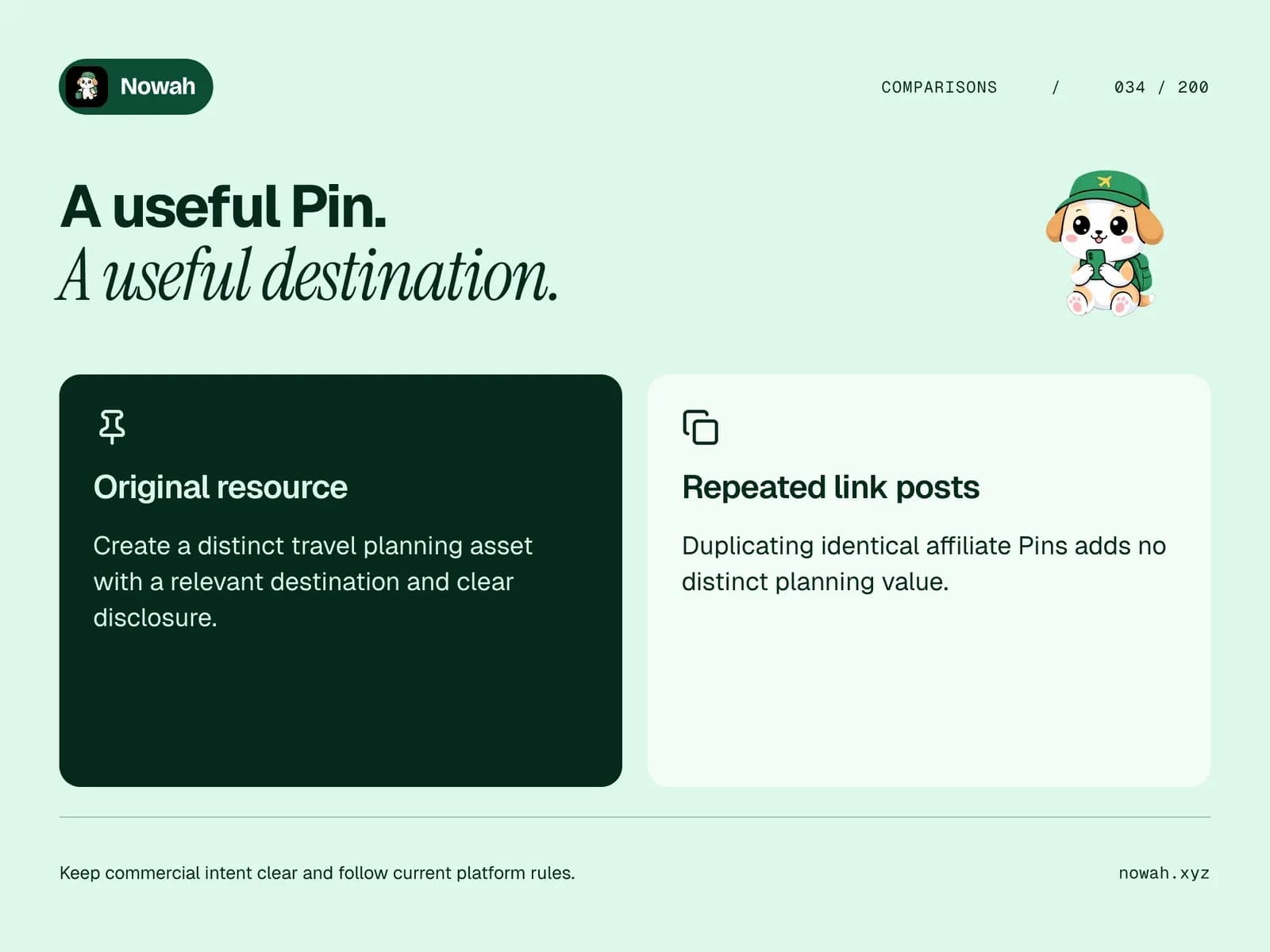
A travel Pin should give someone a useful reason to open or save the resource. Repeating a partner link across many near-identical images does not create that value. For Nowah creators, the stronger opportunity is to explain a specific travel decision and connect the Pin with a relevant, clearly disclosed planning resource.
The Nowah Partner Program offers approved partners 35% of Nowah net revenue from qualifying bookings by eligible attributed accounts. Its continuing account attribution can suit useful evergreen travel content, while the actual introduction and booking conditions remain essential.
Pinterest's commercial and branded content policy emphasizes original affiliate content, transparent commercial purpose and avoidance of repetitive or manipulative distribution. This guide helps you prepare one useful Pin-and-resource pair rather than treating volume as a substitute for a recommendation.
Start with the travel decision the Pin supports
Choose a question a traveller can recognize immediately. A hotel-area tradeoff, a compact-trip checklist or a clearly labelled planning example can give the asset a concrete purpose. A generic destination image with an unexplained earning slogan is less informative.
Write the promise in plain language before choosing the visual. If the Pin promises help comparing location priorities, the destination should actually explain those priorities. Do not promise a fixed rate, guaranteed saving or currently available room unless the relevant evidence supports the claim.
Nowah belongs in the content where it helps the traveller continue that task. A practical demonstration can organize the brief and identify the next information to investigate. The commercial recommendation then supports the useful explanation rather than replacing it.
The one-question demonstration guide helps narrow a broad travel idea into something a single asset and landing resource can explain well.
Make the asset original in substance
Originality is more than changing the background colour of the same message. Give the Pin a distinct question, clear diagram or useful checklist that matches the resource behind it. If two assets teach the same thing, consider whether both are necessary.
Use material you are entitled to publish and label the role of generated artwork. A planning illustration is not a photograph of a real hotel stay or proof that a supplier offer exists. Keep the evidence behind any concrete travel claim separate from the visual's decorative role.
Pinterest's affiliate guidance calls for unique value and cautions against repetitive or large-volume affiliate Pins. Do not turn that into an invented safe posting quota. Review the current policy and assess whether each asset genuinely helps a reader rather than simply repeating the commercial destination.
The avoid-duplicate-topic-assets guide is a useful supporting resource for distinguishing a new teaching idea from a cosmetic variation.
Work through a fictional Pin-and-resource example
Imagine a creator preparing a Pin about choosing a base for a three-night city break. The teaching brief is fictional: two adults, an evening arrival and a preference for a compact daily pace. The creator has no measured audience or earning result to report.
The Pin identifies the location question and shows a simple tradeoff. Its destination is a useful article that explains the priorities, demonstrates how the question can be organized in Nowah and lists supplier facts requiring current verification.
The article does not claim the pictured hotel is available or that a route takes a guaranteed amount of time. The illustration is a planning aid, and the Nowah recommendation has a practical purpose: helping the traveller continue investigating their own trip.
The creator then checks the Pin, title, description and destination together. They should tell one coherent story rather than attract a reader with one promise and send them somewhere unrelated.
Prepare a Pin-value worksheet
Give the proposed asset six fields: reader question, distinct useful information, evidence source, destination promise, commercial disclosure and next action. Add a checked date for material supplier or program facts.
Then answer a simple editorial question: what does this asset add that the previous Pin did not? A different title font or reordered caption is not necessarily a new useful contribution. A different traveller decision or a practical output may be.
For the fictional city-break example, the useful information could be a brief location-priority checklist. A second asset might answer a genuinely separate arrival question, but it should have a matching resource rather than silently repeat the same generic pitch.
Check that a resized or cropped version still preserves the qualifying words beside any percentage or example. A visually attractive crop can become misleading if the earning base or hypothetical label disappears.
The worksheet is not a performance formula. It helps you decide what deserves publication without claiming that originality guarantees reach, clicks or bookings.
Make the commercial purpose understandable
Pinterest's policy requires transparency about commercial content and affiliate links. Review the current guidance for the content you intend to publish and make the relationship clear to the reader. Do not use a vague visual cue to hide that the recommendation may generate commission.
Nowah's promotion terms also require a clear disclosure that you are a partner and may earn commission. Place the explanation with the recommendation in the formats people actually encounter, rather than assuming every reader will inspect your profile.
For a creator-facing resource, the relevant next action may be learning about the program or applying. For an approved traveller recommendation, use the appropriate active partner route. Both destinations can be useful, but they serve different readers.
The Pinterest destination-match guide explores how to keep the promise and actual next page aligned.
Keep link behaviour transparent
Use an actual destination that matches the resource described. Pinterest's policy notes that some link-shortening services are unsupported and asks affiliates to be transparent about link behaviour. Do not treat a blocked or unclear route as a reason to disguise where a reader is going.
If a specific link raises a problem, review the relevant current guidance and the approved program process. Do not invent a new referral address or assume that a visually tidy replacement preserves attribution. Nowah requires tracking to successfully reach the program.
Check the final destination on a phone and read the page as a first-time visitor. The reader should understand why the Pin led there and what useful task they can continue.
The one-link versus clear-next-step guide provides a practical review for the sentence or button surrounding that action.
Understand the Nowah account relationship
For a Pinterest recommendation to establish the relationship described in the Nowah terms, the traveller needs to follow the active partner route and create an eligible new account within 30 days of the valid introduction. Successful tracking is required; existing accounts, self-referrals and artificial accounts remain excluded.
Once established, attribution continues for the traveller account's lifetime and can apply to later qualifying hotel, flight and paid eSIM bookings. That continuity is a meaningful reason to create useful travel resources that remain relevant over time.
A save, Pin view or link interaction does not prove that an eligible account exists. Do not turn those platform events into a forecast of repeat income or claim that every person who opens the guide qualifies.
The clicks-versus-attribution guide helps keep platform attention and recorded program events separate.
Explain the earning model without inflating the promise
Approved Nowah partners earn 35% of Nowah net revenue from qualifying bookings by eligible attributed accounts. The traveller's total retail price is not the base. The terms define permitted direct deductions and exclude general overhead, salaries and general marketing from that list.
As hypothetical arithmetic, a qualifying booking producing $60 of Nowah net revenue would generate a $21 partner share. That does not estimate the value of a Pin, save or article reader. It illustrates the formula only.
Actual earnings require completion, supplier settlement and the hold after the later event, followed by the relevant monthly payout conditions. A pending amount is not a bank receipt. A clear earning explanation makes the Nowah opportunity more credible without needing a guaranteed-income headline.
Maintain the resource after publishing
Review changing facts, source dates and link destinations. An evergreen asset still needs maintenance when the resource or program changes. Do not leave an old earning claim in a graphic simply because it continues to receive attention.
The existing personalised hotel recommendation article is useful background for thinking about a traveller's actual requirements. Link to a relevant explanation where it helps instead of sending every Pin to the same unexplained destination.
Nowah gives creators a compelling model when useful travel resources introduce eligible new accounts and qualifying travel follows. Choose one distinct question, complete the worksheet and apply to Nowah Partners if the opportunity fits your work. Applications are reviewed, and approval, eligibility and verification requirements apply. Create something worth understanding, keep its commercial purpose visible and assess actual outcomes through the relevant events rather than the volume of repeated posts.




