Build Nowah recommendations around the traveller's full decision
Use a full-decision readout to connect rooming, location, dates and offer conditions to a useful Nowah demonstration and clear partner recommendation.
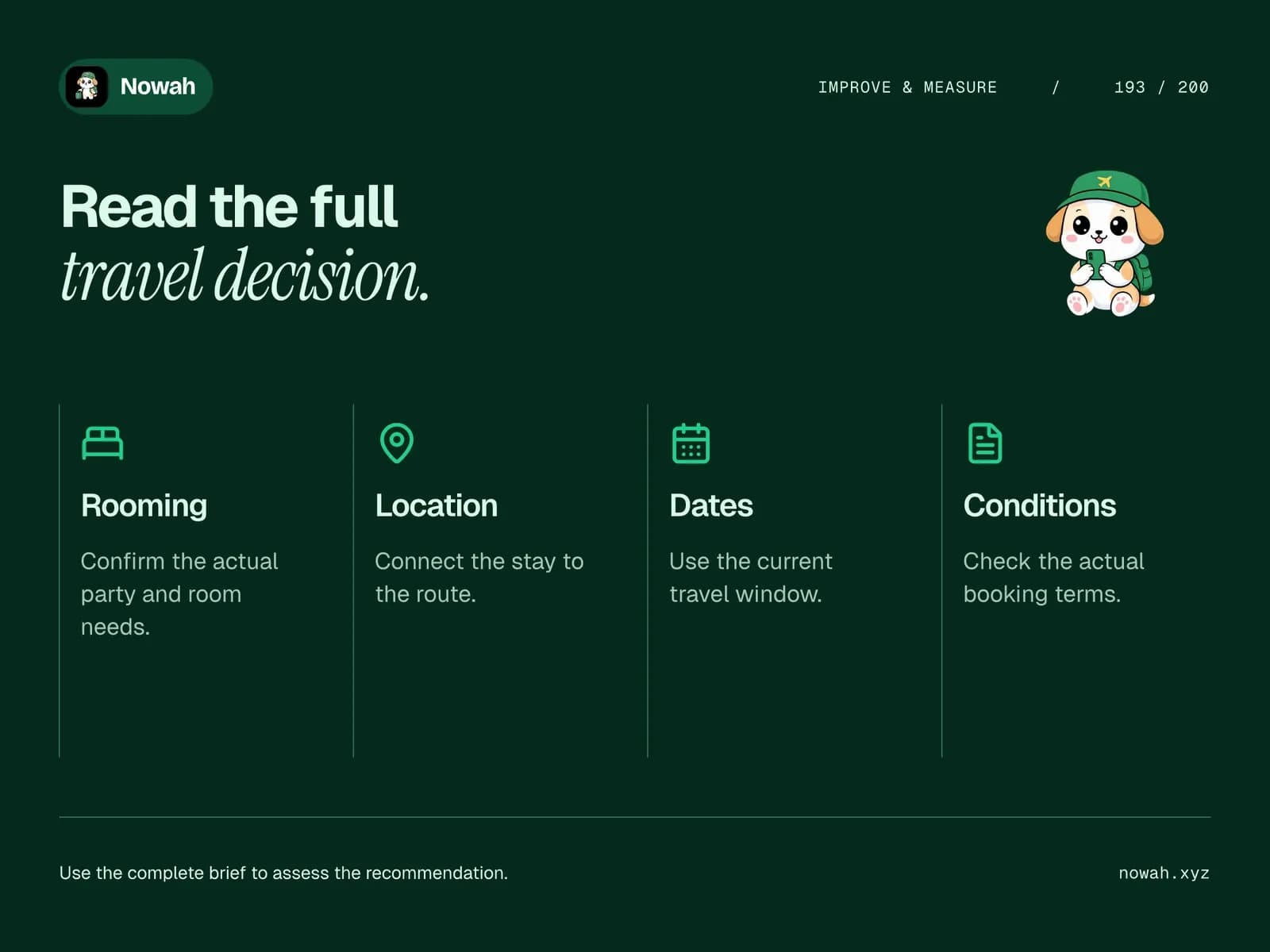
A travel recommendation becomes more useful when it explains the decision behind the attractive image. A follower may like a hotel review but still need to understand rooming, location, dates and the actual offer conditions. Those questions give a creator a meaningful way to demonstrate Nowah and provide a relevant next step.
Through Nowah Partners, approved creators can earn 35% of Nowah net revenue from qualifying referred bookings. That commercial relationship should support a useful recommendation. It should not replace the traveller's requirements with an assumption that the option associated with a commission is automatically the right choice.
This guide provides a full-decision readout you can use when preparing content. It helps you explain what matters to the traveller, show the relevant Nowah planning task and keep open questions visible.
Start with the decision rather than the property image
Identify what the traveller is trying to arrange. A hotel photograph can illustrate a room or setting, but it does not establish whether the option fits a particular party, trip or offer. Start with the requirements that would change the research.
For a short break, those might include the number of nights, who is sharing a room, arrival constraints and the activities that shape the preferred area. Keep the distinction between required conditions and attractive extras clear.
Use real audience questions where you have them. If you create a teaching scenario, label it fictional instead of presenting it as a customer's confirmed trip. The audience-fit worksheet can help select the reader task before you develop the recommendation.
Capture four parts of the brief
Write rooming, location, dates and conditions as separate entries. They interact, but each introduces questions that should remain recognisable in the explanation.
- Rooming: the party, required occupancy and relevant room configuration questions.
- Location: what the traveller wants to be near and what movement the plan involves.
- Dates: the actual trip boundaries and arrival or departure constraints.
- Conditions: the specific offer's inclusions, restrictions and unresolved checks.
Keep each entry concrete enough to affect the research. “A nice hotel” does not establish the same criteria as “a room suitable for this party on these dates, in an area that supports this itinerary.” Your content can then explain the tradeoff in language the viewer can use for their own trip.
Separate requirements, preferences and unknowns
Classify the information before comparing options. A required occupancy condition should not be treated as a minor preference. A preferred setting may permit a tradeoff. A missing supplier detail remains an open question until the appropriate evidence establishes it.
Use those categories to improve the explanation rather than produce an arbitrary hotel score. If you cannot establish a material condition, identify the check that remains. Avoid giving a confident suitability conclusion simply because the image or description feels persuasive.
The independent-judgement guide discusses the creator's reasoning in more detail. A disclosed commercial relationship and a thoughtful recommendation can coexist when the travel requirements remain central.
Build a full-decision readout
Create a readout with five fields: current brief, required conditions, relevant tradeoff, evidence still needed and useful next action. Keep it alongside your production notes.
Field | What the viewer should understand |
|---|---|
Current brief | Who the example serves and the trip boundaries |
Required conditions | What must be established for the option to fit |
Relevant tradeoff | The choice the recommendation helps explain |
Evidence still needed | The supplier or traveller information not yet established |
Next action | How the viewer can investigate their own trip |
The readout is an editorial resource in your own tools. It does not assume that Nowah supplies a particular creator scorecard or certifies a property's suitability from a planning brief.
A hypothetical short-break comparison
Imagine a fictional example involving two adults sharing a room for four nights. They want food-focused outings and one day trip, arrive later in the day and prefer a manageable departure morning. This is a teaching brief, not a confirmed booking or an actual follower record.
The creator compares two possible base directions. One prioritises the planned outings; the other changes the daily movement pattern. The comparison explains that tradeoff without inventing exact travel times or promising a particular room.
The rooming field asks for the actual occupancy and bed-configuration information. The dates field keeps the four-night boundary and arrival constraint visible. The conditions field identifies the current offer details that still need checking.
A useful conclusion might recommend investigating one direction first because it better reflects the stated priorities, while preserving the outstanding checks. It should not claim universal suitability or turn the illustration into evidence of a room's availability.
Use a changed-priority check before filming the conclusion. If the fictional travellers valued a different daily rhythm, would you explain the options differently? Identify which part of the readout would change and which required conditions remain. Rooming and actual offer restrictions still need evidence even when the preferred area changes. This short check helps you explain the reason for the recommendation, rather than merely repeat the option you selected first. It also gives viewers a practical way to adapt the reasoning to their own priorities.
Demonstrate the constraints in Nowah
Use the fictional brief to explore the planning question in Nowah. Explain the information you provide and the part of the proposal you are evaluating. Show a relevant revision if the initial plan does not reflect the stated pace or movement preference.
For the short-break example, a revision might preserve a lighter arrival evening or make the day-trip question easier to investigate. Keep the demonstration tied to the traveller's actual decision rather than adding unrelated features simply to extend the product segment.
This gives Nowah a clear role in creator content. You can connect inspiration to the wider trip the follower is trying to arrange, then show how a practical constraint changes the planning conversation. The focused demonstration guide helps keep that explanation readable.
Verify the actual offer before describing it as confirmed
A planning example and a bookable offer are different kinds of information. Check the relevant supplier details for the actual party and dates before presenting an inclusion, restriction or arrangement as established.
Do not infer breakfast, connecting rooms, a cancellation option or a special benefit from general property imagery. Preserve the source and context for any concrete claim you make. If the condition remains unknown, identify the question rather than filling the gap with an attractive assumption.
The premium-rate inclusions guide provides a separate review card for specific offer conditions. Use it when the decision needs a more detailed comparison of what is actually included.
Keep product scope distinct from the itinerary's interests
A food-focused trip can provide a strong planning context, but the restaurant spending is not a listed Nowah partner earning category. Qualifying hotels, flights and paid eSIMs are the listed products under the program terms.
That distinction lets you make a relevant recommendation without stretching the commercial offer. A creator can explain where to research a base for food outings and demonstrate the broader trip brief in Nowah, while being precise about which qualifying travel bookings may generate earnings.
For background on explaining a hotel choice, read the older anatomy of a hotel recommendation. Keep the current example grounded in the brief and evidence you actually have.
Explain the partner relationship alongside the action
Disclose the commercial relationship when recommending Nowah. Approved partners can use their active partner route as provided, with an explanation of what the traveller can reasonably do next.
Under the Nowah terms, a valid introduction must lead to a new eligible account within 30 days, with tracking successfully reaching Nowah. Existing accounts and self-referrals do not create eligible new attributions. Validly attributed accounts can generate earnings from possible later qualifying bookings for their lifetime, without a guarantee of repeat travel or income.
Keep the 35% share attached to Nowah net revenue rather than booking spend. Completion, supplier settlement and the applicable earning and payout conditions remain separate from the planning demonstration. The commercial explanation should make the relationship clear without replacing the reason the recommendation helps the traveller.
Review the whole recommendation
Read the finished content against the readout. Can a viewer identify the traveller's priorities, the tradeoff, the unresolved checks and the next action? Does the Nowah segment address the same question as the introduction?
If the evidence does not support a conclusion, revise the recommendation before adding stronger sales wording. A clear explanation of what to investigate next can be useful in its own right.
Creators interested in building that approach can apply to Nowah Partners. Prepare one useful travel decision, demonstrate the relevant Nowah workflow and preserve the conditions that make the example interpretable. That provides a more coherent foundation for qualifying introductions than allowing commission alone to determine the recommendation.




