How Regional Creators Can Turn Local Knowledge Into Nowah Travel Referrals
Connect genuine local observations to useful visitor questions, hotel-area research and a disclosed Nowah partner route.
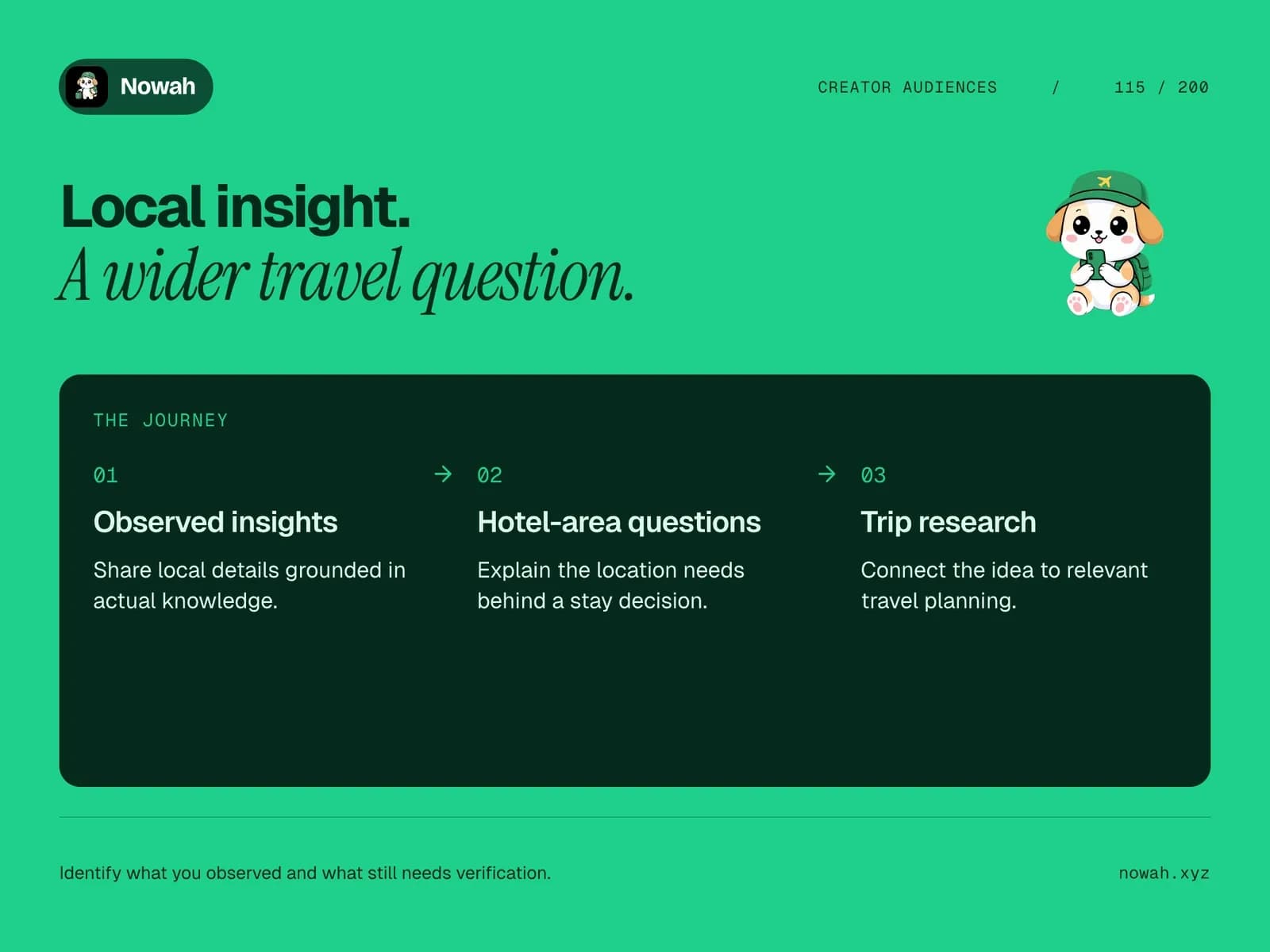
A local observation can help a visitor understand a place, but it becomes more useful when the creator explains the travel question it raises. Accommodation area, arrival context and the wider itinerary may still need research. Approved Nowah partners can connect that explanation to disclosed referrals and potential earnings from qualifying bookings by newly attributed travellers.
Nowah is a strong fit when observed local context becomes a current visitor brief. Show what you know, identify the requirement that changes the recommendation and demonstrate the relevant planning question. The audience sees a practical continuation rather than a generic claim that local knowledge answers every part of the trip.
Keep the commercial scope clear. Qualifying hotels, flights and paid eSIMs are the listed Nowah partner categories. Restaurant bills, local shopping and other purchases are not automatically commissionable because they appear in the regional story. Your own bookings also do not qualify as self-referrals.
Start with an observation you can support
Choose a local insight you actually know or can source appropriately. Explain its circumstances and avoid turning a limited observation into a permanent promise about every visitor's experience.
Do not manufacture local expertise for a region you have not experienced. Supplier information, current official facts and a fictional planning example should remain distinguishable from first-hand observation. A generated illustration can explain the process without documenting a real visit.
For a public demonstration, use a fictional visitor brief. State which inputs are assumptions and what would need current evidence before a traveller relies on the direction. The useful task is to connect the insight to a question, not invent an entire local itinerary for credibility.
Translate local context into a visitor requirement
Ask what the observation changes for the visitor's current trip. An interest in food, an actual fixed commitment or a preference for spending more time in one area may create a different accommodation question.
Do not assume every visitor shares the creator's routine, origin or preferred pace. A place familiar to you can still require route, provider or offer information for someone arriving on different dates with different requirements.
The before-search brief guide provides a structure for party, dates, rooming, budget scope and current priorities. Adapt the relevant questions without assuming the visitor wants a luxury travel style.
Build an observation-to-question log
Give readers a log that keeps the evidence and planning roles clear. Useful fields include:
- The local observation and its actual circumstances.
- The source of any current factual detail.
- The visitor requirement it relates to.
- The hotel-area or itinerary question it creates.
- What remains unresolved for this particular trip.
- The next research action to explore in Nowah.
Do not fill missing information with invented journey times or a broad assurance that an area suits everyone. A visibly open question helps the traveller understand why further research is necessary.
The log can support a companion article while a short video explains one relationship. Preserve the main qualification in the shorter version so the local imagery does not communicate stronger certainty than the evidence supports.
Demonstrate the visitor brief in Nowah
Use Nowah to explore the fictional requirements with the local interest and travel boundary clearly stated. Explain which question you are testing: accommodation direction, a day outline or what changes when a preference differs from your own.
Review the proposed direction against the brief. If it assumes an unverified route relationship or supplier arrangement, identify the issue and revise the question. Show the change so the audience can follow why the direction developed differently.
The practical recommendation is a clearer planning conversation and relevant travel research. It does not imply that Nowah certifies every local fact, guarantees current availability or confirms the suitability of an area for every traveller.
For food-led local content, the hotel-area guide for food creators offers a specific method. Link when the visitor's main question concerns where to stay around that interest rather than adding a food recommendation to an unrelated trip brief.
Compare two fictional visitor priorities
Imagine a fictional visitor attracted by a local observation but undecided about the accommodation direction. One direction prioritises that interest, while another reflects a wider trip requirement the visitor has expressed. These are teaching directions, not actual current property offers.
Keep the dates, party and relevant requirements consistent. Explain which location, route and supplier facts each direction needs. Do not declare one convenient, cheaper or safer without appropriate evidence for the actual trip.
Use Nowah to refine the chosen brief after the visitor identifies the deciding priority. Return to the log and record which questions remain. A useful conclusion can identify the next research action rather than claim that the creator's favourite area is universally best.
The independent-judgement guide supports recommendations whose conclusions follow traveller priorities and actual evidence. A commercial incentive should not make a local preference look like an objective suitability score.
Keep actual offers separate from the place story
When research reaches specific flights, properties or rates, preserve the relevant current information. A neighbourhood observation does not establish room occupancy, included services or cancellation conditions.
Your own stay can provide useful evidence about what you experienced, but it does not promise the same arrangement for every future traveller. Keep provider answers attached to the actual option and conditions they establish.
If a local fact changes, revisit the affected planning question instead of simply adding a new date to an older graphic. A current-looking label should not imply that the entire travel direction has been checked again when only one detail changed.
The older Nowah article on the anatomy of a hotel recommendation provides background for putting requirements before a shortlist. Your observation-to-question log gives that method a local-context application.
Explain the disclosed partner route
When recommending an active Nowah partner link, say that you may receive commission from qualifying referred bookings. Put the relationship beside the useful research action so the visitor understands the destination and your commercial connection.
A traveller needs the appropriate disclosed referral route. Another creator interested in participating needs the program explanation and application. Do not merge those journeys into an unclear invitation or imply that visiting a traveller link establishes a partner relationship.
Keep sharing relevant and appropriate to the audience. The Nowah terms prohibit spam and misleading promotion. A useful local resource for someone seeking travel information is different from bulk unsolicited messages to people who happen to live in or mention a region.
Understand new-account attribution and self-referrals
The terms require an eligible traveller to follow an active partner link and create a new account within 30 days of the introduction. Existing accounts, self-referrals and artificial accounts do not qualify. Tracking must reach Nowah successfully; a local post's reach or a link click is not proof of attribution.
Once valid attribution is established, it can remain for that traveller account's lifetime, including qualifying later bookings. That offers a potential continuing relationship while future travel and income remain unguaranteed.
The real-referrals and self-referrals guide explains why sharing your local knowledge with an eligible new traveller differs from trying to earn on your own bookings. A regional creator's own travel spending does not establish an eligible referral earning.
A useful revision changes one fictional visitor input while keeping the local observation unchanged. If the visitor now prioritises a different daily rhythm or rooming requirement, show why the hotel-area question may change even though the original insight remains accurate in its stated circumstances. This prevents a local preference from becoming a fixed recommendation that every brief must follow.
Read the short-form version on its own. Can a viewer identify the observation, the traveller question and the unresolved fact? If those roles have collapsed into a confident area endorsement, revise the labels. The useful Nowah action should continue the actual research task, not rely on a claim of local authority that the creator cannot support. That keeps the resource adaptable when viewers have different current requirements from the person in the fictional example.
Keep the earning base explicit
The partner receives 35% of Nowah net revenue after the direct deductions defined in the terms, not the visitor's full booking expenditure or local spending. A labelled hypothetical $60 of Nowah net revenue produces $21 in partner earnings. That arithmetic does not forecast a return from the fictional visitor brief or a particular regional audience.
Completion, supplier settlement, the applicable hold and payout conditions matter before earnings become eligible. Keep useful content, valid attribution, qualifying travel and completed payouts distinct when discussing results.
To participate, apply to Nowah Partners. Applying is free, applications are reviewed and there is no minimum follower count. Begin with an honest local observation, demonstrate the relevant Nowah visitor brief and give the audience a transparent way to investigate a trip that reflects its current requirements.




